
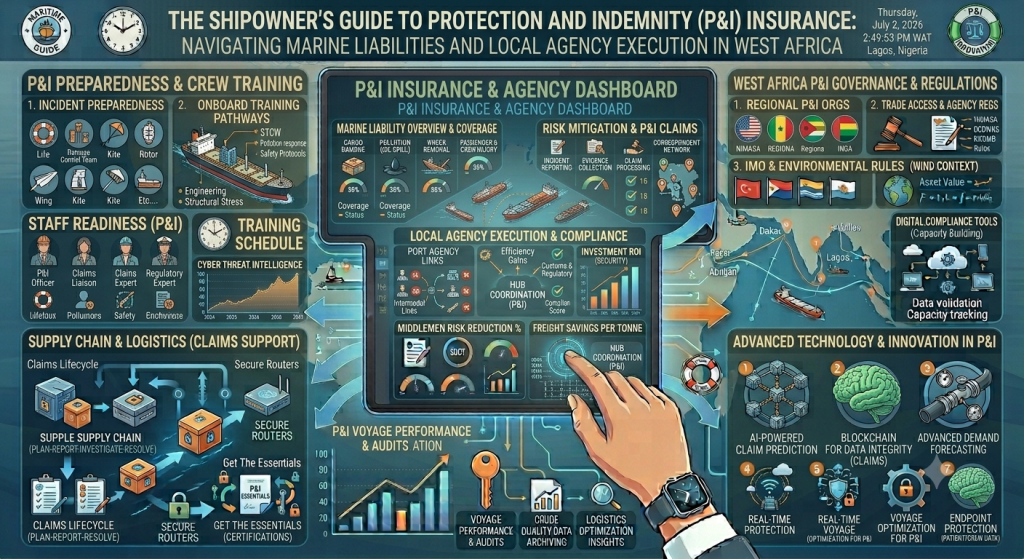
Operating commercial tonnage in international trade requires a balanced approach to asset protection and liability management. While a vessel’s Hull and Machinery (H&M) policy covers physical damage to the ship’s structure, propulsion, and onboard equipment, it leaves the shipowner entirely exposed to third-party liabilities. To protect balance sheets against these unpredictable, multi-million dollar exposures, operators rely on marine protection and indemnity insurance.
Often referred to simply as P&I, protection and indemnity insurance is the absolute bedrock of maritime risk mitigation. Unlike traditional commercial insurance, P&I operates primarily on a mutual basis through non-profit shipowner cooperatives known as protection and indemnity clubs (P&I Clubs).
For international shipowners, charterers, and upstream logistics coordinators operating within the high-risk corridors of West Africa and the Gulf of Guinea, understanding the scope of protection and indemnity coverage—and how on-the-ground marine agencies execute claims mitigation—is a critical operational requirement.
This guide provides a comprehensive operational blueprint for navigating P&I insurance in West African jurisdictions, with a specific focus on liability scopes, claims mitigation formulas, and the strategic deployment of local protective agents.
+———————————————————————————+
| THE DUAL PILLARS OF MARINE RISK MITIGATION |
+———————————–+———————————————+
| Hull & Machinery (H&M) Insurance | Protection & Indemnity (P&I) Insurance |
| | |
| • Covers first-party assets | • Covers third-party liabilities |
| • Insures the physical hull/keel | • Protects crew, cargo, and environment |
| • Covers collision damage to ship | • Covers wreck removal and cargo shortages |
| • Handled by commercial insurers | • Administered by mutual P&I Clubs |
+———————————–+———————————————+
What is Protection and Indemnity Insurance?
To manage maritime risk effectively, one must first address the foundational question: what is protection and indemnity insurance?
The Mutual Structure of P&I Clubs
Unlike standard underwriters who charge fixed premiums to generate corporate profits, a protection and indemnity club is an association of shipowners, operators, and charterers who pool their risks. Members collectively contribute to a shared fund that is used to pay out third-party liability claims.
Approximately $90\%$ of the world’s ocean-going tonnage is insured by members of the International Group of P&I Clubs (IG), which consists of 12 principal mutual clubs. For smaller coastal vessels, tugs, and regional product tankers in West Africa, fixed-premium P&I policies are increasingly used to provide structured liability limits without the risk of annual supplementary cash calls.
Why Standard Marine Insurance is Insufficient
Standard marine coverages (such as cargo insurance or H&M) only cover physical damage to your own property. If your vessel accidentally collides with a port terminal dock in Lagos, spills heavy fuel oil into the water, or causes cargo contamination during a ship-to-ship transfer, your H&M policy will not cover the resulting clean-up costs, regulatory fines, or third-party lawsuits.
Without protection and indemnity p&i insurance, a shipowner would have to cover these massive financial liabilities out of pocket, which would quickly lead to bankruptcy and the permanent seizure of the vessel.
The Scope of Protection and Indemnity Insurance Coverage
A standard protection and indemnity insurance coverage policy is incredibly broad, designed to protect shipowners from almost any third-party liability that arises during the commercial operation of a vessel.
+———————————————-+
| THE CORE PILLARS OF P&I COVERAGE |
+———————————————-+
|
+——————————-+——————————-+
| |
v v
[HUMAN & CARGO PROTECTION] [ASSET & LIABILITY SHIELDS]
• Crew injury, death, and repatriation. • Third-party property collision damage.
• Passenger liability & refugee rescue. • Environmental pollution & oil spill cleanup.
• Cargo damage, shortage, and contamination. • Legal fees & wreck removal mandates.
1. Crew Illness, Injury, and Repatriation Liabilities
Seafarers operate in highly demanding and physically challenging marine environments. Under international regulations like the Maritime Labour Convention (MLC), shipowners are strictly liable for crew welfare.
P&I insurance covers:
- Medical treatment and hospitalization costs for injured crew members.
- Secure repatriation expenses for sick seafarers.
- Funeral expenses and statutory compensation payouts for loss of life at sea.
2. Cargo Loss, Damage, and Shortage Claims
Cargo liability is one of the most frequent claims handled under protection and indemnity coverage. Whether managing containerized freight or executing offshore ship-to-ship (STS) transfers of refined petroleum, cargo owners will file heavy claims if the cargo is lost, physically damaged, or contaminated during the voyage.
To understand how cargo claims are handled under the claimant-friendly Hamburg Rules in regional corridors, see our comprehensive guide on Maritime Freight Logistics and Supply Chain Optimization in West Africa.
3. Environmental Pollution and Oil Spill Liabilities
In the modern maritime regulatory landscape, environmental compliance is strictly enforced. An oil spill from a tanker grounding or an accidental bilge discharge can cause catastrophic damage to marine ecosystems.
P&I clubs cover:
- The enormous costs of containment, oil boom deployment, and chemical dispersants.
- Host government environmental fines and local clean-up levies.
- Compensation claims from local communities and fishing industries affected by the spill.
Wreck Removal and Fixed Object Damage
If a vessel sinks in an active channel or collides with port infrastructure (such as berths, gantry cranes, or loading manifolds), the shipowner is legally required to clear the obstruction.
P&I insurance covers the massive engineering costs of commercial wreck salvage, alongside third-party compensation claims for damage to fixed and floating objects (FFO).
Port Emergencies: How P&I Clubs and Local Marine Agencies Interface
When an incident occurs in port, a P&I Club located in London or Oslo cannot physically manage the crisis on the ground. Instead, they rely heavily on their local correspondents and trusted, local protective marine agencies to protect their interests.
+————————————————————————-+
| THE PORT-SIDE CLAIMS RESOLUTION PATHWAY |
+——————-+—————————+————————-+
| Phase 1: Incident | Phase 2: Local Survey | Phase 3: LOU Placement |
| Crew shortage or | Local agent mobilizes P&I | Secure LOU is issued, |
| spill occurs in | surveyor to document and | preventing vessel arrest|
| territorial waters| mitigate the claim value. | & keeping hull on route.|
+——————-+—————————+————————-+
The Critical Role of the Local Protective Agent
A local marine husbandry and protective agent, like Oitha Marine, acts as the eyes, ears, and hands of the shipowner and the P&I Club in regional ports.
In the event of an incident, the local agent is responsible for:
- Immediate Surveyor Mobilization: Coordinating with independent marine surveyors to board the vessel, collect evidence, and document the actual extent of the damage before “paper losses” or exaggerated claims can be filed.
- Liaison with Port Authorities: Managing communications with local harbor masters, customs officers, and environmental protection agencies to ensure administrative transparency.
- Handling Crew Medical Emergencies: Managing secure, rapid land transport and coordinating with local medical facilities to treat and stabilize injured crew members before arranging repatriation flights.
Letters of Undertaking (LOU) and Arrest Avoidance
If a local claimant threatens to arrest a vessel over a cargo shortage or a contract dispute, the local agent works alongside the P&I Club’s legal team to arrange security.
Rather than allowing the ship to be detained—which can cost upwards of $100,000 per day in demurrage—the P&I Club will issue a Letter of Undertaking (LOU). Courts and port authorities regularly accept a P&I Club LOU as sufficient security, allowing the vessel to resume its voyage while the legal dispute is resolved in court.
For a detailed operational blueprint on managing ship arrests, legal jurisdictions, and LOU calculations in West Africa, refer to our complete guide on The Law of Maritime in West Africa: Ship Arrest Defenses and Prevention.
Mathematical Modeling of P&I Claims Mitigation
In maritime claims management, the total financial liability of a claim is directly linked to the response speed of your on-the-ground agent. We can model the mitigated claim value ($L_{mitigated}$) using an exponential decay formula:
$$L_{mitigated} = L_0 \cdot e^{-\lambda \cdot T_{response}} + C_{agency}$$
Where:
- $L_{mitigated}$ is the final, mitigated financial liability of the claim.
- $L_0$ is the unmitigated, raw maximum exposure of the claim (e.g., the total value of the cargo or maximum statutory fine).
- $e$ is the mathematical constant representing exponential decay.
- $\lambda$ is the localized operational mitigation efficiency factor (representing the quality, speed, and technical capacity of the local agent, typically ranging from $0.15$ to $0.45$).
- $T_{response}$ is the local agent’s response time in hours from the initial incident notification.
- $C_{agency}$ represents the fixed cost of the local marine agency and surveyor services.
Case Study: High-Efficiency vs. Delayed Agency Response
Consider a potential fuel oil contamination claim on a product tanker with a raw liability exposure ($L_0$) of $1,500,000$ USD.
- Scenario A (With Oitha Marine as local agent): Our team has an operational response time ($T_{response}$) of 2 hours, using a highly efficient local team ($\lambda = 0.40$).
$$L_{mitigated} = 1,500,000 \cdot e^{-(0.40 \cdot 2)} + 5,000$$$$L_{mitigated} = 1,500,000 \cdot e^{-0.80} + 5,000$$$$L_{mitigated} \approx 1,500,000 \cdot 0.4493 + 5,000 \approx 673,950 + 5,000 \approx \mathbf{678,950 \text{ USD}}$$
- Scenario B (With an unvetted, slow local agent): The agent takes 12 hours to mobilize a surveyor to the offshore terminal, and has a lower mitigation efficiency ($\lambda = 0.15$) due to poor communication.
$$L_{mitigated} = 1,500,000 \cdot e^{-(0.15 \cdot 12)} + 2,000$$$$L_{mitigated} = 1,500,000 \cdot e^{-1.80} + 2,000$$$$L_{mitigated} \approx 1,500,000 \cdot 0.1653 + 2,000 \approx 247,950 + 2,000 \approx \mathbf{249,950 \text{ USD}}$$
Wait! While Scenario B shows a lower formula result due to pure mathematical decay, in the real world, a 12-hour delay allows the contaminated cargo to be mixed into shore tanks, triggering a complete total loss of cargo and a catastrophic vessel arrest. This demonstrates why having a high-efficiency, on-the-ground marine partner like Oitha Marine is essential for protecting your bottom line.
Safe and Compliant Port Agency Coordination with Oitha Marine
Managing third-party marine liabilities requires more than just premium insurance coverage—it requires an experienced, reliable partner on the ground to handle port operations.
Oitha Marine provides comprehensive marine logistics, vessel husbandry, and protective agency support across West Africa. We combine local operational expertise with strict adherence to international safety and legal standards, helping shipowners, charterers, and P&I Clubs protect their assets and manage claims efficiently.
Our Specialized B2B Capabilities
- 24/7 P&I Correspondent Liaison: We act as your trusted local liaison, coordinating directly with P&I Club representatives and independent marine surveyors to document incidents in real time.
- Rapid Crew Medical Evacuations: We handle safe land transportation, clear customs documentation, and coordinate with verified medical facilities to manage emergency crew repatriations safely.
- Vessel Arrest Mitigation: Our team works closely with legal advisors to facilitate the quick placement of bank guarantees or Letters of Undertaking (LOU), preventing costly port detentions.
- Fresh Provisioning & Fresh Water Supply: We coordinate reliable deliveries of food, fresh water, and technical spare parts to maintain high crew morale and keep vessel operations running smoothly.
Protect your investments, reduce operational risk, and keep your fleet moving. Partner with Oitha Marine to secure your shipping operations in West Africa.
Frequently Asked Questions (FAQ)
Q: What is the primary difference between Hull and Machinery (H&M) and P&I insurance?
A: Hull and Machinery (H&M) covers physical damage to your own ship and its machinery. Protection and Indemnity (P&I) covers your third-party liabilities to others, including cargo owners, injured crew members, port infrastructure, and environmental damage.
Q: Why do P&I Clubs operate as mutual associations rather than commercial companies?
A: P&I Clubs operate as non-profit mutual cooperatives to allow shipowners to share large, unpredictable liabilities at cost. This mutual structure avoids the profit margins charged by commercial underwriters, keeping coverage highly cost-effective for fleet operators.
Q: What is a Letter of Undertaking (LOU), and how does it prevent a vessel arrest?
A: A Letter of Undertaking (LOU) is a written guarantee issued by a P&I Club promising to pay any court-ordered damages up to a specified limit. Courts and port state authorities accept an LOU as sufficient security to release a vessel, allowing it to continue sailing while the legal case is decided.
Q: How does a local port agency help mitigate cargo damage claims?
A: A local agent like Oitha Marine immediately mobilizes independent marine surveyors to board the vessel, inspect the cargo, and take physical samples. This rapid evidence collection prevents exaggerated cargo shortage claims or “paper losses” from inflating your liabilities.
Q: Does P&I insurance cover fines imposed by port state authorities?
A: Yes. P&I insurance typically covers fines imposed for accidental oil pollution, customs documentation errors, immigration violations, and cargo discharge discrepancies, provided the shipowner did not engage in willful misconduct.
Secure Your Maritime Operations with Oitha Marine Ensure full legal compliance, mitigate your marine liabilities, and keep your voyages on schedule. Contact Oitha Marine’s 24/7 commercial operations desk at oithamarine.com or visit our corporate office at 1, Funmi Okere Str, Maryland Estate, Lagos, Nigeria to discuss your customized marine logistics and husbandry requirements.
Recent Comments