
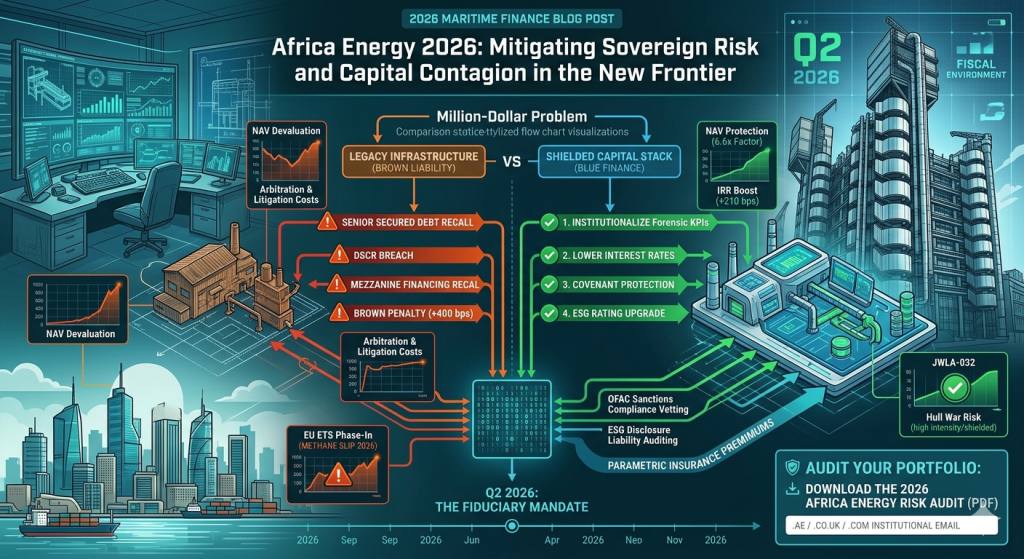
In Q2 2026, the African energy sector has transitioned into a high-stakes jurisdictional battlefield where the “Million-Dollar Problem” is no longer resource extraction, but the catastrophic exposure to Senior Secured Debt recalls triggered by localized ESG non-compliance. Investors in the USA, UAE, UK, and Singapore face a systemic threat from the convergence of the JWLA-032 circular and mounting ESG Disclosure Liability, turning once-lucrative offshore concessions into potential balance-sheet liabilities.
The Economic Impact: Protecting the IRR from Jurisdictional Volatility
For the C-Suite and institutional funds, the 2026 African energy landscape is a paradox of record-breaking yields and unprecedented capital risk. The primary threat to ROI is the “De-risking Gap”—the delta between projected project revenues and the escalating cost of maintaining tradeable status in Western capital markets.
The Capex Pincer: Methane and Mezzanine
As the EU ETS Phase-In costs for methane slip hit full implementation this year, African LNG projects that failed to integrate forensic-level monitoring are seeing their margins evaporate. Lenders, wary of their own Scope 3 emissions targets, are triggering “Step-up” interest clauses. We are seeing a significant migration from traditional bank financing to high-alpha Mezzanine Financing, with rates currently peaking at 18–22% for assets lacking “Green-Bond” certification. This shift alone is eroding the Internal Rate of Return (IRR) for mid-tier offshore operators by as much as 450 basis points.
Insurance as a Tactical Barrier
The expansion of the Joint War Committee (JWC) Circulars has fundamentally altered the OPEX profile of the Gulf of Guinea and the Mozambique Channel. Under the new JWLA-032 framework, “High-Intensity” war risk premiums are no longer static. They are dynamic, fluctuating based on localized kinetic activity and AI-predicted piracy trends. For the institutional owner, this means Parametric Insurance Premiums are no longer an optional hedge—they are the only way to stabilize a budget against a sudden 300% spike in Hull War Risk coverage.
The Compliance/Legal Framework: The 2026 Regulatory Grid
The legal architecture of 2026 has made “plausible deniability” a relic of the past. Three specific frameworks now dictate the tradeability of African energy assets:
I. OFAC Sanctions Compliance and the “Shadow” Pipeline
In 2026, OFAC Sanctions Compliance is being enforced with forensic satellite precision. The US Treasury is aggressively targeting “dark fleet” activity in the East African coast. For Western investors, the risk of accidental association with sanctioned entities through local partnerships has reached a fever pitch. A single flagged transaction in a joint venture can lead to immediate Asset Seizure, freezing the entire capital stack and triggering a total loss of liquidity.
II. AI-Driven Navigation Liability in Kinetic Zones
As AI-driven autonomous and semi-autonomous systems become standard for rig-tending and supply-chain logistics, a new legal frontier has opened: AI-driven navigation liability. In the Red Sea and East African littoral zones, if an AI-optimized route leads a vessel into a conflict area resulting in a “war event” total loss, the subsequent Arbitration & Litigation Costs are staggering. P&I Clubs are now forensic-auditing the “decision-logic” of navigation software before paying out on Hull War Risk claims.
III. The EU ETS Methane Hammer
The 2026 “Methane Slip” protocols mean that every molecule of methane emitted during African production and transport to the EU is taxed at the border. This creates a direct ESG Disclosure Liability for the parent company. If the reporting is found to be non-forensic, the resulting Arbitration & Litigation Costs from shareholder class-action suits in London or New York can exceed the project’s annual EBITDA.
Strategic Recommendations: 3 Actionable Steps for the CEO
I. Institutionalize “Forensic-Level” Emissions Audits
Immediately replace “estimated” methane reporting with real-time, satellite-integrated forensic monitoring. This move is not about sustainability; it is about debt preservation. High-fidelity data allows you to convert high-interest Mezzanine Financing into “Blue/Green Bonds,” securing the Senior Secured Debt stack and preventing a margin-call event triggered by EU ETS overages.
II. Deploy Parametric War Risk Hedges
Given the volatility mentioned in the latest Joint War Committee (JWC) Circulars, transition away from static insurance policies. Negotiate Parametric Insurance Premiums that trigger on “Area-Exclusion” events. This ensures that if the JWLA-032 status of your primary operational zone changes, you receive an immediate liquidity injection to cover the cost of rerouting or project suspension.
III. Conduct a “Sanctions-Clean” Joint Venture Audit
Perform a forensic audit of all local partners in Africa for OFAC Sanctions Compliance. In the 2026 environment, “Local Content” requirements often conflict with Western sanctions. Ensure your BIMCO clauses include “Sanctions Triggered Withdrawal” rights to prevent Asset Seizure by association.
Professional Advisory for High-Risk Sovereigns
Navigating the African energy theater in 2026 requires a lead underwriter’s forensic eye and a risk consultant’s jurisdictional depth. The confluence of JWLA-032 volatility and ESG Disclosure Liability has made the “DIY” approach to risk management a recipe for fiscal ruin. At Oitha Marine, we provide the Professional Advisory Services and Specialized Insurance Cover required to bridge the gap between African yield and institutional safety. Protect your capital from soaring Arbitration & Litigation Costs and the threat of Asset Seizure by anchoring your 2026 strategy in forensic reality.
FAQ: Africa Energy Risk (2026 Edition)
Q: How does the JWLA-032 circular impact my existing Africa-based fleet? A: Under JWLA-032, several new African littorals have been designated as “Listed Areas.” This triggers an automatic premium surcharge and requires a “Notice of Entry.” Failure to comply can void your Hull War Risk policy entirely, leaving the asset uninsured during a kinetic event.
Q: Can Parametric Insurance cover the loss of project timelines in Nigeria or Angola? A: Yes. Modern Parametric Insurance Premiums can be structured to trigger on “Port Closure” or “Strike Action” metrics. Unlike traditional indemnity insurance, these pay out within days, providing the liquidity needed to service Senior Secured Debt while the project is stalled.
Q: Why is Mezzanine Financing suddenly the only option for some African oil projects? A: Western commercial banks are rapidly deleveraging from non-aligned ESG assets. If your project has a high “Methane Slip” profile or lacks OFAC Sanctions Compliance transparency, you are pushed into the high-risk, high-cost Mezzanine Financing market.
Q: What is the risk of AI-driven navigation in the Red Sea? A: The Red Sea is a high-jamming environment. AI-driven navigation liability arises when automated systems fail to account for GPS spoofing, leading to unauthorized entry into sanctioned waters or collision. The Arbitration & Litigation Costs of such events are currently the highest in the maritime sector.
Q: Does the EU ETS apply to African projects if the gas is sold in Asia? A: While the direct tax applies at the EU border, the ESG Disclosure Liability remains. Large institutional investors in London and Singapore are now discounting the NAV of companies that cannot prove “Methane Neutrality” globally, regardless of where the specific cargo is delivered.
The Great De-Leveraging: Africa’s Debt Crisis of 2026
We are currently witnessing a historic migration of capital out of “High-Friction” African energy projects. The “Million-Dollar Problem” for a CEO in 2026 is the Senior Secured Debt trap. Banks are utilizing “Sustainability Clauses” as a back-door for credit recalls. When a project in the East African offshore fails its first ESG Disclosure Liability audit, the lender triggers a “Material Adverse Change” (MAC) clause.
Hull War Risk: The New Tax on Production
The cost of Hull War Risk in 2026 has become a de-facto tax on African production. Following the JWLA-032 update, even “secondary” ports are seeing insurance hikes of 400%. For operators, this means that the “Breakeven” price of oil has shifted. You are no longer just fighting for production; you are fighting the Joint War Committee (JWC) Circulars.
Conclusion: The Strategic Pivot
To survive the 2026 Africa Energy shift, you must move from a posture of “Compliance” to one of “Forensic Defense.” This means utilizing Parametric Insurance Premiums as a liquidity shield and ensuring your capital stack is insulated from the Mezzanine Financing death-spiral.
Oitha Marine is the only partner that provides the underwriting rigor and forensic risk analysis to ensure your African energy portfolio is tradeable in 2026. Secure your forensic audit today.
Recent Comments