
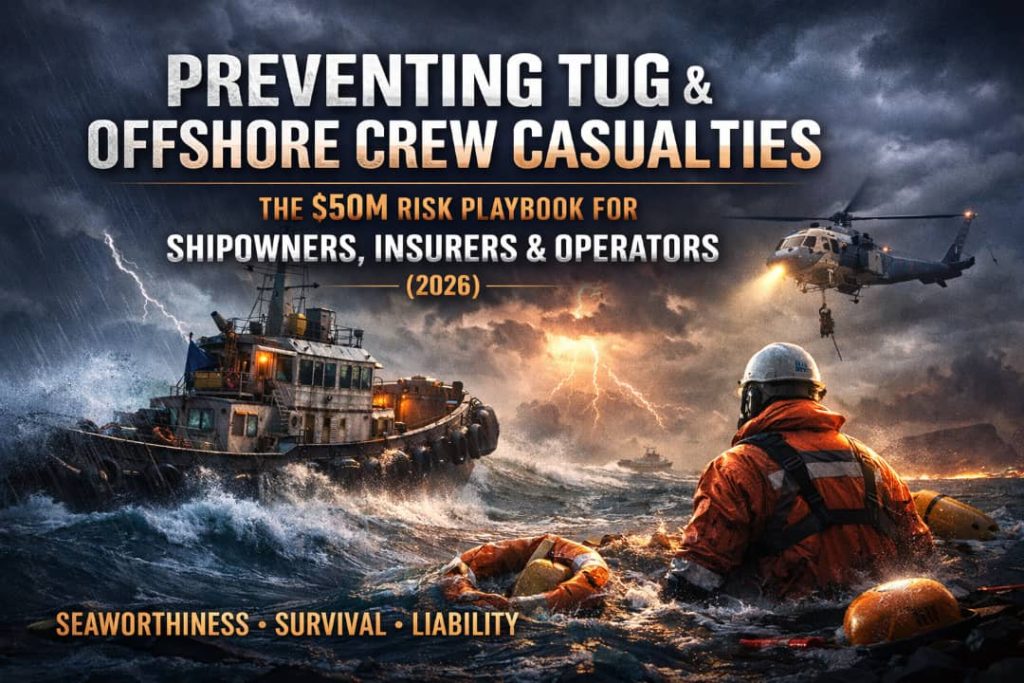
Why Tugboats Still Sink — and What the Industry Must Fix Now
In early 2026, the sinking of the tug MV LEO off the coast of South Africa once again exposed a harsh reality in global maritime operations:
crew casualties are rarely caused by a single failure — they are the result of layered, preventable breakdowns.
Despite advances in vessel design, classification oversight, and insurance frameworks, offshore tugs and support vessels continue to operate at the edge of acceptable risk. The cost is not just human — it is financial, legal, and reputational.
For shipowners, insurers, charterers, and regulators, the question is no longer what happened.
The real question is:
Why do these incidents keep happening — and how can they be prevented systematically?
This report provides a decision-grade playbook to reduce casualty risk, protect crew, and avoid multi-million-dollar liability exposure.
The True Cost of a Tug Casualty
A single offshore tug incident can trigger a cascading chain of financial consequences:
1. Crew Claims & Compensation
Under the Maritime Labour Convention (MLC), crew are entitled to:
Death compensation
Injury claims
Repatriation costs
When crew are missing, they are often legally presumed dead after a defined period — triggering full compensation liabilities.
2. Protection & Indemnity (P&I) Exposure
Most operators rely on coverage from members of the
International Group of P&I Clubs, which handle:
Crew liabilities
Wreck removal
Pollution response
Third-party claims
However, coverage is not unconditional. If unseaworthiness is proven, claims may be reduced — or denied entirely.
3. Hull & Machinery Loss
Total loss of vessel = direct capital loss
potential dispute with insurers over:
Maintenance history
Class compliance
Voyage suitability
4. Charter & Contract Disruption
Breach of contract claims
Delays and project losses
Termination penalties
5. Regulatory & Legal Fallout
Authorities such as the
South African Maritime Safety Authority
initiate investigations that can lead to:
Detentions
Fines
Operational restrictions
Bottom Line
A single casualty can easily escalate into a $10M–$50M exposure event — excluding long-term reputational damage.
Why Tug Casualties Keep Happening
1. The Seaworthiness Illusion
Many vessels are technically “in class” but operationally compromised.
This gap often stems from:
Aging hull structures
Deferred maintenance
Inadequate inspections
Classification societies such as
DNV,
Bureau Veritas, and
American Bureau of Shipping
provide certification — but they do not guarantee real-time operational safety.
2. Commercial Pressure vs Safety Decisions
Operators often face tight margins and deadlines. This creates a dangerous mindset:
“The vessel can handle one more voyage.”
This decision point is where many incidents begin.
3. Weather Miscalculation
Offshore tugs are particularly vulnerable to:
Heavy swell
Beam seas
Sudden weather shifts
In many cases, incidents are linked not to extreme weather — but to underestimating moderate conditions.
4. Watertight Integrity Failures
Flooding remains one of the leading causes of tug losses.
Common issues include:
Compromised seals
Faulty hatches
Poor maintenance of ballast systems
Once flooding begins, small vessels can lose stability rapidly.
5. Crew Preparedness Gap
Training often focuses on compliance, not survival.
Reality shows:
Emergency drills are not always realistic
Crew fatigue reduces response effectiveness
Equipment is sometimes poorly maintained
The Prevention Framework (Industry Best Practice)
To prevent the next casualty, operators must move from compliance to proactive risk management.
✅ 1. Pre-Voyage Risk Audit (Mandatory)
Before any offshore transit:
Conduct full hull integrity checks
Test watertight doors and compartments
Verify stability calculations
Review loading conditions
This must be treated as a go/no-go decision point, not a formality.
✅ 2. Independent Technical Verification
Do not rely solely on class certification.
Engage:
Third-party marine surveyors
Independent engineers
This is especially critical for:
Ocean transits
Post-repair voyages
Long-distance repositioning
✅ 3. Insurance-Aligned Operations
Smart operators align with insurer expectations early.
Engage your P&I provider before high-risk voyages to:
Validate compliance
Identify risk gaps
Ensure coverage clarity
Markets like
Lloyd’s of London
increasingly favor operators who demonstrate proactive risk management.
✅ 4. Weather Risk Threshold Protocol
Every company should define:
Maximum allowable sea state
Wind limits for operations
Clear “no sail” conditions
Most importantly:
Masters must have the authority to delay or cancel voyages without penalty.
✅ 5. Crew Survival Preparedness
This goes beyond compliance drills.
Focus on:
Realistic abandon-ship simulations
Regular equipment checks (EPIRB, life rafts, immersion suits)
Fatigue management
Prepared crews are often the difference between survival and tragedy.
✅ 6. Maintenance Discipline
Eliminate the “defer and manage” culture.
Instead:
Track critical systems rigorously
Enforce maintenance schedules
Prioritize structural integrity over short-term savings
Insurance & Liability Reality Check
When Insurers Pay
Claims are generally honored when:
Vessel is seaworthy
Documentation is complete
Operations follow declared risk parameters
When Claims Are Denied
Coverage may be reduced or rejected if:
Unseaworthiness is proven
Maintenance records are incomplete
Voyage risk was knowingly underestimated
This is where operators face the greatest financial exposure.
Key Insight
Insurance is not a safety net for poor decisions.
It is a risk partnership — and it requires discipline.
The Industry Gap
Despite regulations, incidents persist due to a fundamental issue:
Compliance does not equal safety.
In many regions, particularly in emerging offshore markets:
Oversight is inconsistent
Documentation is prioritized over condition
Commercial urgency overrides caution
Closing this gap requires:
Stronger enforcement
Better operator accountability
Increased transparency
A Smarter Way Forward
The industry must shift from reactive investigation to preventive intelligence.
This means:
Treating every voyage as a risk event
Investing in verification, not assumptions
Empowering crews to prioritize safety
Platforms and operators that adopt this approach will not only reduce casualties — they will become preferred partners for insurers, charterers, and regulators.
Frequently Asked Questions (FAQ)
1. Why are tugboats more vulnerable than larger vessels?
Tugboats are smaller, with lower freeboard and limited stability margins. They are more affected by wave action and flooding, especially in offshore conditions.
2. What is the most common cause of tug sinking incidents?
Flooding due to compromised watertight integrity is one of the leading causes, often combined with rough weather.
3. Does class certification guarantee safety?
No. Certification confirms compliance at a point in time — it does not ensure ongoing operational seaworthiness.
4. Can insurers refuse to pay after an accident?
Yes. If unseaworthiness or negligence is proven, insurers may reduce or deny claims.
5. What role does crew training play in survival?
A critical one. Well-trained crews with realistic emergency preparation significantly improve survival outcomes.
6. How can operators reduce liability risk?
By implementing:
Independent inspections
Strict maintenance regimes
Clear operational limits
Proper documentation
7. What is the role of authorities like SAMSA?
Authorities such as the
South African Maritime Safety Authority
investigate incidents, enforce regulations, and issue safety recommendations.
8. Are offshore tug operations becoming riskier?
Not necessarily — but increased commercial pressure and aging fleets are elevating risk levels in some regions.
Final Word
The loss of a vessel is costly.
The loss of crew is irreversible.
The difference between the two often comes down to decisions made before departure.
For shipowners, insurers, and operators, the message is clear:
Prevention is not an expense — it is the most valuable investment in maritime operations.
Recent Comments