
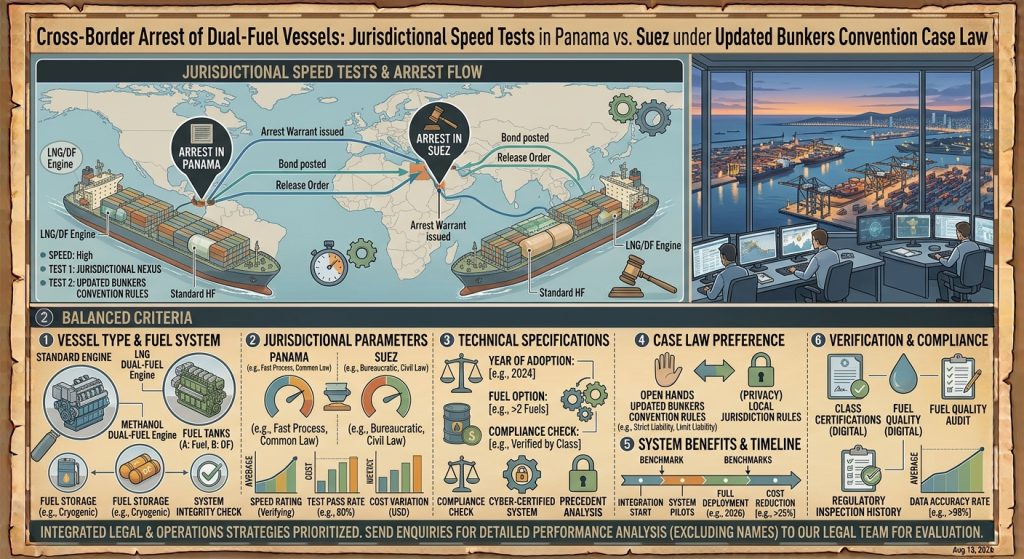
The rapid integration of dual-fuel propulsion systems—specifically Liquefied Natural Gas (LNG), methanol, ammonia, and bio-blends—into the global merchant fleet has transformed ship finance and maritime asset recovery. Valued at premiums 15% to 30% higher than conventional single-fuel equivalents, dual-fuel vessels represent high-value targets for maritime claimants. However, enforcing maritime liens, bunker claims, or mortgage defaults against these complex assets introduces unique legal hurdles under international conventions.
When a dual-fuel asset incurs liabilities or becomes involved in off-spec alternative fuel disputes, the claimant’s success depends on jurisdiction selection and speed of arrest. This comparative legal analysis evaluates the procedural mechanics, filing velocities, security requirements, and enforcement parameters of two of the world’s most critical maritime chokepoints: Panama (The Maritime Courts of Panama) and Egypt (The Maritime Courts of Suez/Port Said).
+——————————————————————-+
| DUAL-FUEL VESSEL ARREST DYNAMICS |
+———————————-+——————————–+
|
+———————-+———————-+
| |
v v
+————————————+ +————————————+
| PANAMA MARITIME COURTS | | EGYPT (SUEZ CANAL AREA) |
+————————————+ +————————————+
| • Legal System: Hybrid (In Rem) | | • Legal System: Civil Law Code |
| • Execution Speed: Very Fast (2-6h)| | • Execution Speed: Moderate (12-36h|
| • Counter-Security: Discretionary | | • Counter-Security: Strict/Mandatory|
| • Bunkers Convention Status: Party | | • Bunkers Convention Status: Party |
| • Key Advantage: Pre-arrival Orders| | • Key Advantage: Physical Chokepoint|
+————————————+ +————————————+
Key tactical takeaways for shipowners, charterers, marine insurers, and bunker suppliers include:
- Procurement & Legal Complexity: Dual-fuel assets blur traditional legal definitions under the International Convention on Civil Liability for Bunker Oil Pollution Damage, 2001 (the Bunkers Convention). Disputes over off-spec cryogenic or chemical fuels (e.g., LNG boil-off rate variances, methanol contamination, tank insulation damage) complicate maritime lien attachment depending on whether the fuel is classified as “bunkers,” “cargo,” or “machinery operational media.”
- Panama Speed Advantage: Panama’s specialized Maritime Courts operate 24/7/365 and permit in rem arrest petitions via electronic filing prior to the vessel entering territorial waters. Execution times by the Maritime Marshal average 2 to 6 hours from transit notification, making Panama the premier jurisdiction for time-sensitive arrests.
- Suez Statutory Framework: Egyptian maritime law relies on Civil Code mechanisms and strictly enumerated statutory maritime claims under Maritime Code No. 8 of 1990. While a physical arrest in the Suez Canal Anchorage (Suez/Port Said) halts vital global supply chains, legal procedural hurdles—including sworn official Arabic translations, strict consular notarization requirements, and mandatory counter-security demands—can delay execution by 12 to 36 hours.
- Financial Exposure & Security: In Panama, initial court arrest deposits are fixed and modest (
), with counter-security left to judicial discretion. In Egypt, courts routinely require substantial cash or bank guarantee counter-security to offset potential wrongful arrest damages to canal operations, creating high friction for debt recovery.
The Legal Nuance of Dual-Fuel Vessels & Bunkers Convention Case Law
Defining “Bunker Oil” in the Dual-Fuel Era
Article 1(5) of the International Convention on Civil Liability for Bunker Oil Pollution Damage, 2001 defines “bunker oil” as:
“any hydrocarbon mineral oil, including lubricating oil, used or intended to be used for the operation or propulsion of the ship, and any residues of such oil.”
This definition presents significant legal ambiguity in modern maritime litigation involving alternative fuels:
+—————————+———————————–+————————————+
| Fuel Type | Bunkers Convention Classification | Primary Legal Risk / Litigation |
+—————————+———————————–+————————————+
| Conventional Fuel (VLSFO) | Fully Covered | Standard maritime lien; off-spec |
| LNG (Liquefied Natural Gas| Excluded / Highly Disputed | Non-hydrocarbon gas phase; HNS |
| | (Methane is a non-mineral gas) | Convention application debate |
| Bio-methanol / E-Methanol | Partially Covered / Ambiguous | Chemical classification; corrosion |
| | (Depends on origin source) | and tank lining damage claims |
| Ammonia (NH₃) | Excluded | Non-hydrocarbon chemical toxicity; |
| | (Governed by HNS Convention) | strict operational liability |
+—————————+———————————–+————————————+
The LNG Paradox
Because LNG consists predominantly of methane gas compressed into a liquid state, traditional Civil Law jurisdictions (such as Egypt) strictly interpret the phrase “hydrocarbon mineral oil” to exclude natural gas. Consequently, pure LNG pollution claims or off-spec bunkering disputes may fail to establish a direct statutory maritime lien under Article 1(10) of the Egyptian Maritime Code unless categorized under general tort or contractual breach.
Conversely, Panama’s Maritime Court case law (applying Article 164 of Law 8 of 1982, as amended by Law 12 of 2009) treats dual-fuel equipment, cryogenic storage tanks, and specialized fuel gas supply systems (FGSS) as integral parts of the vessel (appurtenances). Thus, claims arising from off-spec alternative fuel delivery, FGSS thermal damage, or charter party disputes over boil-off gas (BOG) management directly attach in rem to the vessel itself.
Alternative Fuel Off-Spec Disputes: A New Class of Maritime Claims
The operational physics of dual-fuel bunkering introduce unique causes of action that claimants must convert into arrestable maritime claims:
- Cryogenic Temperature Contamination & Boil-Off Overruns: Bunkering LNG with excessive nitrogen content or improper temperature profiles causes rapid boil-off, pressure spikes, and fuel loss. Claimants must establish whether this constitutes a supply deficit (traditional bunker claim) or machinery damage caused by the supplier.
- Methanol Phase Separation & Water Contamination: Bio-methanol is highly hygroscopic. Water ingress during ship-to-ship (STS) transfer leads to engine misfires and severe corrosion of high-pressure injection systems. Proving where contamination occurred requires immediate vessel detention and forensic bunker sampling before the vessel leaves port.
- Dual-Fuel Capital Expenditure Mortgages vs. Bunker Liens: Dual-fuel retrofits and newbuilds carry complex green financing structures, often backed by preferred ship mortgages. In cross-border arrest scenarios, determining priority between a green bank’s mortgage enforcement and a bunker supplier’s maritime lien for unpaid alternative fuel creates complex multi-jurisdictional priority battles.
Head-to-Head Comparison: Panama Maritime Courts vs. Suez (Egypt) Maritime Courts
When an arrest warrant must be executed against a dual-fuel vessel transiting either the Panama Canal or the Suez Canal, timing, court efficiency, and procedural requirements dictate success.
+————————————+————————————+————————————+
| Comparative Parameter | Panama Maritime Jurisdiction | Suez / Egypt Maritime Jurisdiction |
+————————————+————————————+————————————+
| Governing Procedural Framework | Law 8 of 1982 (Amended by Law 12) | Egyptian Maritime Code No. 8/1990 |
| Specialized Maritime Courts | Yes (2 Dedicated Courts in Panama) | No (Commercial Division Courts) |
| Court Operational Hours | 24/7/365 Electronic Duty System | Standard Business Hours (Sun-Thu) |
| In Rem Arrest Permitted? | Yes (Direct Action Against Ship) | No (In Personam via Owner/Asset) |
| Pre-Arrival Arrest Warrant Filing | Yes (Filing Prior to Canal Entry) | No (Vessel Must Be in Anchorage) |
| Typical Time to Execution | 2 to 6 Hours | 12 to 36 Hours |
| Document Legalization Requirement | Power of Attorney (Apostilled/P.O.A| Formal Legalization via Egyptian |
| | can be filed retroactively) | Embassy / Consular Chain |
| Initial Court Arrest Deposit | $2,500 – $5,000 USD | EGP equivalent of $3,000 – $10,000 |
| Counter-Security Demand on Claimant| Discretionary (Rarely Exceeds $10k)| Common (Can require 10-20% of claim|
| Release Mechanism for Shipowner | P&I Club LOU / Bank Guarantee | Cash Deposit or Egyptian Bank LOU |
+————————————+————————————+————————————+
Jurisdictional Deep Dive 1: Panama Maritime Jurisdiction
Panama is widely recognized as one of the most efficient jurisdictions for vessel arrest due to its specialized legal infrastructure, alignment with global maritime commerce, and constant flow of canal traffic.
+———————————————————————————–+
| PANAMA ARREST PROCEDURAL TIMELINE |
+———————————————————————————–+
| [Hour 0:00] Claim Instructions & Draft Petition Prepared |
| │ |
| v |
| [Hour 1:00] Pre-Filing Electronic Petition Submitted to On-Duty Maritime Judge |
| │ |
| v |
| [Hour 2:30] Judicial Order & Arrest Warrant Issued; Deposit ($2,500) Lodged |
| │ |
| v |
| [Hour 4:00] Panama Canal Authority (ACP) & Maritime Marshal Formally Served |
| │ |
| v |
| [Hour 5:30] Marshal Boards Vessel at Balboa (Pacific) or Cristobal (Atlantic) |
| │ |
| v |
| [RESULT] Vessel Detained; Canal Transit Hold Placed |
+———————————————————————————–+
Key Advantages in Panama
- In Rem Jurisdiction: Under Panamanian law, a legal action can be filed directly against the vessel itself (in rem), regardless of whether the registered owner has personal liability, provided the claim gives rise to a maritime lien under applicable law or Panamanian conflict-of-law rules.
- Pre-Arrival Arrest Orders: A claimant does not need to wait until the vessel enters Panamanian waters to petition the court. The Panama Maritime Court can review the petition and issue an arrest order in limine. The order is served to the Panama Canal Authority (ACP) and National Aeronaval Service (SENAN) the moment the vessel enters the anchorage area at Balboa (Pacific) or Cristobal (Atlantic).
- Flexible Power of Attorney (P.O.A.) Rules: Panamanian courts permit local counsel to file an arrest petition with a simple fax or scanned P.O.A., provided a formal, notarized, and apostilled original is submitted within a court-mandated deadline (typically 15 to 30 days post-arrest).
- P&I Club Letters of Undertaking (LOU): Panama routinely accepts standard P&I Club LOUs from recognized International Group (IG) Clubs as valid counter-security to lift an arrest, minimizing prolonged operational delays for shipowners once security is posted.
Jurisdictional Deep Dive 2: Suez Canal / Egypt Maritime Jurisdiction
The Suez Canal is a critical maritime transit corridor. Arresting a vessel in Egyptian territorial waters (Port Said Northern Anchorage or Suez Southern Anchorage) exerts commercial pressure on a shipowner, but navigating the Egyptian judicial system requires strict adherence to formal civil law procedures.
+———————————————————————————–+
| SUEZ ARREST PROCEDURAL TIMELINE |
+———————————————————————————–+
| [Hour 0:00] Maritime Claim Accrues; Translation of Documents to Arabic Begins |
| │ |
| v |
| [Hour 8:00] Consular Legalization / Notarization Verification Completed |
| │ |
| v |
| [Hour 14:00] Formal Petition Filed with Chief Judge of Suez/Port Said Court |
| │ |
| v |
| [Hour 22:00] Judicial Review & Mandatory Counter-Security Order Issued |
| │ |
| v |
| [Hour 28:00] Arrest Order Delivered to Suez Canal Authority (SCA) & Port State |
| │ |
| v |
| [Hour 34:00] Port Police & Canal Officials Executive Arrest Order at Anchorage |
| │ |
| v |
| [RESULT] Vessel Detained in Suez/Port Said Anchorage Area |
+———————————————————————————–+
Key Procedural Challenges in Egypt
- Strict Closed List of Maritime Claims: Under Article 73 of Egyptian Maritime Code No. 8 of 1990, a vessel can only be arrested for specific statutory “Maritime Claims.” While unpaid conventional bunkers are recognized, claims involving alternative green fuel supply, dual-fuel technical warranties, or complex financial derivative claims must be carefully drafted to fit standard statutory categories:
- Section (f): Supplies of products or equipment necessary for the vessel’s operation or maintenance.
- Section (g): Construction, repair, or equipment of the vessel and dock charges.
- In Personam Prerequisite: Egyptian civil law does not recognize direct in rem actions against ships in the common law sense. The legal action is formally brought against the owner or operator (in personam), with the vessel attached as an asset to secure the monetary claim.
- Documentary Rigor: Egyptian courts strictly reject non-Arabic evidence. Every supporting contract, Bunker Delivery Note (BDN), email exchange, and invoice must undergo certified translation into Arabic. Furthermore, powers of attorney must go through full consular legalization via the Egyptian Embassy in the country of origin, creating significant initial delay unless pre-prepared.
- Counter-Security Risks: Judges in Suez and Port Said often order claimants to post substantial cash counter-security or local Egyptian bank guarantees to cover potential wrongful arrest damages—particularly if arresting a container ship or gas carrier on a scheduled Suez transit.
Technical & Commercial Operational Comparison
To illustrate the financial and operational mechanics of arresting a modern dual-fuel vessel, consider an dual-fuel LNG/VLSFO Newcastlemax/Capesize bulk carrier valued at $75,000,000 USD, subject to a $1,800,000 USD claim for unpaid off-spec methanol bunkering and associated engine damage.
+——————————————–+———————–+———————–+
| Cost / Operational Parameter | Panama Execution | Suez Execution |
+——————————————–+———————–+———————–+
| Court Filing & Official Fees | $2,500 – $4,000 USD | $3,500 – $6,000 USD |
| Local Legal Representation Fees (Avg.) | $12,000 – $25,000 USD | $15,000 – $30,000 USD |
| Sworn Official Translation Costs | Minimal (English ok) | $4,000 – $8,000 USD |
| Claimant Counter-Security Deposit | $10,000 USD (Fixed) | $180,000 USD (10%) |
| Average Execution Time (Filing to Service) | 4 Hours | 24 Hours |
| Daily Canal Anchorage / Off-Hire Loss | $35,000 USD / day | $35,000 USD / day |
| Risk of Counter-Claim for Wrongful Arrest | Low | Moderate to High |
| Acceptability of International IG P&I LOU | High | Moderate (Prefers Cash|
| | | or Local Bank Guarantee|
+——————————————–+———————–+———————–+
Operational Considerations for Dual-Fuel Systems During Arrest
When a dual-fuel ship is arrested and held at anchorage, operational risks increase due to the nature of alternative fuel systems:
- Boil-Off Gas (BOG) Management in LNG Ships: Liquid natural gas requires continuous boil-off management. If an arrest holds an LNG dual-fuel vessel at anchorage for extended periods without allowing engine operation or auxiliary gas consumption, cargo/bunker tank pressures rise. The Panama Canal Authority and Suez Canal Authority both impose strict safety directives regarding venting or flaring BOG within anchorage limits.
- Methanol & Ammonia Safety Buffers: Methanol and ammonia carry stringent toxic gas and flammable flashpoint isolation requirements. Port State Control (PSC) inspectors in both Panama and Suez will inspect bunker tank containment systems during a court-ordered detention, potentially adding safety compliance holds on top of legal arrest orders.
Tactical Recommendations for Shipowners, Charterers, and Marine Insurers
+————————————————-+
| CLAIM & ARREST STRATEGY MATRIX |
+————————+————————+
|
+—————————–+—————————–+
| |
v v
+————————–+ +————————–+
| CLAIMANT ADVANTAGE | | DEFENDANT PROTECTION |
+————————–+ +————————–+
| • Prefer Panama for speed| | • Keep apostilled POAs |
| • Pre-translate evidence | | on file with local bar |
| • Pre-verify Bunkers Conv| | • Pre-arrange IG Club LOU|
| jurisdictional status | | • Monitor BOG management |
+————————–+ +————————–+
For Maritime Claimants & Bunker Suppliers
- Choose Panama for Speed: If a targeted dual-fuel vessel’s trade route includes both the Panama and Suez Canals, prioritize Panama. The ability to file prior to arrival, lower initial security deposits, and rapid 24/7 service by the Panama Maritime Marshal significantly reduce the risk of a vessel escaping jurisdiction.
- Structure Bunker Terms for Dual-Fuel Specifics: Ensure sales contracts for alternative fuels explicitly state that supply of LNG, methanol, ammonia, or bio-blends creates a direct maritime lien attached to the vessel, and incorporate choice-of-law clauses that support in rem enforcement in Panama or US maritime courts.
- Prepare Document Bundles in Advance: For Suez arrests, translate standard contract templates, supply invoices, and BDNs into Arabic before the vessel reaches the Suez approach corridor to avoid losing crucial execution time.
For Shipowners, Managers, and Charterers
- Maintain Standby Powers of Attorney: Keep legalized and apostilled Powers of Attorney on file with trusted local maritime law firms in Panama City and Alexandria/Cairo to enable fast legal representation if an unmeritorious arrest occurs.
- Pre-Arrange P&I Club Security Protocols: Ensure your P&I Club or hull insurer has established relationships with Panamanian and Egyptian local correspondent brokers to issue acceptable Letters of Undertaking (LOUs) or bank guarantees within hours of an arrest order.
- Enforce Strict Quality Testing at Transfer: Given the ambiguity surrounding alternative fuel compliance under the Bunkers Convention, conduct continuous manifold sampling during LNG or methanol bunkering. Retain certified lab analysis proving fuel specifications to defeat invalid arrest petitions quickly.
Strategic Agency and Support Services from Oitha Marine
Managing maritime claims, emergency detentions, and vessel clearances at key maritime crossroads requires experienced local handling and commercial coordination:
- Port Agency & Husbandry Clearances: Direct on-the-ground support for vessel calls, anchorage management, and Port State clearances across key transit hubs.
- Bunkering Logistics & Quality Coordination: Coordination of compliant marine fuel deliveries, STS transfer oversight, and independent manifold sampling to mitigate fuel quality claims.
- Maritime Consulting & Claims Assistance: Practical commercial guidance for shipowners, charterers, and suppliers facing operational disputes, vessel detentions, or charterparty line-item claims.
Need immediate port agency, vessel clearance, or operational support for your fleet? Contact Oitha Marine to discuss your operational requirements.
Frequently Asked Questions (FAQ)
1. Does the 2001 Bunkers Convention automatically apply to alternative fuels like LNG and Methanol?
The International Convention on Civil Liability for Bunker Oil Pollution Damage (2001) specifically defines bunker oil as “hydrocarbon mineral oil.” While standard VLSFO and MGO are fully covered, non-mineral alternative fuels like pure LNG, green methanol, or ammonia fall into legal gray areas. Claims involving these fuels are frequently argued under general statutory maritime supply provisions or national maritime codes rather than strict convention liability.
2. How fast can a vessel be arrested in the Panama Canal?
In Panama, an arrest petition can be reviewed and granted by the specialized 24/7 Maritime Courts in limine before the vessel enters Panamanian waters. Once the vessel arrives at the Balboa or Cristobal anchorage, service by the Maritime Marshal typically takes between 2 and 6 hours.
3. Can you arrest a ship while it is actively transiting through the Suez Canal?
Neither the Suez Canal Authority nor Egyptian courts will physically halt a vessel while it is actively moving in a convoy inside the canal due to navigational safety risks. The arrest order is executed upon arrival at the northern anchorage (Port Said) or southern anchorage (Suez), or immediately upon completion of the convoy transit.
4. What is the typical court deposit required to arrest a vessel in Panama versus Egypt?
Panama requires a fixed court cash deposit of $2,500 to $5,000 USD to cover initial marshal and maintenance fees. In Egypt, while official filing fees are relatively low, judges frequently require the claimant to post substantial counter-security (often 10% to 20% of the claim value) to cover potential wrongful arrest damages.
5. Are standard P&I Club Letters of Undertaking (LOUs) accepted to release arrested ships in both jurisdictions?
Panama Maritime Courts regularly accept LOUs from recognized International Group (IG) P&I Clubs to release an arrested vessel. Egyptian courts are more restrictive and historically prefer cash deposits into court or bank guarantees issued by accredited local Egyptian banks, though IG Club LOUs can be accepted if explicitly agreed to by the arresting party.
6. What is an in rem vessel arrest, and is it available in Panama and Egypt?
An in rem action is a legal proceeding directed directly against the vessel as the legal entity liable for the debt, independent of the personal liability of its owner. Panama fully recognizes in rem arrests under its Maritime Code. Egypt follow civil law principles and does not recognize pure in rem actions; arrests are filed in personam against the owner or operator, with the ship attached as security.
7. How are boil-off gas (BOG) risks handled if an LNG dual-fuel vessel is arrested at anchorage?
Extended detention at anchorage risks excessive pressure buildup in cryogenic fuel tanks. Port authorities in both Panama and Suez monitor vessel safety status closely. If BOG venting becomes necessary, the court may order emergency port shifting, gas combustion unit (GCU) operation, or fuel offloading at the shipowner’s expense.
8. What documentation is required to execute an urgent arrest in Egypt?
Egypt requires all supporting legal documents (contracts, invoices, bunker delivery notes, communications) to be officially translated into Arabic by a licensed legal translator. Additionally, a legalized Power of Attorney (POA) validated through an Egyptian diplomatic post is required for full representation.
Need expert maritime support, port agency clearance, or operational assistance for your vessel?
Whether managing complex port calls, coordinating fuel deliveries, or safeguarding high-value marine assets across major global shipping lanes, Oitha Marine provides commercial and operational expertise.
Contact Oitha Marine Operations Team Today to discuss your vessel requirements.
Recent Comments