
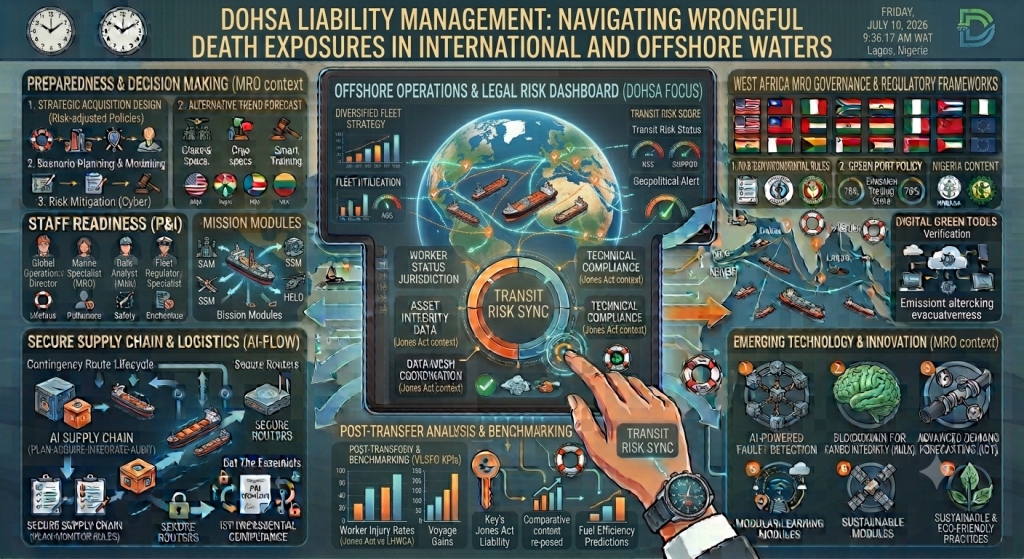
For C-suite executives, risk management directors, and offshore operations managers, mitigating catastrophic risk is a fundamental operational necessity. While standard shore-based businesses operate under predictable state workers’ compensation systems and localized tort rules, deep-water maritime and energy operations exist within a unique, highly technical federal framework.
When a fatal incident occurs in international waters, the primary statute governing employer and vessel liability is the Death on the High Seas Act (DOHSA). Codified at 46 U.S.C. §§ 30301–30308, DOHSA is an exclusive federal statute that handles wrongful death claims resulting from negligence or unseaworthiness outside territorial waters.
Understanding the geographical boundaries, damage limitations, and compliance rules of DOHSA is essential for safeguarding marine assets and preventing multi-million-dollar coverage gaps. This technical guide outlines the operational realities and corporate exposures of managing fatal risks on the high seas.
Statutory Comparison: High-Exposure Wrongful Death Frameworks
To manage risk effectively, fleet operators must understand how DOHSA interacts with—and preempts—other maritime injury laws during a fatal incident investigation.
[ Maritime Fatal Injury Frameworks ]
│
┌─────────────────────────────────┼─────────────────────────────────┐
▼ ▼ ▼
[ The Jones Act ] [ The LHWCA ] [ DOHSA ]
• Boundary: No geographic limits • Boundary: Land/Situs Limit • Boundary: Beyond 3 NM
• Target: Qualified “Seamen” • Target: Harbor Workers • Target: Any person at sea
• Remedy: Negligence lawsuit • Remedy: Scheduled compensation • Remedy: Pecuniary damages only
A. The Geographic Boundary (The 3-Nautical-Mile Line)
The primary trigger for DOHSA is location. The statute applies to any death caused by a wrongful act, neglect, or default occurring on the high seas beyond three (3) nautical miles from the shore of the United States or its territories.
- Inside 3 Nautical Miles: If a fatal accident occurs within state territorial waters (inside the 3-mile line), the claim is governed by General Maritime Law or state wrongful death statutes. These frameworks allow for a wider array of emotional and non-economic damages.
- Outside 3 Nautical Miles: Once a vessel or offshore asset crosses the 3-nautical-mile threshold, DOHSA takes absolute control, completely overriding state laws.
B. The Exclusivity and Preemption Rule
DOHSA is a strict, preemptive statute. Plaintiffs cannot combine a DOHSA claim with state law survival actions to pursue non-economic damages like emotional distress or loss of consortium.
However, for qualified crew members, a DOHSA action can be brought alongside a Jones Act negligence claim to expand potential avenues of recovery, provided the employer’s liability can be clearly proven.
2. Damage Architecture: The “Pecuniary Loss” Restriction
The defining feature of DOHSA—and its most critical asset protection attribute for corporate risk managers—is the strict limitation on recoverable damages. Under 46 U.S.C. § 30303, financial recovery is strictly limited to fair compensation for pecuniary losses sustained by surviving beneficiaries.
[ DOHSA Recoverable vs. Excluded Damages ]
│
┌───────────────────────────┴───────────────────────────┐
▼ ▼
[ Permitted Pecuniary Losses ] [ Excluded Non-Pecuniary Losses ]
• Lost financial support & wages • Grief and mental anguish
• Loss of care, nurture, and guidance • Loss of consortium & companionship
• Net household services value • Punitive damages for gross negligence
• Documented burial/funeral expenses • Pre-death pain and suffering (exceptions apply)
A. Quantifiable Economic Damages
Pecuniary losses represent actual, calculable financial support that the decedent would have provided to their dependents. Financial analysts and forensic economists evaluate claims based on:
- Loss of Support: The portion of the deceased worker’s future earnings that would have directly supported their spouse, children, or dependent parents.
- Loss of Services: The tangible monetary value of household services, maintenance, and child care the decedent performed.
- Nurture and Guidance: Minor children can recover quantified damages for the loss of parental training, education, and spiritual guidance.
B. The Absolute Exclusion of Emotional Damages
DOHSA explicitly bars recovery for non-pecuniary losses. Courts cannot award damages for the grief, sorrow, or broken companionship suffered by surviving family members.
Furthermore, punitive damages are completely unavailable under a standard DOHSA claim, even if the claimant alleges gross negligence or extreme corporate misconduct on the part of the vessel owner.
3. Special Operational Jurisdictions: Commercial Aviation Exemption
While DOHSA was originally designed to govern maritime vessel sinkings and commercial fishing accidents, modern amendments have created an entirely separate jurisdictional tier for commercial aviation accidents over open water.
Under 46 U.S.C. § 30307, if a fatal accident involves a commercial aircraft flying over the high seas, the geographic boundary shifts from 3 nautical miles to beyond 12 nautical miles from the shore.
[ Aviation Accident Location ] ──► Check Boundary
│
┌──────────────────────────┴──────────────────────────┐
▼ ▼
[ Inside 12 Nautical Miles ] [ Outside 12 Nautical Miles ]
• State Wrongful Death Laws Control • DOHSA Controls Exclusively
• Full economic & emotional recovery • Non-Pecuniary Recovery Allowed (Care/Comfort)
• Punitive damages may apply • Punitive Damages Strictly Prohibited
For aviation accidents occurring outside the 12-mile mark, DOHSA permits an exception: claimants can recover non-pecuniary damages defined specifically as the loss of “care, comfort, and companionship”. However, the strict prohibition against punitive damages remains in full effect.
4. Managing Corporate Liability Exposure and Sourcing Risks
For global shipping lines, energy infrastructure companies, and marine construction contractors, an unmanaged DOHSA claim can lead to complex multi-party litigation.
[ Corporate Risk Management Checklist ]
│
┌───────────────────────────┼───────────────────────────┐
▼ ▼ ▼
[ Class Society Audits ] [ Mutual Indemnity ] [ MEL & P&I Sourcing ]
• Enforce strict structural • Enforce Knock-for-Knock • Eliminate coverage gaps
• inspections across hulls • rules with third-party • between land operations
• and deck cargo cranes • offshore subcontractors • and international waters
A. The Evidentiary Burden of Unseaworthiness
In addition to standard negligence claims, DOHSA allows actions based on the absolute Warranty of Unseaworthiness. If a fatality occurs because a piece of heavy deck machinery fails, or because safety equipment is improperly maintained, the vessel owner can face strict liability exposures. This risk highlights the importance of keeping detailed maintenance logs and conducting regular third-party classification society surveys.
B. The 3-Year Statutory Deadline
Under 46 U.S.C. § 30106, all claims under DOHSA must be filed within a strict three (3) year statute of limitations from the date of the fatal incident. Because evidence and witness accounts can fade quickly at sea, corporate risk teams must launch immediate, structured internal investigations following any major offshore event.
B2B Technical FAQ: High-Seas Liability and Asset Management
Q1: Can an executor file a DOHSA claim on behalf of an estate?
No. Under 46 U.S.C. § 30302, a DOHSA action can only be brought by the appointed personal representative of the decedent’s estate. The lawsuit must be filed for the exclusive benefit of a specific, limited class of statutory beneficiaries: the surviving spouse, children, parents, or dependent relatives.
Q2: How does a worker’s contributory negligence impact a DOHSA claim?
Under 46 U.S.C. § 30304, contributory negligence is not a complete bar to financial recovery. If the deceased worker’s actions contributed to the accident, the court applies a pure comparative fault standard, reducing the overall damage award by the worker’s percentage of fault.
Q3: Does DOHSA cover fatal incidents on foreign-flagged vessels?
Yes. Under 46 U.S.C. § 30306, if a foreign nation’s laws provide a wrongful death remedy for an incident on the high seas, a civil action in admiralty can be maintained in U.S. federal courts. This allows international claimants to leverage U.S. jurisdictions when dealing with multinational fleet owners.
Q4: What is a “Survival Action,” and does DOHSA permit it?
A survival action allows an estate to recover damages for the personal losses suffered by the victim before death, such as conscious pain and suffering. DOHSA generally does not include a survival action.
However, an exception applies under 46 U.S.C. § 30305: if an individual files a personal injury lawsuit in federal court for an incident on the high seas and subsequently dies from those injuries while the case is pending, their personal representative can convert the action into a DOHSA wrongful death claim.
Q5: How can fleet owners protect against DOHSA claims from independent contractors?
Companies should ensure all master service agreements (MSAs) with third-party offshore vendors contain clear, reciprocal Knock-for-Knock indemnity structures. These contract terms require each subcontractor to take full financial responsibility for fatalities among their own workforce, protecting the primary vessel owner from direct liability.
6. Strategic Ad Placement Optimization for Maritime Media
This deeply technical analysis provides a structured environment for specialized B2B ad units:
- Legal & Corporate Defense Ads: The focus on federal admiralty statutes and unseaworthiness litigation naturally aligns with advertisements from specialized maritime defense firms and corporate trial networks.
- Marine Underwriting Ads: The emphasis on pecuniary damages, multi-party contracts, and liability management provides an excellent layout for showcasing Protection & Indemnity (P&I) Clubs and international marine asset underwriters.
Secure Fleet Sourcing and Strategic Compliance Advisory with Oitha Marine
Navigating complex international admiralty laws, managing high-exposure charter risks, and sourcing compliant tonnage across changing trade lanes requires an experienced maritime partner. At Oitha Marine, we support shipowners, offshore energy operators, and corporate charterers with expert vessel sourcing, regulatory compliance reviews, and comprehensive marine logistics coordination.
Protect your offshore operations and fleet strategies from regulatory and liability risks. Contact our technical advisory team today at oithamarine.com or visit Oitha Marine Technical Insights to schedule a professional operational risk assessment.
Recent Comments