
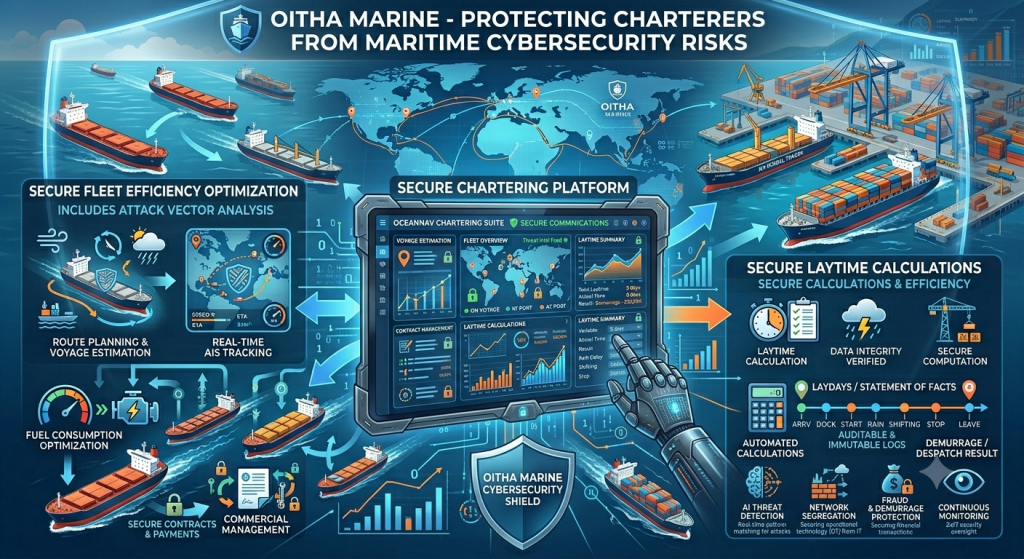
The digitization of the global maritime supply chain has introduced unprecedented levels of operational efficiency. Today, vessel tracking, cargo manifests, bunker optimization, and port scheduling are entirely managed via cloud-based networks and automated data streams. However, this hyper-connected ecosystem has also birthed a sophisticated, high-stakes threat landscape. As shipping operations migrate to digital platforms, maritime cyber attacks have surged dramatically, forcing the international shipping sector to confront an uncomfortable reality: cyber security is no longer just an IT issue; it is a core component of seaworthiness and operational safety.
For ship charterers, the financial vulnerabilities are exceptionally high. When a charterer leases an oil tanker, a dry bulk carrier, or an offshore support vessel, they trust that their commercial data, freight payments, and voyage instructions are secure. A breach in a ship’s onboard Operational Technology (OT) or an operator’s corporate Information Technology (IT) infrastructure can lead to catastrophic disruptions. These range from misdirected cargo and stolen bunkering funds to total vessel immobilization at sea.
As a leading maritime operator and vessel manager, Oitha Marine prioritizes robust cyber defenses. This comprehensive guide details the unique maritime cybersecurity risks facing ship charterers in 2026 and outlines the specific protocols implemented by Oitha Marine to safeguard our clients’ commercial interest, vessel data, and maritime assets.
The Invisible Threat: Why Ship Charterers Are Prime Targets
In traditional maritime logistics, risk management centered around physical threats: severe weather, mechanical failure, port congestion, and piracy in volatile shipping lanes. While those risks remain, the modern threat matrix includes digital pirates—organized cybercriminal syndicates, state-sponsored actors, and ransomware extortionists.
Ship charterers are uniquely vulnerable to these digital threats due to three structural factors:
1. High-Value Financial Transactions (Business Email Compromise)
The maritime chartering process involves substantial capital movements. Day-rates for long-term time charters, massive freight payments, bunker fuel invoices, and port disbursement accounts represent multi-million dollar transaction pipelines. Cybercriminals exploit these high-value streams through Business Email Compromise (BEC). By intercepting communications between a charterer, a shipowner, and a shipbroker, hackers deploy spoofed emails and altered invoices, fraudulently redirecting legitimate shipping funds into untraceable offshore bank accounts.
2. Vulnerabilities in Vessel Operational Technology (OT)
Modern vessels are floating data centers. Onboard Operational Technology networks handle the physical movement of the ship, including GPS navigation systems, Electronic Chart Display and Information Systems (ECDIS), ballast water management, and main engine diagnostics. If an operator fails to isolate the ship’s crew Wi-Fi or corporate IT network from these critical OT networks, malware can bleed through. A corrupted ECDIS system can allow hackers to feed false coordinates to a vessel, knocking it off course or causing deliberate groundings that trigger massive commercial delays and legal disputes for the charterer.
3. Supply Chain Multiplicity
A standard chartering fixture involves an extensive web of stakeholders: the charterer, the shipowner, the technical manager, the commercial crew operator, port agents, stevedores, and customs brokers. Every single entity represents a potential entry point for a cyber attack. If a single local port agent uses an compromised computer to upload a loading statement or a Statement of Facts (SoF) into a shared chartering portal, they can inadvertently introduce ransomware that locks down the entire voyage file, halting cargo operations instantly.
How Oitha Marine Protects Your Chartering Operations
Oitha Marine understands that a robust supply chain requires a proactive defense posture. We have built an enterprise-grade cybersecurity framework that protects our corporate chartering clients from the initial pre-fixture negotiation phase down to final voyage execution and laytime settlement.
[Secure B2B Data Vault] ➔ [Network Segmentation (IT vs. OT)] ➔ [Verified Invoice Protocols] ➔ [Continuous Crew Training]
1. Advanced Network Segmentation and Vessel Hardening
To prevent malware from disrupting physical vessel movements, Oitha Marine enforces strict Network Segmentation across our managed and operated fleet.
- IT and OT Isolation: The vessel’s administrative IT networks (used for emails, passenger/crew internet, and port documentation) are physically and digitally decoupled from the core Operational Technology (OT) networks that govern propulsion, ballasting, and navigation.
- Satellite Communication Security: All satellite communication (VSAT) uplinks linking our vessels to shore-based operations are encrypted using modern cryptographic standards, shielding data transmissions from unauthorized interception or spoofing.
2. Dual-Factor Financial Verification & Anti-Fraud Protocols
To completely neutralize the threat of Business Email Compromise and fraudulent invoice manipulation, Oitha Marine mandates a strict multi-channel verification policy for all financial transactions.
- Out-of-Band Verification: Any request to alter bank details, update banking routings, or settle unexpected port disbursements must be verified using an independent, out-of-band communication protocol (such as a secure voice verification sequence with a designated financial officer) before any capital is transferred.
- Encrypted Documentation Portals: Instead of sending vulnerable, unencrypted PDF invoices via open email, Oitha Marine utilizes secure corporate portals featuring end-to-end encryption. This ensures that charterparties, freight calculations, and hire invoices remain uncorrupted and visible only to authenticated corporate users.
3. Rigorous Vendor and Supply Chain Vetting
Because a cybersecurity framework is only as strong as its weakest link, Oitha Marine extends its digital defensive standards to our third-party vendors. We thoroughly vet the cybersecurity readiness of our local port agents, bunker suppliers, and independent maritime surveyors. By requiring our operational partners to comply with recognized international digital hygiene standards, we insulate our charterers from external vulnerabilities introduced at the port level.
4. Continuous Crew Awareness and Digital Hygiene Training
Human error remains the leading catalyst for corporate cyber breaches. A single crew member plugging an infected USB flash drive into a shipboard computer to print a document can compromise a vessel’s network.
Oitha Marine conducts continuous cybersecurity training modules for all offshore crew and shore-based personnel. Our teams are trained to identify sophisticated spear-phishing attempts, enforce strict access-control policies on shipboard terminals, and handle data backup routines regularly. This ensures that a culture of digital vigilance is maintained around the clock.
Regulatory Compliance: Meeting International Maritime Standards
Our security protocols are not just designed to protect commercial interests; they are engineered to fulfill stringent international regulatory mandates. The International Maritime Organization (IMO) explicitly requires shipowners and managers to integrate cyber risk management into their safety management systems (SMS), governed by the International Safety Management (ISM) Code.
Furthermore, Oitha Marine reviews its digital architecture against the comprehensive cyber risk management guidelines put forth by BIMCO, the International Chamber of Shipping (ICS), and major classification societies. Operating in absolute compliance with these global benchmarks guarantees that our chartered vessels never face operational detentions by port state control authorities over cybersecurity deficiencies, ensuring an unhindered transit for your cargo.
Frequently Asked Questions (FAQ)
What is the difference between IT and OT cybersecurity in the maritime sector?
Information Technology (IT) security focuses on protecting data, corporate emails, commercial software, and financial transactions from unauthorized access or theft. Operational Technology (OT) security protects the physical hardware and software systems onboard the vessel that control maritime operations, such as GPS navigation, radar, steering gear, and engine control mechanisms.
How can a ship charterer detect a Business Email Compromise (BEC) attempt?
The most common indicators of a BEC attempt include sudden requests to change bank account details right before a major hire or freight payment, emails sent from domains that mimic a trusted partner’s name with slight misspellings (e.g., matching a “.co” extension instead of “.com”), or an artificial sense of extreme urgency demanding that standard financial verification steps be skipped.
What happens to a chartering agreement if a ship suffers a cyber attack at sea?
If a cyber attack incapacitates a vessel’s navigation or propulsion systems, it can lead to complex legal disputes regarding whether the ship was legally “seaworthy” at the start of the voyage. Depending on the custom clauses embedded in the Charterparty (such as specialized BIMCO Cyber Security Clauses), the vessel may be placed “off-hire,” meaning the charterer stops paying daily rental fees until the operator restores full digital control.
Can hackers remotely manipulate a ship’s GPS or navigation systems?
Yes. A technique known as GPS Spoofing involves sending false satellite signals to a vessel’s receiver, making the onboard radar and navigation units believe the ship is in a different geographic location. Oitha Marine mitigates this severe risk by using multi-source redundant navigation systems and continuous crew training on cross-checking digital data with manual marine charts.
Why should charterers care about an operator’s cybersecurity protocols?
Charterers bear the ultimate financial burden of voyage delays. If an operator’s network is locked down by ransomware, port documentation cannot be processed, leading to severe berth delays and massive demurrage bills. Partnering with a digitally secure company like Oitha Marine ensures your logistics remain highly secure, safe, and protected from digital interruptions.
Conclusion: Securing Every Trade Lane in a Digital Era
Digitalization is a powerful tool for modern maritime logistics, but it requires an unwavering commitment to data protection. As ship charterers navigate volatile global markets, protecting operations from invisible, digital threats is non-negotiable. Selecting a maritime partner who views cybersecurity as an integral part of fleet safety is the single best way to de-risk your cargo supply chain.
Oitha Marine continues to lead the regional maritime sector by offering a secure, highly transparent, and digitally hardened shipping experience. By integrating advanced network isolation, rigorous anti-fraud financial validations, and strict regulatory compliance frameworks, we provide our clients with total operational peace of mind across every single mile of the voyage.
Are you looking to charter assets or secure vessel management services backed by elite digital defense frameworks? Contact the commercial operations team at Oitha Marine today to discuss how we secure your cargo and maritime operations from modern threat vectors.
Recent Comments