
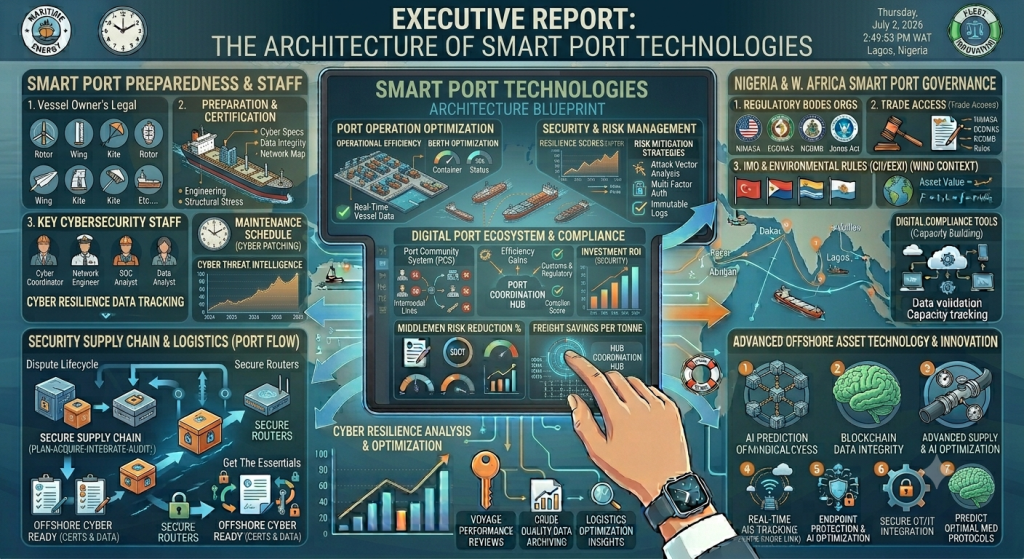
The global maritime logistics sector has passed the point where physical expansion—simply building larger berths or buying more land—can resolve supply chain bottlenecks. As global trade volumes swell and geopolitical or environmental challenges compress traditional transit routes, the world’s premier maritime hubs have transitioned into highly integrated digital corridors.
A smart port is no longer defined merely by its physical cargo throughput capacity. Instead, it is an automated, data-driven ecosystem that integrates the Internet of Things (IoT), artificial intelligence (AI), machine learning, and autonomous systems to maximize operational efficiency, achieve deep data transparency, and drastically reduce vessel and truck turnaround times.
For enterprise stakeholders, terminal operators, and logistics executives across critical trade hubs—including the United Arab Emirates (such as DP World’s Jebel Ali Port), the United Kingdom, and the United States—the deployment of smart port technologies is an operational necessity. According to market data, the global smart ports market size is estimated to reach $9,520 million, with process automation alone commanding a dominant 33% share of that footprint. These investments are driven by a single corporate mandate: replacing structural silos with real-time data visibility to protect supply chain resilience.
This comprehensive technical report examines the core architectural pillars driving modern smart ports, detailing automated gate systems, drone surveillance, and IoT-enabled cargo handling, followed by regional implementation models, deployment strategies, and a strategic executive FAQ.
Automated Gate Systems (AGS) and Optical Character Recognition
The terminal gate is historically one of the most severe bottlenecks in port logistics. Traditional, manually managed gates rely heavily on paper documentation, physical security checks, and manual data entry. These legacy processes generate long truck queues, increase fuel emissions from idling engines, and introduce costly transcription errors into terminal operating systems (TOS).
Automated Gate Systems (AGS) resolve these inefficiencies by replacing manual validation checkpoints with an integrated suite of hardware and software technologies operating at the port perimeter.
Multi-Sensor Data Capture Infrastructure
Modern AGS architectures rely on an array of high-speed sensors positioned along dedicated entry and exit portals:
- Optical Character Recognition (OCR): High-resolution, weather-sealed OCR cameras are mounted on gantry frames at the gate approach. As a drayage truck enters the portal at low speeds, these systems automatically capture and digitize the container’s unique ISO code, the chassis number, and the truck’s license plate. Advanced AI models process these images instantly, correcting for dirt, structural distortion, or poor lighting with high accuracy.
- Radio Frequency Identification (RFID) & DSRC: Dedicated Short-Range Communication (DSRC) and active RFID systems interact with electronic tags mounted on registered fleet vehicles. This setup provides instantaneous biometric and corporate identification of the transport provider without requiring the driver to roll down a window or halt completely.
- Weigh-in-Motion (WIM) Scales: Integrated directly into the approach lane’s pavement, WIM sensors calculate the gross vehicle weight and axle distribution of the truck while it is moving. This data is cross-referenced with the digital shipping manifest to verify weight declarations and comply with regional safety regulations in real time.
- Laser Scanners & Damage Inspection Imaging: High-frequency LiDAR and line-scan cameras generate a complete 3D profile of the vehicle and container. This automated inspection captures structural damage or seal tampering upon entry, creating a permanent, time-stamped digital ledger that protects port operators and logistics clients from fraudulent liability claims.
+———————————————————————–+
| AUTOMATED GATE SYSTEM (AGS) |
+———————————————————————–+
| |
v (Truck Enters Portal) v (Real-Time API Query)
+—————————————————————+ +————————–+
| OCR Gantry: Identifies ISO Container, Chassis, & Plate IDs | | |
| RFID / DSRC: Validates Driver Biometrics & Carrier Profile |=>| Terminal Operating |
| Weigh-in-Motion (WIM): Measures Gross & Axle Weight Scales | | System (TOS) Validation |
| LiDAR / 3D Cameras: Conducts Structural Damage Inspection | | |
+—————————————————————+ +————————–+
|
v
+————————–+
| PBN / Slot Match Verification|
+————————–+
|
v
+————————–+
| Automated Lane Access |
| & Digital Yard Routing |
+————————–+
TOS Integration and Predictive Gate Management
The physical sensors of an AGS are only as effective as the software networks backing them. Raw data from the gate portal is funneled directly into the port’s Terminal Operating System (TOS) via low-latency Application Programming Interfaces (APIs).
When a truck approaches, the system cross-references the captured vehicle ID, container ID, and weight metrics against the port’s active Premium Booking Network (PBN) or truck slot reservation database. If the digital manifest matches the physical parameters and the security clear-to-rate parameters are satisfied, the gate barrier lifts automatically. The entire process takes less than 25 seconds, down from an average of 10 to 15 minutes under legacy manual workflows.
Furthermore, predictive gate management systems leverage machine learning algorithms to analyze historical arrival patterns, seasonal trade peaks, and vessel discharge schedules. By forecasting upcoming truck traffic densities, the TOS can dynamically reallocate gate lane configurations (e.g., converting exit lanes to entry lanes) and alert local drayage networks to adjust their dispatch windows, effectively smoothing out traffic spikes and eliminating terminal-adjacent congestion.
Autonomous Drone Surveillance and Perimeter Security
Maritime ports are vast, sprawling industrial complexes that frequently encompass thousands of acres of land, complex waterways, and miles of exposed perimeter fencing. Traditional security frameworks—relying on static Closed-Circuit Television (CCTV) networks and occasional human security patrols—struggle to maintain complete situational awareness. This exposes the facility to risks ranging from cargo theft and smuggling to unauthorized perimeter breaches.
Autonomous drone surveillance platforms have emerged as a critical capability for smart ports, acting as persistent, airborne sensor nodes integrated directly into the facility’s security command center.
Drone-in-a-Box (DiaB) Frameworks
The baseline for industrial port drone operations is the “Drone-in-a-Box” (DiaB) architecture. These automated systems eliminate the need for an on-site human pilot. Weatherproof, ruggedized docking stations are placed strategically throughout the port terminal.
+————————————————————+
| DRONE-IN-A-BOX (DiaB) ORCHESTRATION |
+————————————————————+
| |
| [ Docking Station ] —> Scheduled/Anomaly Launch Trigger |
| | |
| v |
| [ Flight Profile ] —-> Autonomous Multi-Sensor Patrol |
| | |
| v |
| [ Edge AI Stream ] —-> Thermal / Electro-Optical Feed |
| | |
| v |
| [ Threat Analysis] —-> Real-Time Command Center Alert |
| |
+————————————————————+
The system operates autonomously through a structured sequence:
- Trigger Launch: At scheduled intervals, or when tripped by a perimeter fence sensor alarm, the docking station roof slides open.
- Autonomous Patrol: The drone ascends and executes a pre-programmed flight path, navigating via RTK (Real-Time Kinematic) GPS, which ensures positioning accuracy down to the centimeter level.
- Data Capture & Transmission: Using high-definition electro-optical (EO) cameras for daylight surveillance and long-wave infrared (LWIR) thermal sensors for nighttime operations, the drone streams encrypted telemetry and video back to the central security database.
- Precision Landing & Recharge: Upon completing its mission, the drone lands back inside the enclosure, where internal mechanical systems automatically charge its battery or swap it out, preparing the unit for its next launch sequence.
Computer Vision and Predictive Threat Analysis
The video streams generated by automated aerial patrols undergo automated analysis via edge-computed computer vision models. These AI networks are specifically trained to identify operational anomalies and security threats within highly dynamic port environments:
- Intrusion Detection: The system sets up geofenced boundaries along waterlines and structural boundaries. If an individual crosses a baseline or an unregistered vessel enters a restricted berth zone, the computer vision model flags the entity, tracks its path, and alerts security personnel.
- Thermal Anomaly and Fire Detection: Infrared cameras scan container stacks, hazardous material holding bays, and equipment engines. Sudden temperature spikes are flagged immediately, enabling response teams to address potential fires or chemical leaks long before physical smoke is visible to human observers.
- Asset Inspection & Logistics Support: Beyond security, drones conduct automated inspections of hard-to-reach port assets, such as the upper structures of ship-to-shore (STS) cranes, structural concrete on piers, and terminal lighting gantries. Machine learning algorithms analyze this imagery over time to identify micro-cracks, rust formation, or structural warping, feeding this data directly into predictive maintenance schedules.
IoT-Enabled Cargo Handling and Predictive Analytics
At the heart of any smart port’s operational capability is its capacity to accelerate the movement of cargo while minimizing equipment downtime. Traditional cargo handling relies on reactive operations, where equipment operators and yard managers react to tasks as they appear on static daily schedules. IoT-enabled cargo handling transforms this workflow by turning every piece of heavy machinery, container, and slot into an intelligent, communicating asset.
The Sensorized Supply Chain
To build an effective IoT infrastructure, ports embed specialized hardware across the entire terminal footprint:
- Telematics on Heavy Equipment: Ship-to-Shore (STS) cranes, Rubber-Tired Gantry (RTG) cranes, straddle carriers, and Automated Guided Vehicles (AGVs) are equipped with comprehensive industrial telematics packages. These systems monitor hundreds of parameters simultaneously, including hydraulic pressure, motor temperature, brake wear, fuel or electrical efficiency, and vibration frequencies.
- Smart Containers & Asset Tracking: Containers are increasingly monitored via low-power wide-area network (LPWAN) sensors, such as LoRaWAN or NB-IoT. These compact devices transmit internal temperature, humidity, shock forces (indicating rough handling), and precise location data. This is particularly vital for cold chain logistics, where cold storage containers must maintain unbroken temperature profiles.
- Geofencing and RTLS: Real-Time Location Systems (RTLS), relying on a combination of GPS, differential Bluetooth Low Energy (BLE), and ultra-wideband (UWB) anchors, track the absolute position of every asset in the yard. This ensures that the terminal operating system knows the exact coordinate of a specific container down to its specific stack layer and row, eliminating the costly “lost container” phenomenon that plagues un-automated yards.
Digital Twins and Machine Learning Optimization
The massive influx of telemetry data generated by these thousands of IoT nodes is synthesized within a centralized Digital Twin platform. A digital twin is a dynamic, real-time virtual replica of the entire physical port infrastructure.
By pairing this real-time digital model with machine learning algorithms, smart ports transition from static execution to predictive optimization:
- Predictive Maintenance: Rather than servicing a multi-million-dollar crane based on arbitrary calendar cycles or waiting for a critical component to break down mid-operation, machine learning models analyze sensor vibrations and thermal telemetry. The software identifies subtle signs of component degradation, allowing maintenance teams to intervene during planned operational windows. This approach reduces equipment downtime by up to 40% and significantly lowers total operating costs.
- Intelligent Container Stacking: When an incoming vessel’s manifest is uploaded, AI scheduling engines evaluate historical dwell times, final inland transportation modes (rail vs. truck), and customs clearance profiles for each container. The system then determines an optimal stacking strategy that minimizes “reshuffling”—the inefficient process of moving top containers out of the way to reach a bottom container. This intelligent layout speeds up yard crane operations and helps lower overall energy consumption.
- Dynamic Berth and Equipment Allocation: As weather conditions, vessel delays, and gate congestion fluctuate, the digital twin constantly runs simulations to find the most efficient operational path forward. If a ship arrives ahead of schedule, the system recalculates crane assignments, worker shifts, and AGV routing patterns in minutes rather than hours. This level of responsiveness maximizes throughput across all active berths.
Global Implementation Models: Comparative Analysis
The execution strategies for smart port technologies vary considerably based on regional governance models, labor dynamics, and legacy infrastructure constraints. Examining how leading hubs implement these systems reveals distinct operational approaches.
Jebel Ali Port (UAE) – The DP World Benchmark
DP World’s flagship Jebel Ali Port in Dubai serves as one of the world’s most advanced automated terminals. Facing high transshipment volumes and acting as a critical gateway connecting East-West trade corridors, Jebel Ali has leaned heavily into large-scale, automated infrastructure.
A clear example of this commitment is the ongoing expansion of its AI-powered container terminal automation frameworks. This system integrates advanced machine learning models with automated stacking cranes and robotic container handling systems.
The primary business objective is clear: reduce vessel turnaround times by 18% while expanding terminal capacity by an additional 1.5 million TEUs annually. Jebel Ali’s strategy relies on building proprietary, highly centralized end-to-end ecosystems, combining physical automation with comprehensive digital trade platforms like CARGOES to ensure data transparency across the entire Middle Eastern supply chain network.
United States Ports – Selective Automation and Digital Integration
In contrast to the greenfield, fully automated terminal models frequently built in Asia and the Middle East, major ports in the United States—such as the Port of Los Angeles, the Port of Long Beach, and the Port of New York and New Jersey—often navigate complex brownfield environments, strict environmental mandates, and distinct labor unions.
Consequently, U.S. ports favor a phased, highly targeted automation strategy. Investments focus heavily on digitalizing data exchanges and automating gate systems rather than completely replacing terminal assets with robotics. Initiatives like the “Port Optimizer” platform in Los Angeles act as a shared digital portal, securely aggregating data from shipping lines, truck operators, railroads, and cargo owners well ahead of a vessel’s arrival.
Concurrently, selected terminals, like the recently expanded Pier T in Long Beach, utilize automated guided vehicles and automated cranes to maximize container handling speed within existing land footprints, balancing technological growth with local operational frameworks.
United Kingdom and European Ports – The Collaborative Ecosystem
Ports across the United Kingdom (such as the Port of London Authority or Felixstowe) and mainland Europe (such as Rotterdam and Hamburg) focus their smart port frameworks heavily on intermodal integration, community networks, and green port sustainability initiatives.
The European model relies extensively on Port Community Systems (PCS)—open, cloud-based data hubs that connect public customs authorities, private terminal operators, freight forwarders, and rail networks. This data-sharing foundation is paired with smart grid technologies and shore-power facilities that monitor and optimize energy usage to meet strict regulatory decarbonization targets.
By building shared digital twin architectures across the entire supply chain corridor, these ports optimize vessel approach routes, reduce anchoring times, and manage rail and barge connections smoothly, treating the port as an integrated component of a broader multi-modal transport grid.
Strategic Blueprint for Enterprise Technology Deployment
For terminal operators and logistics executives looking to design and implement a smart port framework, the following structured blueprint outlines the critical deployment sequence:
The Deployment Sequence
1
Sensorization and Edge Infrastructure
Phase 1: Foundation
1.Sensorization and Edge Infrastructure:Phase 1: Foundation.
Deploy active RFID tags on fleet vehicles, fit WIM scales into entry lanes, install OCR camera arrays at perimeter gates, and instrument heavy yard machinery with industrial IoT telematics packages. Ensure all hardware carries edge-computing capabilities to filter out raw data noise before transmission.
2
Unified Communication Fabric (5G/LPWAN)
Phase 2: Connectivity
2.Unified Communication Fabric (5G/LPWAN):Phase 2: Connectivity.
Install a private, industrial-grade 5G network across the entire terminal footprint to guarantee low-latency, high-bandwidth data streams for automated machinery and real-time video feeds. Complement this with a robust LoRaWAN or NB-IoT network to support long-range, battery-powered tracking sensors embedded within cargo containers.
3
TOS Integration and Digital Twin Layer
Phase 3: Synthesis
3.TOS Integration and Digital Twin Layer:Phase 3: Synthesis.
Consolidate all disparate data streams into a centralized data lake. Connect this data repository directly to the Terminal Operating System (TOS) via secure APIs, and deploy a 3D Digital Twin visualization platform. This step aggregates operational data to unlock complete, real-time situational awareness for dispatchers.
4
AI Scheduling and Autonomous Automation
Phase 4: Optimization
4.AI Scheduling and Autonomous Automation:Phase 4: Optimization.
Activate machine learning algorithms to manage predictive gate flows, optimize container stacking locations, and automate crane movements. Transition security patrols to autonomous Drone-in-a-Box platforms and integrate computer vision threat assessment directly into the primary security command dashboard.
A Note on Cyber-Resilience: Because smart ports rely on heavily interconnected IoT networks, cloud infrastructures, and automated systems, they also present an expanded attack surface for cyber threats. A robust smart port deployment must incorporate a comprehensive zero-trust network architecture. This includes continuous device authentication, end-to-end data encryption for all sensor streams, and air-gapped system isolation for core automated machinery to protect operations from ransomware or malicious network intrusions.
Strategic B2B Industry FAQ
How do smart port technologies affect the average truck turnaround time?
Automated gate systems, real-time yard tracking, and AI-optimized container layouts work together to reduce truck turnaround times by 40% to 60%. By replacing manual paperwork and physical inspections with OCR gantry processing, lane processing drops to under 30 seconds, allowing logistics providers to maximize their daily truck utilization rates.
What are the main obstacles when integrating IoT cargo systems with legacy Terminal Operating Systems (TOS)?
The most common challenges include fragmented, non-standardized data formats, siloed software architectures, and insufficient bandwidth on older network configurations. Overcoming these hurdles requires deploying standardized, open API layers and transitioning to modern, cloud-based TOS solutions capable of managing high-velocity data ingestion.
How does drone surveillance integrate with existing maritime security frameworks like the ISPS Code?
Autonomous drone systems enhance compliance with the International Ship and Port Facility Security (ISPS) Code. They provide continuous, auditable aerial coverage of restricted areas, automate perimeter verification, and speed up incident verification. This allows security personnel to assess and mitigate threats more safely and efficiently than traditional manual patrols alone.
What role do smart ports play in corporate ESG compliance and sustainability targets?
Smart ports directly advance environmental goals by reducing resource waste and carbon emissions. Automated traffic coordination eliminates truck idling at the gates, while AI-driven yard mapping reduces the fuel consumed by heavy cranes during container reshuffling. Additionally, real-time energy monitoring helps ports integrate shore-power options, lowering the environmental impact of vessels while they are berthed.
Additional Resources
For a detailed look at how global maritime hubs are implementing these automated systems on the ground, watch this analytical overview on Expert Port Technology Upgrades. This breakdown details how digital infrastructure improvements help resolve modern shipping disruptions and improve supply chain transparency.
Recent Comments