
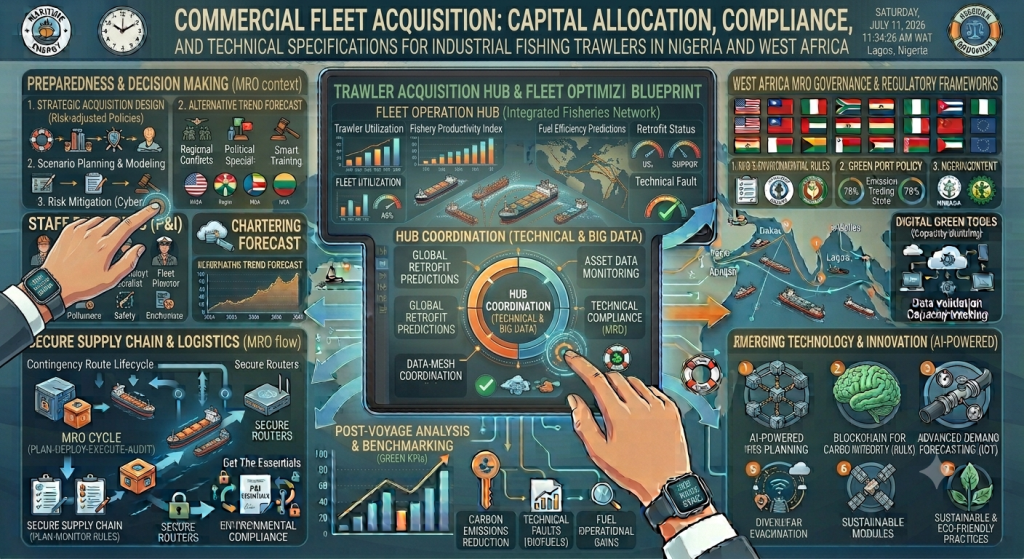
The marine fisheries sector in West Africa—particularly within Nigeria’s Exclusive Economic Zone (EEZ)—represents a major frontier for institutional capital allocation in the regional blue economy. Backed by the Federal Ministry of Marine and Blue Economy, the industrial capture fishery sector is transitioning away from unmonitored, legacy operations toward heavily regulated, high-yield commercial fleets.
With a domestic seafood deficit exceeding 2.0 million metric tons annually, the dependency on imported frozen pelagic fish presents a direct market opportunity for localized industrial harvesting.
[Domestic Seafood Demand] ──► 3.0M+ Metric Tons Annually
│
┌────────────────────────┴────────────────────────┐
▼ ▼
[Local Capture & Aquaculture] [Import Dependency Gap]
(~1.0M Metric Tons) (2.0M+ Metric Tons Deficit)
│
▼
[Market Entry Opportunity]
Industrial Trawler Fleets
However, executing a multi-vessel fleet acquisition in the Gulf of Guinea requires deep technical knowledge. Disorganized procurement strategies often lead to severe operational risks, such as buying structurally deficient hulls, facing asset seizures under the Sea Fisheries Act, or dealing with unhedged operational costs where Marine Gas Oil (MGO) accounts for over 80% of running expenses.
This comprehensive guide analyzes the asset classes, regulatory structures, financial considerations, and technical strategies required to successfully acquire and operate commercial fishing trawlers in Nigeria and the wider West African maritime territory.
Asset Classification: Technical Specifications and Vessel Selection
Navigating the West African maritime theater requires matching your vessel asset class with your specific target catch, planned operational depth, and regional current profiles. Standard classifications include:
A. Coastal Inshore Wetfish Vessels (Small-Scale Commercial)
- Hull Construction: High-density polyethylene (HDPE) or Marine-Grade Aluminum Alloy (5083/5086).
- Length Overall (LOA): 12 to 18 meters.
- Propulsion Matrix: Twin outboard configurations or single resiliently mounted diesel inboard (e.g., Yanmar Marine or Cummins Marine) generating 150 to 350 horsepower (hp).
- Primary Application: Operating within coastal waters up to the 5-nautical-mile statutory limit, targeting demersal species (such as Croaker and Snapper). These vessels utilize crushed ice storage systems without onboard freezing plants.
B. Medium-Sized Outrigger Trawlers & Shrimpers
- Hull Construction: A-36 structural shipbuilding steel with reinforced scupper systems and high-wear plating along the draft line.
- Length Overall (LOA): 20 to 32 meters.
- Propulsion Matrix: Medium-speed, single-screw diesel propulsion systems (e.g., Caterpillar Marine or MAN Energy Solutions) delivering 450 to 800 hp, coupled with fixed-pitch ducted propellers inside Kort nozzles to maximize bollard pull during active trawling.
- Primary Application: Operating inside the Nigerian continental shelf, optimized with dual outrigger booms designed to deploy twin shrimp trawl nets simultaneously.
C. Industrial Deep-Sea Stern Trawlers & Factory Ships
- Hull Construction: ICE Class or equivalent heavy steel fabrication featuring double bottoms and reinforced forward frames designed to withstand rough conditions in the open South Atlantic.
- Length Overall (LOA): 35 to 65+ meters.
- Propulsion and Energy Matrix: Heavy-duty main engines (exceeding 1,200 hp) running on Marine Gas Oil (MGO) or Low Sulfur Fuel Oil (LSFO). These setups are integrated with large auxiliary generator sets (e.g., Baudouin or Volvo Penta) to power high-capacity onboard processing equipment.
- Primary Application: Long-range pelagic and deep-sea harvesting across the Exclusive Economic Zone (EEZ). These vessels feature complete onboard processing facilities, including automated gutting tables, sorting systems, and specialized flash-freezing equipment.
Financial Capital Allocation and Operational Cost Realities
Investing in the Nigerian commercial fishing sector requires an accurate understanding of both upfront capital expenditure (CAPEX) and ongoing operational expenses (OPEX). Legacy business models often fail because they underestimate structural costs.
[ Total Annual Operational Expenditure (OPEX) ]
│
┌───────────────────────┴───────────────────────┐
▼ ▼
[ Fuel & Lubricants (MGO) ] [ Fixed Overhead Matrix ]
(75% – 82% of Total OPEX) (18% – 25% of Total OPEX)
│ │
▼ ▼
• Refineries / Depots • NIMASA Sea Certification
• Offshore Bunkering • Crew Share Allocations
• Fuel Additive Controls • Dry-docking Reserves
The Capital Expenditure Baseline
The acquisition cost of a fishing trawler fluctuates significantly based on hull composition, class certification status, and on-board processing capacity:
| Asset Class & Condition | Length Overall (LOA) | Estimated Valuation Range (NGN) | Estimated Capital Cost (USD Equivalent) |
| New Aluminum Inshore Boat | 14m – 16m | ₦15,000,000 – ₦35,000,000 | $10,000 – $23,000 |
| Used Steel Hull Shrimper (Refitted) | 24m – 28m | ₦65,000,000 – ₦120,000,000 | $43,000 – $80,000 |
| Industrial Deep-Sea Stern Trawling Asset | 45m+ | ₦250,000,000 – ₦750,000,000+ | $166,000 – $500,000+ |
The Reality of Operational Cost Breakdown
Empirical operational studies show that fuel costs alone account for 75% to 82% of total running expenses for industrial vessels in Nigeria. Because Marine Gas Oil (MGO) prices are closely tied to international oil benchmarks and foreign exchange rates, unoptimized engine performance can quickly erode profit margins.
The remaining operational expenses include crew labor shares, marine insurance policies, hull maintenance reserves, and harbor dues paid to the Nigerian Ports Authority (NPA).
Step-by-Step Regulatory Compliance and Importation Workflow
Operating an industrial fishing fleet legally within Nigerian territorial waters requires navigating a strict, multi-agency compliance process. Failing to follow these statutory steps can result in heavy fines or asset forfeiture under federal anti-poaching laws.
Step 1: Secure the Federal Department of Fisheries Letter of Intent
Before purchasing or importing a hull, an investor must submit a formal application to the Federal Department of Fisheries and Aquaculture under the Federal Ministry of Marine and Blue Economy. The department reviews the applicant’s business case, processing infrastructure, and target catch profiles to issue a formal Letter of Intent to Import.
Step 2: NIMASA Ship Registry and Pre-Purchase Survey
The vessel must undergo a comprehensive physical out-of-water survey conducted by an accredited marine surveyor (such as Lloyd’s Register or Bureau Veritas). The survey report is submitted to the Nigerian Maritime Administration and Safety Agency (NIMASA) to open the provisional ship registry log, verify the builder’s certificate, and ensure the vessel complies with safety standards.
Step 3: Form M Generation and Customs Tariffs at Lagos Ports
The buyer files a commercial Form M via the Central Bank of Nigeria portal using the designated Harmonized System (HS) Code for fishing vessels (HS Code 8902.00.00). Upon arrival at a port like Apapa or Tin Can Island, the importer must settle the calculated customs duties, port handling fees, and relevant administrative levies.
Step 4: Federal Fishery Vessel Licensing and Mesh Size Verification
Following customs clearance, the vessel must be inspected by federal fisheries officers. They measure the net dimensions to verify compliance with conservation rules, ensuring the cod-end mesh size is not less than 76mm for demersal fish and not less than 44mm for shrimp trawling. After verification, the official annual fishing license is issued.
Step 5: Operational Security Activation (VMS & AIS Deployment)
To legally operate, the vessel must install an approved Vessel Monitoring System (VMS) and an Automatic Identification System (AIS). The transponder frequencies must be integrated with the NIMASA C4i command center under the Deep Blue Project infrastructure, providing real-time tracking to protect the vessel from security threats in the Gulf of Guinea.
Technical Operational Best Practices for West African Waters
To protect asset investments and maximize catch returns, fleet superintendents should implement standardized operational guidelines:
A. Strict Maintenance of the Cold Chain Matrix
The commercial value of the catch depends on the performance of the onboard refrigeration systems. For wetfish vessels, this requires maintaining a consistent supply of clean, freshwater flake ice at a stable internal storage temperature of 0°C to -2°C.
For larger deep-sea factory trawlers, the blast freezing systems must lower internal fish temperatures to -35°C within four hours of landing, before transferring the product to hold areas maintained at a steady -18°C or lower. Any temperature fluctuations can degrade product quality, leading to lower prices at port markets.
B. Prevention of Marine Growth and Hull Fouling
The warm, nutrient-rich waters of the Gulf of Guinea accelerate the growth of marine organisms on vessel hulls. Heavy bio-fouling increases hydrodynamic drag, which can raise fuel consumption by up to 18%.
Operators should apply high-performance, copper-free fluoropolymer anti-fouling coatings during scheduled dry-dockings. Additionally, technical teams should schedule regular underwater hull cleaning and hull thickness testing every 24 months at regional facilities like the Continental Shipyard in Lagos or the West Africa ENI base.
[ Warm, Nutrient-Rich Gulf of Guinea Waters ]
│
▼
[ Accelerated Marine Bio-Fouling ]
(Barnacle Growth, Algae Accumulation)
│
▼
[ Hydrodynamic Hull Drag Increases by up to 18% ]
│
┌────────────────────────┴────────────────────────┐
▼ ▼
[ Operational Risk ] [ Preventative Countermeasure ]
Escalating MGO Fuel Burn Fluoropolymer Anti-Fouling
& Main Engine Overheating + 24-Month NDT Hull Thickness Audits
C. Compliance with Fishery Conservation Laws
Nigerian maritime law strictly enforces sustainable fishing practices to prevent overfishing:
- Territorial Exclusion Zones: Motorized fishing trawlers are legally barred from fishing within the first 5 nautical miles of the Nigerian continental shelf, an area reserved for artisanal fishermen.
- Bycatch Discard Regulations: Under the Sea Fisheries Regulations, shrimp trawlers must land a bycatch mix consisting of at least 75% fish by weight relative to the total shrimp volume landed. Dumping marketable fish back into the ocean is illegal and subject to severe financial penalties and vessel grounding orders.
Technical FAQ: Vessel Acquisition and Operations
Q1: What are the current licensing fees for commercial fishing vessels in Nigeria?
Licensing fees are determined by the vessel’s operational range and gross registered tonnage. Inshore fishing and shrimping vessels operating within the continental shelf are charged an annual baseline licensing fee of ₦500,000. For deep-sea vessels or large industrial factory trawlers engaged in distant-water fishing within the wider EEZ scope, the standard federal licensing fee is ₦1,000,000 per vessel, renewable every calendar year.
Q2: Has NIMASA completely removed the Cabotage compliance fees for fishing vessels?
Yes. To encourage domestic investment and reduce operational costs within the fishing industry, NIMASA has removed the 2% administrative fee previously collected under the Coastal and Inland Shipping (Cabotage) Act from fishing trawler operators. However, vessels must still complete standard safety inspections, register their hulls, and maintain valid safety certificates to operate legally.
Q3: What type of steel hull thickness is required to clear a NIMASA safety survey?
NIMASA surveyors look for structural integrity verified by ultrasonic thickness testing (UTM). For steel hull trawlers between 20 and 40 meters, the keel and bottom shell plating should maintain a thickness of not less than 8.0mm to 10.0mm, while the side shell and deck plating should measure at least 6.0mm to 8.0mm. Hulls showing localized structural wasting or corrosion exceeding 20% of the original nominal thickness must undergo plate replacement before a safety certificate is issued.
Q4: Can a foreign-flagged fishing trawler operate commercially within Nigerian waters?
No. Under current fisheries policy, foreign-flagged vessels cannot fish commercially within Nigeria’s territorial waters without an approved joint-venture structure or a direct federal allocation. The operating company must be registered in Nigeria with the Corporate Affairs Commission (CAC), maintain a minimum local equity share, and officially register the vessel under the Nigerian flag through NIMASA.
Q5: How do regional security measures protect commercial fishing fleets in the Gulf of Guinea?
Maritime security has improved significantly through the implementation of the Deep Blue Project, managed by the Federal Ministry of Marine and Blue Economy and NIMASA. This initiative uses a combination of special mission vessels, interceptor boats, maritime surveillance aircraft, and an integrated C4i command center. Trawlers equipped with functioning AIS and VMS transponders receive continuous protection and rapid response support from naval security patrols.
7. Strategic Summary for Fleet Management Groups
Developing a sustainable, high-yield fishing fleet in West Africa requires a systematic approach to asset management:
- Align Hull Choice with Targeted Geography: Choose robust steel or aluminum hulls with specialized propulsion systems designed to handle the specific operational demands of the Gulf of Guinea.
- Maintain Multi-Agency Compliance: Follow the proper regulatory sequence across the Federal Department of Fisheries, NIMASA, and Nigerian Customs to protect your vessels from legal risks and operational disruptions.
- Implement Condition-Based Monitoring: Utilize fuel flow meters and continuous data tracking to optimize fuel use and manage the engine wear associated with long-range fishing deployments.
Industrial Vessel Sourcing and Maritime Advisory with Oitha Marine
Navigating the technical requirements, regulatory environment, and logistics of commercial fleet procurement in West Africa requires an experienced maritime partner. At Oitha Marine, we support enterprise investors, fleet owners, and seafood processing firms with professional vessel sourcing, technical hull surveys, customs clearance management, and specialized marine engineering consultation.
Optimize your commercial fleet acquisition and ensure full compliance with regional maritime standards. Contact our technical operations desk today at oithamarine.com or visit Oitha Marine Technical Insights to schedule an operational consultation.
Recent Comments