
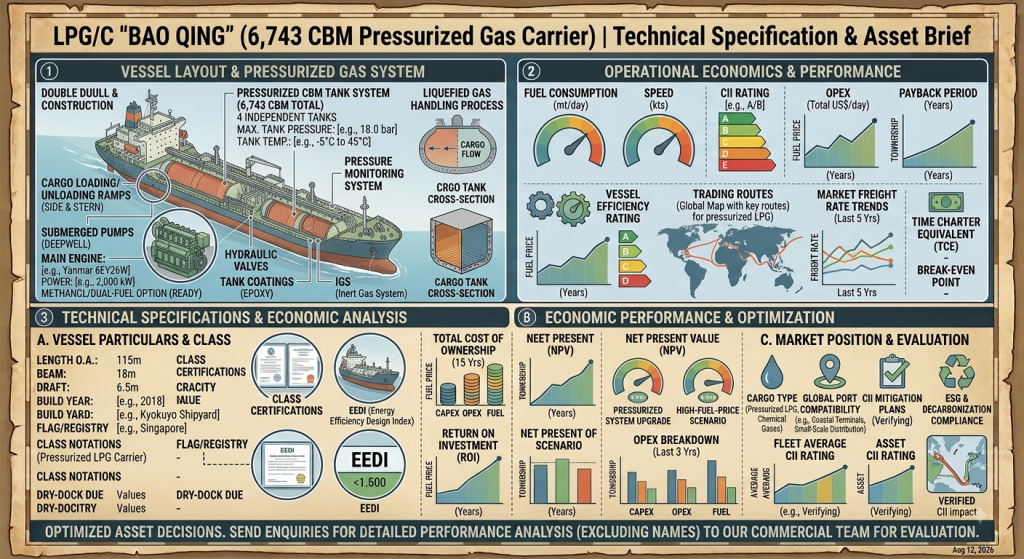
A Technical Vetting, Market Analysis, and Compliance Brief for Gas Charterers and Shipowners
Prepared by Oitha Marine Gas & S&P Brokerage Desk
Executive Summary & Market Positioning
In regional liquefied petroleum gas (LPG) and petrochemical logistics, small-scale pressurized gas carriers offer vital supply-chain flexibility across coastal, short-sea, and island-archipelago distribution routes. This technical brief details the LPG/C “BAO QING”, a versatile 6,743 CBM pressurized LPG carrier constructed in January 2013 by Zhejiang Sanmen Qianghui Shipbuilding Co., Ltd., China. Operating under China Classification Society (CCS) international classification, the vessel combines heavy-duty pressure vessel engineering with specialized features tailored for regional gas trades.
Engineered with dual independent Type C cylindrical cargo tanks capable of withstanding working pressures up to 17.5 bar and minimum cargo temperatures down to -10°C, the LPG/C “BAO QING” is fully equipped to transport commercial propane, butane, propylene, and chemical gas feedstocks without requiring refrigeration units. Fitted with high-specification Hamworthy Svanehøj deepwell pumps, an onboard nitrogen generator, and Ice Class B reinforcement, this vessel represents a highly operable asset for Asian coastal distribution or international short-sea reflagging opportunities.
Detailed Technical & Machinery Specifications
Below is a technical specification breakdown structured for technical vetting departments, gas chartering desks, and maritime S&P analysts:
| Parameter | Technical Specification / Description |
| Vessel Name & Flag | LPG/C “BAO QING” | China Flag |
| Deadweight & Draft | Approximately 5,511 Metric Tons (DWT) on 5.95 Meter Summer Draft |
| Principal Dimensions | LOA: 119.00m | LBP: 110.43m | Beam: 18.80m | Depth: 8.40m |
| Tonnage (GT/NT) | Gross Tonnage: 5,899 | Net Tonnage: 1,769 |
| Builder & Delivery | Zhejiang Sanmen Qianghui Shipbuilding Co., Ltd., China (January 2013) |
| Classification & Ice Class | CCS International (China Classification Society) | Ice Class B |
| Survey Position | Special Survey (SS) & Drydocking (DD) Due: March 2027 |
| Cargo Tank Setup | 2 Independent Type C Cylindrical Cargo Tanks |
| Volumetric Capacity | 6,743 CBM at 98% Filling Capacity |
| Pressure & Thermal Limits | Maximum Working Pressure: 17.5 Bar | Minimum Cargo Temp: -10°C |
| Pumping System | 2 x 350 CBM/h Hamworthy Svanehøj Deepwell Pumps |
| Gas Handling & Purging | 1 x 8.0 CBM/min Cargo Compressor | Fitted with Onboard Nitrogen Generator |
| Main Propulsion Engine | Qingdao Zichai 8N330-EN | 3,310 kW at 620 RPM |
| Auxiliary Generators | 3 x 294 kW Generator Sets | Fixed Pitch Propeller (FPP) | No Bow Thruster |
| Speed & Fuel Consumption | Abt 11.0 Knots on 10.0 MT IFO 180 + 0.8 MT MGO |
| Environmental Standard | Ballast Water Treatment System (BWTS) Fitted |
Gas Handling Systems & Operational Advantages
The cargo plant design of LPG/C “BAO QING” provides excellent flexibility and security during loading, voyage transit, and discharge:
- Robust 17.5 Bar Tank Pressure Rating: High-pressure Type C tanks allow ambient temperature loading of fully pressurized propane and butane mixes without ambient temperature venting or boiling losses.
- Hamworthy Svanehøj Pumping Precision: Fitted with dual 350 CBM/h Svanehøj deepwell cargo pumps, enabling complete cargo discharge in under 10 hours, minimizing berth occupancy costs at shore terminals.
- Integrated Nitrogen Generator: Onboard nitrogen generation ensures rapid, independent tank purging and inerting during cargo grade changes, eliminating reliance on expensive shore-supplied nitrogen.
- Ice Class B Capability: Reinforced hull structure allows safe operation in light sea ice conditions, extending trading scope into northern Asian and sub-arctic coastal zones during winter periods.
Commercial Trade Suitability & Market Potential
- Regional Coastal LPG Distribution: With a shallow draft of 5.95m and an LOA of 119.0m, the vessel easily accesses restricted secondary gas terminals, river ports, and island-hopping distribution networks across East Asia, Southeast Asia, and regional coastal hubs.
- Petrochemical Gas Feedstock Transport: Capable of handling light chemical gases down to -10°C, the vessel serves intermediate industrial feedstock trades (such as raffinate, propylene, and chemical LPG blends) between regional refineries and chemical processing complexes.
Vetting, Class Status & Risk Management
Prospective buyers and charterers must evaluate structural and operational parameters during asset acquisition:
1. Survey Schedule Security
With CCS Special Survey and Drydocking both valid until March 2027, the vessel offers near-term operational continuity prior to entering her next scheduled class renewal cycle.
2. Environmental & Flag Compliance
Equipped with a fitted Ballast Water Treatment System (BWTS), the asset complies with international IMO ballast conventions. Buyers seeking international trading deployment can seamlessly transfer class or flag state registration.
Why Partnering with Oitha Marine Delivers Value
- Technical Gas Plant Evaluation: Our technical team conducts comprehensive audits of pressure vessel inspection logs, cargo pump performance history, compressor hours, and nitrogen system maintenance.
- Transaction & Reflagging Guidance: We guide buyers through Chinese flag export protocols, CCS class transfers, and international reflagging documentation for smooth ownership handovers.
- Commercial Chartering Placement: Beyond S&P execution, Oitha Marine assists new owners in securing long-term period time charters with reputable regional gas charterers and industrial end-users.
Frequently Asked Questions (FAQ)
Q1: What are the primary cargo tank specifications for LPG/C “BAO QING”?
Answer: The vessel features 2 independent Type C cylindrical cargo tanks with a combined 98% capacity of 6,743 CBM, a maximum working pressure of 17.5 bar, and a minimum design temperature of -10°C.
Q2: When are the next major class surveys due?
Answer: Both Special Survey (SS) and Drydocking (DD) under CCS classification are valid through March 2027.
Q3: Is the vessel equipped for rapid cargo grade changes?
Answer: Yes, the vessel is fitted with an onboard nitrogen generator and an 8.0 CBM/min cargo compressor, allowing independent purging, gassing-up, and inerting without shore assistance.
Q4: What is the vessel’s propulsion engine and fuel consumption profile?
Answer: Powered by a Qingdao Zichai 8N330-EN main engine (3,310 kW), she operates at approximately 11.0 knots on a daily consumption of 10.0 MT IFO 180 and 0.8 MT MGO.
Q5: Can this vessel trade in cold weather and ice conditions?
Answer: Yes, the vessel carries an Ice Class B notation, making her suitable for navigation in light ice conditions in northern seasonal waters.
Q6: How can interested charterer or buyers inspect the vessel?
Answer: Contact Oitha Marine’s S&P desk to obtain the full technical specification pack, recent class survey records, and arranged inspection schedules.
Recent Comments