
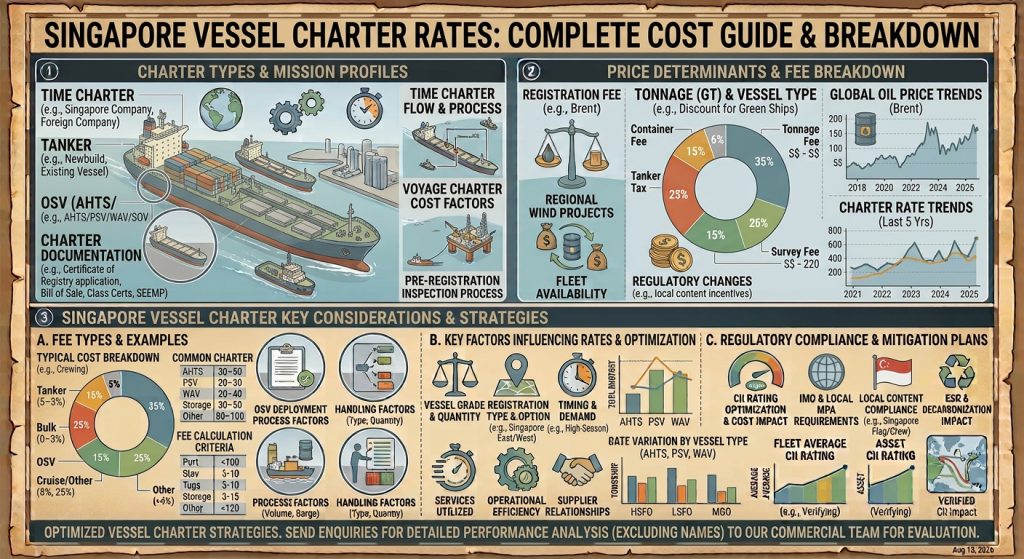
Chartering a vessel in Singapore—the world’s busiest transshipment hub and premier bunkering port—requires navigating a dynamic, multi-layered pricing environment. Because Singapore operates as a primary node for global container lines, dry bulk corridors, tanker trades, and offshore support activities, charter rates vary significantly based on vessel specification, charter party structure, port tariffs, and market conditions.
Whether securing a harbor launch for crew changes in the Eastern Working Anchorage (EWA), chartering an offshore support vessel (OSV) for regional project cargo, or fixing a spot time charter for a chemical tanker, commercial decision-makers must evaluate both baseline hire rates and secondary operational expenditures.
This comprehensive analysis breaks down current charter rate ranges across vessel sectors in Singapore, outlines the structural components of local charter contracts, analyzes Maritime and Port Authority of Singapore (MPA) fee structures, and identifies key strategies for mitigating charter party financial exposure.
Executive Summary
- Harbor Craft & Local Service Vessels: Daily charter hire for harbor launches, workboats, and tugboats operating within Singapore Port Limits ranges from SGD 800 to SGD 12,000 per day, depending on engine horsepower, bollard pull, and regulatory licensing.
- Regional & Offshore Support Tonnage: Anchor Handling Tug Supply (AHTS) vessels and Platform Supply Vessels (PSVs) supporting Southeast Asian offshore projects command daily time charter rates ranging between USD 8,500 and USD 35,000 per day, driven by regional oil and gas activity and offshore wind installations.
- Ocean-Going Tonnage (Tankers, Dry Bulk, Containers): Charter rates for ocean tonnage fixed in or out of Singapore mirror global index fixtures (e.g., Baltic Exchange metrics). Rates range from USD 12,000 per day for Handysize bulkers to over USD 45,000 per day for modern MR2 eco-tankers or feeder container vessels, subject to spot availability and fuel efficiency ratings.
- Secondary Cost Drivers: Baseline hire rates represent only a fraction of total chartering expenditure. Charterers must account for MPA port dues, pilotage, towage, fuel/bunkering costs (VLSFO/MGO/LNG), port agency fees, and crew mobilization/demobilization charges.
- Contractual Safeguards: Incorporating standard BIMCO charter party forms (e.g., SUPPLYTIME 2017, BALTIME, or GENTIME) with tailored Singapore jurisdiction clauses protects charterers against off-hire disputes, unexpected bunker adjustments, and regulatory compliance penalties.
1. Primary Factors Influencing Vessel Charter Rates in Singapore
Vessel chartering costs in Singapore do not operate in a vacuum. Rates are determined by a combination of global macroeconomics, localized port logistics, vessel specifications, and contractual risk allocation.
┌──────────────────────────────────────────────┐
│ Singapore Charter Rate Pricing Dynamics │
└──────────────────────┬───────────────────────┘
│
┌───────────────────────────────────┼───────────────────────────────────┐
▼ ▼ ▼
┌──────────────────────────┐┌──────────────────────────┐┌──────────────────────────┐
│ Market Dynamics ││ Vessel Specifications ││ Operational Liabilities │
├──────────────────────────┤├──────────────────────────┤├──────────────────────────┤
│ • Regional Trade Supply ││ • Gross Tonnage (GT) ││ • MPA Port Dues & Tariffs│
│ • Global Index Metrics ││ • Engine HP & Bollard ││ • Fuel/Bunker Intensity │
│ • Anchorages Congestion ││ • IMO / Class Approvals ││ • Pilotage & Towage Rules│
│ • Off-Shore Field Activity││ • Age & Fuel Efficiency ││ • Agency & Husbandry │
└──────────────────────────┘└──────────────────────────┘└──────────────────────────┘
Vessel Class, Capacity, and Technical Capabilities
The primary determinant of hire cost is the vessel’s technical profile. A standard 15-meter crew launch designed for inner anchorage transport operates under a radically different capital and operational cost structure than a 70-meter AHTS equipped with Dynamic Positioning System 2 (DP2) and fire-fighting class 1 (FiFi 1) capabilities. Higher bollard pull ratings for tugs, specialized tank coatings for chemical parcel tankers, and eco-engine configurations command premium rates in the Singapore spot market.
Charter Agreement Structure (Bareboat vs. Time vs. Voyage)
The commercial structure selected by the charterer dictates who absorbs operational risk, fuel expenditure, and port liabilities:
- Time Charter (TC): The vessel owner provides the ship, crew, engine maintenance, and insurance, while the charterer pays a fixed daily hire rate plus variable operational costs (bunkers, port dues, pilotage, cargo handling). This is the most common commercial arrangement in Singapore for regional trade and project logistics.
- Bareboat Charter (Demise Charter): The charterer assumes complete operational control, providing their own crew, engine maintenance, insurance, and fuel. Bareboat rates reflect pure capital asset depreciation and interest costs, resulting in lower daily rates but substantially higher operational liabilities.
- Voyage Charter: The charterer pays a fixed rate per metric ton or a lump sum for moving cargo from Point A to Point B. The shipowner pays for fuel, port dues, and operational expenses.
Geographic Scope and Operating Limits
Charter contracts executed in Singapore distinguish between operations within Singapore Port Limits (SPL) and outer port limits (OPL) or international waters. Harbor craft licensed by the MPA under the Prevention of Pollution of the Sea Act operate under specific local tariffs. Conversely, vessels chartering for cross-border trades (e.g., Singapore to Pasir Gudang, Batam, or international offshore blocks) incur higher insurance surcharges, international crew mobilization fees, and customs clearance formalities.
2. Comprehensive Cost Breakdown by Vessel Sector
To provide actionable baseline figures for maritime executives, procurement managers, and charterers, the tables below outline typical 2026 charter hire cost benchmarks across major vessel categories operating in and through Singapore.
Local Harbor Craft & Utility Vessels (Inside Singapore Port Limits)
Harbor craft facilitate port operations, crew changes, stores delivery, bunkering support, and ship-to-ship (STS) transfers across Singapore’s major anchorages (Eastern, Western, Changi, and OPL).
| Vessel Type | Typical Specification | Charter Type | Daily Rate Range (SGD) | Daily Rate Range (USD Approx.) |
| Crew Launch / Passenger Boat | 12–20 meters (12–30 passengers) | Spot / Daily TC | SGD 800 – SGD 1,800 | USD 600 – USD 1,350 |
| Supply Launch / Stores Workboat | Deck capacity 10–30 MT | Daily / Monthly TC | SGD 1,500 – SGD 3,200 | USD 1,100 – USD 2,400 |
| Harbor Tugboat | 3,000–5,000 BHP (40–65 MT Bollard Pull) | Time Charter | SGD 4,500 – SGD 8,500 | USD 3,350 – USD 6,300 |
| Bunker Barge (Clean/Dirty Petroleum) | 1,000–5,000 DWT (Mass Flow Meter Equipped) | Time Charter | SGD 6,000 – SGD 14,000 | USD 4,500 – USD 10,400 |
| Flat Top Deck Cargo Barge | 180–300 feet (1,500–5,000 DWT) | Bareboat / TC | SGD 700 – SGD 2,500 | USD 520 – USD 1,850 |
Note: Figures above reflect standard working day hire within SPL. Overtime, night operations, and emergency calls carry surcharges ranging from 15% to 35%.
Offshore Support Vessels (OSVs) & Regional Workboats
Singapore serves as the primary mobilization and procurement hub for offshore support vessels operating across the Asia-Pacific region, supporting oil and gas fields in Malaysia, Indonesia, Vietnam, and Australia.
| Vessel Category | Technical Specification | Charter Structure | Estimated Daily Rate (USD) | Primary Cost Drivers |
| Anchor Handling Tug Supply (AHTS) | 6,000–8,000 BHP (80–110 MT BP) | Time Charter | USD 8,500 – USD 15,000 | Bollard pull, DP1/DP2 capability, deck space |
| Deepwater AHTS | 12,000+ BHP (150+ MT BP, DP2) | Time Charter | USD 18,000 – USD 35,000 | Deepwater winch capacity, FiFi 2, oil recovery |
| Platform Supply Vessel (PSV) | 3,000–4,500 DWT (Deck space >700 | Time Charter | USD 12,000 – USD 22,000 | Mud/liquid capacity, DP2, fuel efficiency |
| Crew Transfer Vessel (CTV) / Fast Craft | 24–35 meters (High-speed aluminum) | Time Charter | USD 3,500 – USD 7,500 | Fuel consumption curves, sea-keeping ability |
| Subsea Support / IMR Vessel | Accommodates 60–100 pax, Crane 50–100t | Time Charter | USD 25,000 – USD 55,000 | Active heave compensated (AHC) crane, ROV spread |
Ocean-Going Tonnage Fixing via Singapore Spot/Time Charter Markets
For global shipowners and charterers fixing commercial tonnage via Singapore-based shipbrokers, rates correspond directly to global shipping market indices adjusted for local positioning.
[ Merchant Vessel Charter Types (Singapore Port Limits / Regional Trades) ]
│
┌─────────────────────────────┴─────────────────────────────┐
▼ ▼
[ Dry Bulk Tonnage ] [ Tanker Tonnage ]
• Handysize (28k-38k DWT): $11,000 – $16,000/day • MR2 Product (45k-55k DWT): $24,000 – $38,000/day
• Supramax/Ultramax (55k-64k DWT): $14,000 – $22,000/day • Aframax / LR2 (110k DWT): $32,000 – $48,000/day
• Panamax/Kamsarmax (75k-82k DWT): $15,000 – $25,000/day • VLCC (300k DWT): $40,000 – $65,000/day
3. Secondary and Operational Expenditures (OpEx) in Singapore
When entering a time charter agreement in Singapore, the charter hire rate represents only the baseline capital charge for using the vessel. The charterer assumes responsibility for operational costs associated with the vessel’s port call and fuel consumption.
┌──────────────────────────────────────────┐
│ Total Cost of Charter Architecture │
└────────────────────┬─────────────────────┘
│
┌─────────────────────────────┴─────────────────────────────┐
▼ ▼
┌──────────────────────────────────────────┐ ┌──────────────────────────────────────────┐
│ Capital / Fixed Hire Element │ │ Variable Operational Expenditures (OpEx) │
├──────────────────────────────────────────┤ ├──────────────────────────────────────────┤
│ • Base Daily Charter Rate (Bareboat/TC) │ │ • Maritime & Port Authority Dues (MPA) │
│ • Vessel Depreciation & Financing │ │ • Marine Fuel / Bunkering (VLSFO/MGO) │
│ • Crewing, Stores & Hull Insurance (TC) │ │ • Pilotage & Towage Statutory Charges │
│ • Ship Management Overhead │ │ • Port Agency & Husbandry Services │
└──────────────────────────────────────────┘ └──────────────────────────────────────────┘
Maritime and Port Authority of Singapore (MPA) Port Dues
All vessels calling at the Port of Singapore or operating within SPL incur mandatory port dues administered by the MPA. Port dues are calculated based on the vessel’s Gross Tonnage (GT), purpose of call, and duration of stay.
For example, commercial vessels calling at Singapore anchorages for marine services (such as bunkering, crew changes, stores loading, or repairs) are subject to tiered port dues rates under the MPA tariff schedule:

- Standard Loading/Discharging Operations: Higher per-GT rates apply to vessels conducting cargo operations at PSA terminals or Jurong Port.
- Services Call Rate (Bunkering/Stores/Crew Change): Reduced port dues apply to vessels calling solely for port services, provided the stay remains within specified duration thresholds (e.g., under 48 hours).
- Green Port Programme (GPP) Discounts: Under the Maritime Singapore Green Initiative, vessels that exceed IMO energy efficiency requirements or utilize low-carbon alternative fuels (such as LNG, Green Methanol, or Ammonia) receive a 25% to 50% concession on MPA port dues.
Fuel and Bunkering Costs
Under a standard time charter, fuel expenses are borne entirely by the charterer. Singapore is the world’s largest marine bunkering hub, offering transparent fuel pricing based on Mass Flow Meter (MFM) delivery standards mandated by the MPA.
┌────────────────────────────────────────────────────────┐
│ Singapore Bunkering Cost Components │
└───────────────────────────┬────────────────────────────┘
│
┌──────────────────────────────┴──────────────────────────────┐
▼ ▼
┌────────────────────────────────────────┐ ┌────────────────────────────────────────┐
│ Marine Fuel Procurement Costs │ │ Delivery & Operational Overheads │
├────────────────────────────────────────┤ ├────────────────────────────────────────┤
│ • Very Low Sulfur Fuel Oil (VLSFO 0.5%)│ │ • MFM Bunker Barge Delivery Fee │
│ • Low Sulfur Marine Gas Oil (LSMGO) │ │ • Fuel Quality Testing (ISO 8217) │
│ • LNG / Biofuel Blends │ │ • Survey & Sampling Verification │
└────────────────────────────────────────┘ └────────────────────────────────────────┘
- VLSFO (0.5% Sulfur): Primary fuel for main propulsion engines.
- LSMGO (0.1% Sulfur): Utilized in auxiliary engines, harbor craft, and during emissions-restricted transit.
- Bunker Barge Delivery Fees: Depending on anchorage location and volume ordered, delivery charges via licensed MFM bunker barges range between USD 5 to USD 15 per metric ton.
Pilotage and Towage Statutory Requirements
The MPA enforces mandatory pilotage for commercial vessels exceeding specific tonnage thresholds navigating within designated pilotage districts (such as the East Johor Strait, West Johor Strait, and Cruise/Ferry Corridors).
- Pilotage Fees: Administered by licensed pilotage providers (e.g., PSA Marine). Charges are calculated per movement based on vessel GT, time of booking (peak vs. off-peak), and distance navigated. Typical harbor pilotage ranges from SGD 350 to SGD 1,800 per movement.
- Towage / Tug Assistance: Ocean-going tankers, container ships, and bulkers berthing at terminals or transiting narrow channels require tug assistance. Standard harbor tug assistance charges range from SGD 800 to SGD 2,500 per tug per hour.
Port Agency and Husbandry Services
A local ship agency must be appointed to clear the vessel with MPA, Immigration and Checkpoints Authority (ICA), and Singapore Customs.
- Standard Port Agency Fees: A routine port call agency fee for a merchant vessel performing crew changes, bunkering, or stores loading ranges between USD 1,500 and USD 3,500 per call.
- Husbandry Services: Handling crew sign-on/sign-off, medical evacuations, launch hire coordination, and emergency spare part delivery incurs administrative management fees alongside third-party disbursements.
4. Illustrative Cost Model: Chartering a Vessel in Singapore
To demonstrate how baseline charter hire interacts with variable operational costs, consider the following practical scenarios.
Scenario A: Chartering a Harbor Tug for a 7-Day Project in Singapore Port Limits
A marine construction firm charters a 4,500 BHP harbor tugboat on time charter terms to support barge movement within the Western Working Anchorage (WWA) for a 7-day duration.
┌─────────────────────────────────────────────────────────────────────────┐
│ FINANCIAL BREAKDOWN: 7-DAY HARBOR TUG TIME CHARTER (SINGAPORE LIMITS) │
├─────────────────────────────────────────────────────────┬───────────────┤
│ Cost Component │ Amount (SGD) │
├─────────────────────────────────────────────────────────┼───────────────┤
│ Baseline Time Charter Hire (7 Days @ SGD 5,500/day) │ SGD 38,500 │
│ Fuel Consumption: LSMGO (14 MT @ SGD 950/MT) │ SGD 13,300 │
│ MPA Port Dues (Vessel GT 450, 7-day duration) │ SGD 420 │
│ Ship Agency & ICA Clearance Fees │ SGD 2,200 │
│ Mobilization / Demobilization Charge │ SGD 3,500 │
│ Contingency / Miscellaneous Disbursements │ SGD 1,500 │
├─────────────────────────────────────────────────────────┼───────────────┤
│ TOTAL ESTIMATED PROJECT EXPENDITURE │ SGD 59,420 │
└─────────────────────────────────────────────────────────┴───────────────┘
Scenario B: Fixing a Medium Range (MR2) Tanker on a 30-Day Spot Time Charter
An energy trader fixes a 50,000 DWT product tanker in Singapore for a 30-day period to store and transport clean petroleum products regionally.
┌─────────────────────────────────────────────────────────────────────────┐
│ FINANCIAL BREAKDOWN: 30-DAY MR2 TANKER TIME CHARTER (REGIONAL TRADE) │
├─────────────────────────────────────────────────────────┬───────────────┤
│ Cost Component │ Amount (USD) │
├─────────────────────────────────────────────────────────┼───────────────┤
│ Time Charter Hire (30 Days @ USD 28,000/day) │ USD 840,000 │
│ Fuel Consumption: VLSFO (450 MT @ USD 620/MT) │ USD 279,000 │
│ Auxiliary Fuel: LSMGO (60 MT @ USD 850/MT) │ USD 51,000 │
│ Singapore Port Call Dues & Services (2 In/Out Calls) │ USD 12,500 │
│ Pilotage & Towage Assistance │ USD 8,200 │
│ Local Ship Agency Fees & Husbandry │ USD 5,500 │
│ P&I Insurance War Risk Surcharge / Miscellaneous │ USD 6,000 │
├─────────────────────────────────────────────────────────┼───────────────┤
│ TOTAL ESTIMATED CHARTER EXPENDITURE │ USD 1,202,200 │
└─────────────────────────────────────────────────────────┴───────────────┘
5. Regulatory, Insurance, and Contractual Frameworks
Chartering a vessel in Singapore requires strict compliance with international maritime law and local port regulations enforced by statutory bodies.
Regulatory Oversight and Licensing
- Maritime and Port Authority of Singapore (MPA): Oversees all marine operations, safety navigation guidelines, vessel craft licensing, and environmental protection rules under the Singapore Merchant Shipping Act.
- Harbor Craft Licensing: Any vessel operating exclusively within Singapore Port Limits must hold a valid MPA Harbor Craft License. Chartering an unlicensed foreign-flagged vessel for local harbor services without a specific MPA working permit is strictly illegal.
- Singapore Customs & ICA Regulations: Crew transfers, ship stores clearances, and equipment offloading must comply with Immigration and Checkpoints Authority clearance protocols and customs declaration filings.
Maritime Insurance Considerations
Chartering operations require structured insurance coverage to mitigate exposure to marine perils, cargo damage, and third-party liabilities:
- Protection and Indemnity (P&I) Insurance: Shipowners maintain P&I cover for crew injury, pollution liabilities, and wreck removal. Charterers should verify that the owner’s P&I club belongs to the International Group of P&I Clubs (IGP&I).
- Charterer’s Liability Insurance (CLH): Essential for time and bareboat charterers. CLH covers the charterer’s liabilities for damage to the hull (Damage to Hull cover), cargo damage, oil pollution, and indemnification obligations under the charter party.
- War Risk and Piracy Surcharges: Vessels transiting high-risk areas in regional waters (e.g., specific transit corridors within the Malacca Strait or South China Sea) may incur War Risk Additional Premiums (AP) levied by marine underwriters.
BIMCO Standard Contracts and Dispute Resolution
Most charter agreements in Singapore are drafted using standard Baltic and International Maritime Council (BIMCO) contracts:
- BIMCO SUPPLYTIME 2017: The industry standard charter party agreement for offshore support vessels and workboats.
- BALTIME / GENTIME: Standard time charter agreements for general cargo and utility vessels.
- Singapore Chamber of Maritime Arbitration (SCMA): Charter agreements executed in Singapore frequently specify SCMA arbitration as the governing dispute resolution mechanism. SCMA provides an efficient, maritime-specific arbitration framework governed by Singapore law.
Need assistance with your vessel chartering, port agency, or marine logistics requirements in Singapore or West Africa? Contact the commercial marine team at Oitha Marine to request a customized charter rate quote and operational assessment.
6. Strategic Recommendations to Optimize Chartering Costs
Commercial charterers and ship managers can implement several operational and contractual strategies to mitigate chartering expenditure in Singapore:
- Optimize Bunker Procurement Timings: Under time charters, coordinate fuel procurement with licensed Singapore suppliers utilizing Mass Flow Meter deliveries to ensure volume accuracy and avoid delivery delay surcharges.
- Utilize MPA Concession Schemes: Leverage the MPA’s Green Port Programme by chartering energy-efficient or alternative-fuel-capable tonnage to secure up to 50% reductions in mandatory port dues.
- Consolidate Port Calls & Husbandry: Combine bunkering, crew changes, and stores loading into a single anchorage call within a 24-to-48-hour window to minimize cumulative port dues, agency fees, and launch hire charges.
- Negotiate Off-Hire and Speed/Consumption Clauses: Incorporate clear BIMCO performance benchmark clauses into the charter party. Ensure strict financial penalties apply if the vessel fails to maintain agreed speed curves or exceeds fuel consumption limits during the charter period.
- Appoint an Experienced Local Ship Agent: Engage a knowledgeable port agent to optimize pilotage bookings, coordinate launch trips efficiently, and prevent costly vessel delays at Singapore anchorages.
Frequently Asked Questions (FAQ)
What is the average daily cost to charter a small harbor boat in Singapore?
Chartering a small crew launch or passenger boat inside Singapore Port Limits typically costs between SGD 800 and SGD 1,800 per day, depending on engine capacity, passenger capacity (12 to 30 pax), and operating hours. Larger stores supply workboats range from SGD 1,500 to SGD 3,200 per day.
What is the difference between a time charter and a bareboat charter in Singapore?
Under a Time Charter, the vessel owner provides the ship, crew, engine maintenance, and insurance, while the charterer pays for fuel, port dues, pilotage, and cargo expenses. Under a Bareboat Charter, the charterer assumes full operational control, providing their own crew, maintenance, insurance, and fuel, paying the owner a pure asset hire rate.
Who pays for port dues when chartering a vessel in Singapore?
In a Time Charter or Bareboat Charter, the charterer is responsible for paying all MPA port dues, pilotage, towage, and agency disbursements. In a Voyage Charter, the vessel owner absorbs port dues and operational costs within the agreed freight rate.
How are fuel (bunker) costs handled during a vessel charter?
Under a time charter, the vessel is delivered to the charterer with a measured quantity of fuel on board. The charterer pays for all fuel consumed during the charter period and must redeliver the vessel with an equivalent quantity of fuel (or settle the financial difference based on agreed bunker prices).
What documents are required to charter a vessel in Singapore?
Key required documents include a legally binding Charter Party Agreement (e.g., BIMCO SUPPLYTIME or BALTIME), valid Certificate of Registry, Ship Sanitation Control Certificate, MPA Harbor Craft License (for local vessels), P&I Insurance certificates, and crew STCW documentation.
How does vessel size (GT) affect Singapore port charges?
The Maritime and Port Authority of Singapore (MPA) calculates port dues using a vessel’s Gross Tonnage (GT) multiplied by duration-based tariff tiers. Larger vessels incur higher daily port dues, pilotage fees, and towage charges.
What is the role of the Maritime and Port Authority of Singapore (MPA) in vessel chartering?
The MPA regulates all maritime traffic, enforces safety and environmental standards, issues harbor craft licenses, collects port dues, and oversees bunkering operations within Singapore Port Limits.
Can foreign-flagged vessels perform local charter work within Singapore Port Limits?
Foreign-flagged vessels cannot freely perform local harbor services within Singapore limits without specific MPA permits or temporary working approvals. Local harbor services are typically reserved for MPA-licensed harbor craft.
What is the Singapore Chamber of Maritime Arbitration (SCMA)?
The SCMA is a specialized, independent arbitration institution that provides a neutral framework for resolving maritime, charter party, trade, and offshore disputes under Singapore law.
How can a charterer reduce vessel chartering costs in Singapore?
Charterers can optimize costs by consolidating anchorage activities into single port calls, scheduling pilotage outside peak demand hours, selecting eco-efficient vessels eligible for MPA green port concessions, and enforcing speed/consumption warranties in charter contracts.
Recent Comments