
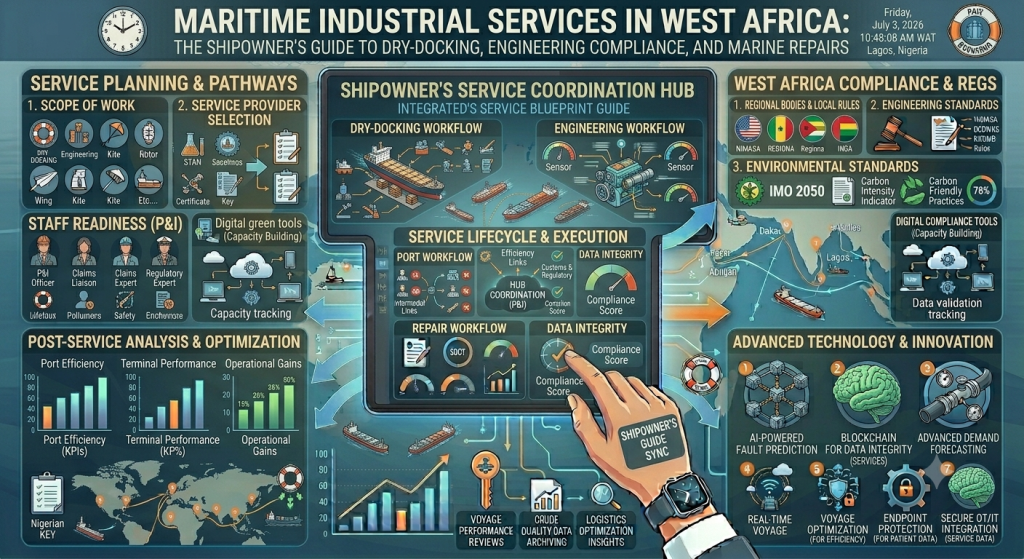
Operating commercial tonnage along the Atlantic coast of Africa—stretching from the Canary Islands down to the active oil and gas hubs of the Gulf of Guinea—presents deepwater operators with a demanding operational environment. While West Africa represents one of the world’s most critical midstream energy corridors, managing the maintenance, regulatory compliance, and emergency engineering needs of modern fleets requires a calculated approach.
For technical directors, marine superintendents, and shipowners, the primary challenge has never been finding general harbor support; it is sourcing high-spec maritime industrial services that strictly align with International Association of Classification Societies (IACS) standards. When a single day of off-hire downtime can cost an operator anywhere from $35,000 to over $100,000 in charter losses, executing repairs quickly and safely is a critical commercial requirement.
This guide provides a comprehensive operational blueprint for navigating the maritime industrial base in West Africa, detailing class-approved fabrication, engine overhauls, regulatory clearances, and the mathematics of dry-docking optimization.
+———————————————————————————+
| WEST AFRICAN MARITIME REPAIR MATRIX |
+———————————–+———————————————+
| IACS Class-Approved Engineering | On-Site Husbandry & Logistics |
| (Hull, Machinery, & Automation) | (Surveyor Liaison & Spares Clearance) |
| | |
| • Emergency steel insert renewals | • Direct coordination with DNV, LR, ABS, BV |
| • In-situ crankshaft line boring | • Fast-track custom clearance for parts |
| • Bilge alarm & OWS calibration | • Minimizing shipyard stay timelines |
+———————————–+———————————————+
Defining the Regional Maritime Industrial Base
The West African maritime industrial base has evolved significantly over the past decade. Historically, shipowners facing complex mechanical failures or scheduled intermediate surveys had to plan long ballast voyages back to European or South African yards. Today, regional hubs are developing the physical infrastructure to handle complex maintenance, yet severe regional constraints remain.
The Scale of the Regional Maritime Industry
The commercial maritime industry in West Africa is dominated by offshore support vessel (OSV) campaigns, regional product tankers, and international dry bulk vessels loading iron ore, bauxite, and agricultural commodities. The high density of offshore oil fields in the Gulf of Guinea has created a concentrated demand for specialized engineering. However, shipowners often struggle to find local engineering partners who maintain verified welding procedures (WPS), certified materials, and traceably calibrated testing tools.
Bridging the Infrastructure Gap
Without proactive oversight, sourcing high-spec marine repairs locally can expose shipowners to the risk of failed surveys, sub-standard steel fabrication, and ultimately, vessel detention by Port State Control (PSC).
Oitha Marine acts as the crucial link. We bridge the gap between local shipyard infrastructure and strict international classification requirements, ensuring that every weld, overhaul, and calibration matches the standards expected by global underwriters.
Comprehensive Maritime Industrial Services Breakdown
To demonstrate physical execution capacity to class surveyors, marine superintendents must ensure that local repair teams operate with audited procedures. Oitha Marine provides a specialized suite of maritime industrial services tailored to commercial cargo and offshore vessels.
+———————————————-+
| CORE INDUSTRIAL REPAIR SECTORS |
+———————————————-+
|
+——————————-+——————————-+
| |
v v
[STEEL & STRUCTURAL] [PROPULSION & AUTOMATION]
• IACS-grade steel plate renewal. • In-situ main engine overhauls.
• Non-Destructive Testing (NDT). • Alarm Monitoring System (AMS) calibration.
• Low-hydrogen electrode welding. • 15 ppm Oily Water Separator (OWS) audits.
1. Emergency Steel Fabrication & Welding
Hull stress and localized corrosion are common in warm, highly corrosive tropical waters. When renewing steel plates, there is no margin for error.
- Material Compliance: We source only IACS-certified steel grades (such as Grade A, AH32, or DH36) accompanied by mill test certificates (MTCs).
- Welding Quality: All structural welding is executed by certified 6G welders using low-hydrogen electrodes stored in portable holding ovens to prevent moisture contamination.
- Non-Destructive Testing (NDT): Upon completion, all critical butt welds undergo NDT inspections—including Ultrasonic Testing (UT), Magnetic Particle Inspection (MPI), or Dye Penetrant Inspection (DPI)—to secure class surveyor approval.
2. Mechanical & Engine Overhauls
Main propulsion and auxiliary power failures require rapid, expert intervention to prevent cargo delays. Our engineering teams perform complex in-situ repairs, including:
- Auxiliary Generator Overhauls: Executing complete cylinder head refurbishments, liner honing, piston crown renewals, and bearing clearance measurements.
- Propulsion System Alignment: Laser alignment checks of main propulsion shafts and intermediate shaft bearings to eliminate vibration issues.
- Turbocharger Servicing: Dynamically balancing rotor shafts, renewing nozzle rings, and executing chemical cleanings to restore engine efficiency.
3. Electrical & Automation Calibration
Modern commercial vessels rely on sophisticated electrical systems that must remain fully operational to pass safety inspections.
- Alarm Monitoring Systems (AMS): Troubleshooting and calibrating critical exhaust gas temperature sensors, main engine lube oil low-pressure alarms, and cooling water high-temperature shutdowns.
- Environmental Compliance: Servicing and calibrating bilge alarm monitors (15 ppm oily water separator systems) to ensure full compliance with MARPOL Annex I, preventing severe environmental fines.
- Switchboard Audits: Executing thermal imaging scans on main switchboards to identify loose connections or overloaded breakers before they cause catastrophic blackouts.
Classification Surveys and Regulatory Compliance
In the commercial shipping sector, technical repairs are meaningless without formal class approval. If a repair is executed without the proper documentation or surveyor oversight, the vessel’s safety construction and equipment certificates can be suspended, rendering the hull uncharterable and leading to port detention.
+————————————————————————-+
| THE CLASS SURVEY COORDINATION PATHWAY |
+——————-+—————————+————————-+
| Phase 1: Planning | Phase 2: Execution | Phase 3: Certification |
| Submit repair plan| Surveyor supervises and | Class surveyor issues |
| & WPS to surveyor | verifies NDT test results.| interim certificates. |
+——————-+—————————+————————-+
Coordinating with Major Classification Societies
Oitha Marine maintains direct working relationships with surveyors from all major classification societies, including:
- DNV (Det Norske Veritas)
- Lloyd’s Register (LR)
- Bureau Veritas (BV)
- American Bureau of Shipping (ABS)
We manage the entire survey lifecycle: drafting the initial repair specification, submitting welding procedure specifications (WPS) for approval, arranging on-site surveyor attendance, and delivering the complete quality package required to issue interim and final class certificates.
Avoiding Port State Control (PSC) Detentions
A failed PSC inspection can delay a vessel for weeks, costing shipowners thousands of dollars in off-hire losses and damaging their safety profile on international vetting databases. Understanding the regulatory landscape is essential to preventing these issues.
For an in-depth analysis of port state control jurisdictions, ship arrest defenses, and cabotage compliance, refer to our complete Law of Maritime in West Africa Guide.
Mathematical Optimization of Dry-Dock Downtime
Dry-docking is the single most expensive maintenance event in a vessel’s lifecycle. To minimize the overall cost of a repair campaign, technical managers must optimize shipyard timelines. We can model the total cost of a repair campaign ($TC_{repair}$) using the following formula:
$$TC_{repair} = \left( C_{daily} + C_{dock} \right) \cdot T_{repair} + \sum C_{parts} + C_{class}$$
Where:
- $TC_{repair}$ is the total financial cost of the industrial repair campaign.
- $C_{daily}$ represents the vessel’s daily off-hire charter loss (the opportunity cost of the ship not earning freight).
- $C_{dock}$ is the daily dry-docking fee or shipyard berth rate (including shore power, fire watch, and water charges).
- $T_{repair}$ is the total duration of the repair in days.
- $\sum C_{parts}$ represents the cumulative cost of technical spare parts, custom fabrication materials, and local labor.
- $C_{class}$ is the fee for classification society surveyor attendance and certification.
Case Study: Optimizing $T_{repair}$ Through Proactive Logistics
Consider a Medium Range (MR) product tanker executing an emergency rudder horn repair at a regional yard:
- Daily Off-Hire Loss ($C_{daily}$): $35,000 \text{ USD/day}$
- Yard Berth Rate ($C_{dock}$): $8,000 \text{ USD/day}$
- Spares & Labor ($\sum C_{parts}$): $120,000 \text{ USD}$
- Class Survey Fees ($C_{class}$): $15,000 \text{ USD}$
Scenario A: Unoptimized Campaign (Delayed Logistics & Surveyor Alignment)
The vessel owner handles logistics independently, resulting in delays waiting for spare parts to clear customs and coordinating surveyor schedules.
- Repair Duration ($T_{repair}$): $15 \text{ days}$
$$TC_{repair} = \left( 35,000 + 8,000 \right) \cdot 15 + 120,000 + 15,000$$$$TC_{repair} = \left( 43,000 \cdot 15 \right) + 135,000$$$$TC_{repair} = 645,000 + 135,000 = \mathbf{780,000 \text{ USD}}$$
Scenario B: Optimized Campaign (With Oitha Marine)
By utilizing Oitha Marine’s 24/7 technical desk, spare parts are pre-cleared through customs, and welding procedures are pre-approved by the class surveyor.
- Repair Duration ($T_{repair}$): $11 \text{ days}$ (a 27% reduction in drydock stay)
$$TC_{repair} = \left( 35,000 + 8,000 \right) \cdot 11 + 120,000 + 15,000$$$$TC_{repair} = \left( 43,000 \cdot 11 \right) + 135,000$$$$TC_{repair} = 473,000 + 135,000 = \mathbf{608,000 \text{ USD}}$$
The Financial Verdict
By reducing the shipyard stay ($T_{repair}$) by just 4 days, the shipowner saves $172,000 USD in cumulative off-hire losses and berth rates. This demonstrates why partnering with an experienced, proactive regional marine agent is essential to protecting your voyage margins.
Managing Emergency Repairs and Marine Liabilities
When structural damage occurs due to a collision, grounding, or mechanical failure, the priority is to stabilize the vessel and secure the necessary approvals to sail. However, these emergency situations often involve complex marine insurance claims.
+—————————————————————–+
| EMERGENCY REPAIR WORKFLOW |
+——————-+—————————+—————–+
| Phase 1: Incident | Phase 2: Claims Survey | Phase 3: Repair |
| Emergency hull or | P&I correspondent and H&M | Mobilize teams, |
| machinery failure | surveyor board the vessel.| execute repairs.|
+——————-+—————————+—————–+
Managing emergency repairs requires careful coordination between the shipowner, the Hull and Machinery (H&M) underwriter, and the Protection and Indemnity (P&I) Club to document the damage and secure the necessary letters of undertaking (LOUs) to prevent vessel arrests by third parties.
For a detailed operational blueprint on managing third-party liabilities, letters of undertaking, and local claims mitigation, refer to our comprehensive P&I Insurance Guide.
High-Compliance Marine Engineering with Oitha Marine
Minimizing off-hire downtime and maintaining class compliance requires more than just skilled labor—it requires an experienced partner on the ground to handle logistics, surveyor liaison, and regulatory approvals.
Oitha Marine provides comprehensive marine engineering, dry-docking coordination, and technical husbandry support across West Africa. We combine deep local operational expertise with a commitment to international safety standards, helping shipowners and charterers protect their assets and keep their fleets moving.
Our B2B Technical Capabilities
- 24/7 Technical Husbandry Desk: We manage port clearances, arrange shipyard berths, and coordinate class surveyor attendance to ensure smooth, delay-free operations.
- IACS-Compliant Fabrication: We supply certified steel plates and certified 6G welders to execute high-quality hull and structural repairs.
- Fast-Track Spares Logistics: Our team handles customs clearances and local transportation to deliver critical spare parts directly to your vessel, minimizing shipyard wait times.
- In-Situ Mechanical Repairs: We provide experienced marine engineers to perform on-board engine overhauls, turbocharger servicing, and automation calibrations.
Streamline your repair campaigns, avoid port delays, and protect your bottom line. Partner with Oitha Marine to secure your shipping operations in West Africa.
Frequently Asked Questions (FAQ)
Q: What classification societies does Oitha Marine coordinate with?
A: We work directly with surveyors from all major IACS-member classification societies, including DNV, Lloyd’s Register (LR), Bureau Veritas (BV), and the American Bureau of Shipping (ABS), to secure approvals for all structural and mechanical repairs.
Q: How does Oitha Marine help reduce total dry-docking costs?
A: We use a mathematical cost model to identify and eliminate downtime bottlenecks. By pre-clearing spare parts through customs and pre-arranging class surveyor schedules, we reduce the vessel’s shipyard stay ($T_{repair}$), saving shipowners thousands of dollars in cumulative off-hire losses and berth rates.
Q: Can Oitha Marine handle emergency structural repairs outside of scheduled dry-dockings?
A: Yes. Our teams are equipped to perform emergency afloat repairs at anchorage or during cargo operations, including certified steel plate renewals, mechanical overhauls, and electrical troubleshooting, allowing your vessel to remain on hire.
Q: What quality controls are used for steel welding repairs?
A: All structural welding is executed by certified 6G welders using low-hydrogen electrodes stored in controlled holding ovens. Once complete, all critical welds undergo Non-Destructive Testing (NDT)—including Ultrasonic Testing (UT) or Magnetic Particle Inspection (MPI)—to secure class surveyor approval.
Q: Does Oitha Marine assist with MARPOL and environmental compliance?
A: Yes. We calibrate bilge alarm systems (15 ppm oily water separators) and troubleshoot critical alarm monitoring systems to ensure full compliance with international MARPOL regulations, helping you prevent expensive environmental fines and PSC detentions.
Secure Your Fleet’s Technical Compliance with Oitha Marine Minimize your dry-dock downtime, secure class approvals, and protect your voyage margins. Contact Oitha Marine’s 24/7 commercial operations desk at oithamarine.com or visit our corporate office at 1, Funmi Okere Str, Maryland Estate, Lagos, Nigeria to discuss your customized marine logistics and repair requirements.
Recent Comments