
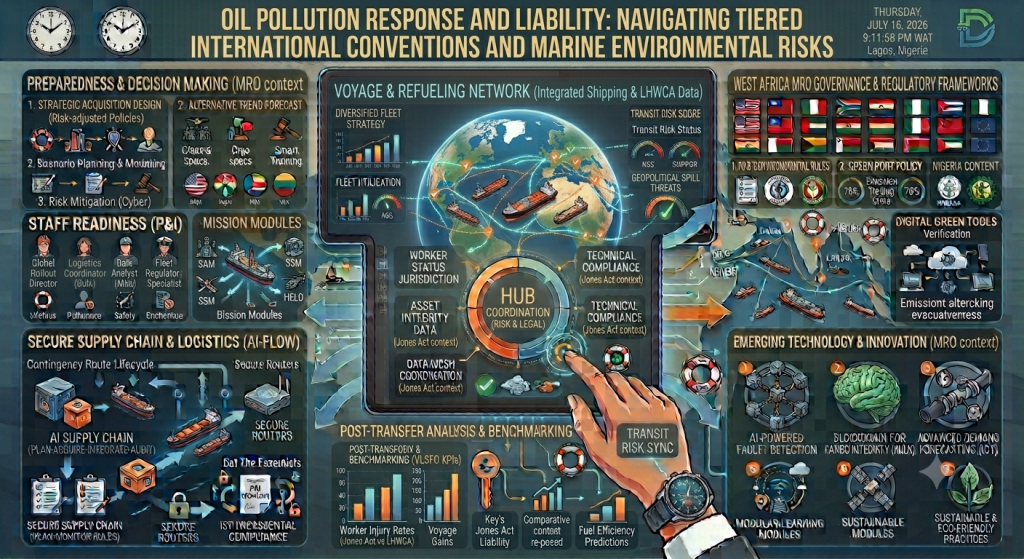
For shipowners, offshore infrastructure operators, and commercial vessel charterers, managing environmental risk is a primary pillar of modern corporate governance. In an era marked by heightened international regulatory scrutiny, an oil spill incident is no longer just an operational emergency—it is a significant threat to financial stability and corporate survival.
The legal frameworks governing marine environmental disasters operate on a strict liability baseline. This means that when persistent hydrocarbon oil escapes or is discharged from a vessel, the shipowner is held liable automatically, regardless of fault or negligence.
A single major spill can trigger multi-million dollar environmental cleanup obligations, heavy economic loss claims from coastal industries, and steep fines from port state authorities.
For maritime executives, including those managing logistics and bunkering services across major continental trade routes, understanding the international convention tiers, mandatory shipboard preparedness rules, and liability limitations is essential for securing appropriate protection and indemnity (P&I) insurance coverage and protecting the enterprise balance sheet.
Statutory Architecture: The Three-Tiered Global Compensation Framework
When a maritime spill occurs in international or territorial waters, financial recovery and liability allocation are managed through an integrated, multi-layered international convention network.
[ The Global Oil Pollution Compensation Pillars ]
│
┌──────────────────────────────────────────────┼──────────────────────────────────────────────┐
▼ ▼ ▼
[ Tier 1: 1992 CLC ] [ Tier 2: 1992 Fund ] [ Tier 3: Supplementary Fund ]
• Cover: Shipowner’s Insurance • Cover: Global Cargo Receivers • Cover: Optional Third Layer
• Basis: Strict Liability • Basis: Exceeded CLC Limits • Basis: Catastrophic Disasters
• Cap: Up to 89.77M SDR • Cap: Up to 203M SDR Combined • Cap: Up to 750M SDR Aggregate
Tier 1: The 1992 Civil Liability Convention (CLC)
The 1992 CLC places the primary financial responsibility for oil pollution damage directly on the registered shipowner.
- The Insurance Obligation: Under Article VII of the CLC, any vessel carrying more than 2,000 tonnes of persistent oil in bulk as cargo must maintain compulsory liability insurance or financial security. This coverage is validated by a State-issued Blue Card and an onboard Certificate of Insurance.
- Limitation Caps: Except in cases of intentional or reckless corporate misconduct, shipowners are entitled to limit their financial liability based on the gross tonnage of the vessel:
- For vessels up to 5,000 gross tonnes: Liability is capped at 4.51 million Special Drawing Rights (SDR) (approximately $6.12 million USD).
- For vessels between 5,000 and 140,000 gross tonnes: 4.51 million SDR plus 631 SDR for each additional unit of tonnage.
- For vessels exceeding 140,000 gross tonnes: The absolute liability ceiling is capped at 89.77 million SDR (approximately $121.7 million USD).
Tier 2: The 1992 International Oil Pollution Compensation Fund (1992 Fund)
When the total cost of pollution damage exceeds the shipowner’s maximum liability limit under the CLC, or if the shipowner is financially insolvent, the 1992 Fund provides a critical secondary layer of compensation.
- Funding Mechanism: The Fund is financed by levies on corporate entities that receive more than 150,000 tonnes of contributing oil per year via seaborne transport.
- Extended Coverage Cap: The maximum compensation payable by the 1992 Fund is 203 million SDR (approximately $275.3 million USD), which includes the amount paid under the Tier 1 CLC layer.
Tier 3: The Supplementary Fund Protocol
For catastrophic oil spills, the Supplementary Fund Protocol offers a third, optional tier of protection. Available to states that choose to participate, it boosts the total available compensation pool to an aggregate of 750 million SDR (approximately $1.017 billion USD). This ensures that even the largest environmental disasters can be funded without bankrupting localized marine economies.
Operational Readiness: The OPRC Convention and SOPEP Mandates
Corporate liability protection requires robust, pre-incident emergency response planning. Under the International Convention on Oil Pollution Preparedness, Response and Co-operation (OPRC), commercial vessels and offshore installations must maintain clear, actionable spill response frameworks.
[ Shipboard Oil Pollution Emergency Plan (SOPEP) ]
│
┌───────────────────────────────────┼───────────────────────────────────┐
▼ ▼ ▼
[ Incident Reporting ] [ Coastal Notifications ] [ Mitigation Steps ]
• Mandatory immediate radio/telex • Contact nearest coastal state • Emergency fuel transfers
• Logs exact time & coordinates • Alert local port authorities • Immediate tank ullage checks
• Classifies oil type & volume • Coordinate with response teams • Deployment of sorbent booms
The Core Elements of a Standard SOPEP
Every ocean-going oil tanker of 150 gross tonnage and above, and every conventional cargo vessel of 400 gross tonnage and above, must carry an approved Shipboard Oil Pollution Emergency Plan (SOPEP). This operational document details exactly how the crew will react to a spill:
- Standardized Reporting Formats: The plan provides strict, step-by-step reporting protocols to ensure that state coastal authorities are notified immediately following an actual or probable discharge of oil.
- Coastal State Coordination Interfaces: SOPEP lists the exact contact details for port state authorities, emergency response teams, and marine cleanup agencies along the vessel’s trading routes.
- Operational Mitigation Procedures: The manual provides clear technical checklists for the crew to reduce onboard oil loss during an emergency, such as running emergency ballast transfers, checking tank ullages, and deploying onboard containment booms and sorbent kits.
Defining Recoverable Damages: What Can Claimants Collect?
Under international conventions, the definition of “pollution damage” is carefully constructed to ensure fair restitution while preventing speculative or punitive claims.
[ Recoverable Oil Spill Damage Sectors ]
│
┌─────────────────────────────────┼─────────────────────────────────┐
▼ ▼ ▼
[ Response & Cleanup ] [ Economic Loss Claims ] [ Environmental Reinstatement ]
• Deployment of offshore booms • Lost profits for fisheries • Costs for active replanting
• Mechanical skimming vessels • Cancelled coastal tourism bookings • Long-term monitoring surveys
• Disposal of oily waste materials• Shoreline business washdowns • Reasonable reinstatement metrics
A. Preventative Measures and Active Response Costs
Any reasonable costs incurred by public authorities or private salvage companies to prevent or minimize a spill are fully recoverable. This category includes deploying offshore containment booms, operating specialized mechanical skimming vessels, applying approved chemical dispersants, and handling and disposing of recovered oily waste material.
B. Property Damage and Shoreline Contamination
Claimants can recover the actual cost of cleaning, repairing, or replacing physical property that comes into contact with spilled oil. This includes restoring fouled fishing gear, washing down oiled boat hulls, and repairing contaminated beachfront docks, cooling water intakes, or port seawalls.
C. Pure Economic Loss and Environmental Reinstatement
- Economic Losses: Businesses can claim for lost income directly caused by oil contamination. For instance, a commercial fishery forced to suspend harvesting due to a closing of waters, or a coastal resort experiencing documented booking cancellations, can claim for net lost profits.
- Environmental Reinstatement: The 1992 Conventions explicitly limit environmental damage compensation to the costs of reasonable measures of reinstatement actually undertaken or planned. Claimants cannot pursue abstract, calculated damages for environmental harm based on theoretical models. Instead, recovery is strictly limited to the actual cost of physical efforts to restore the area, such as replanting mangrove zones or funding long-term marine monitoring studies.
B2B Technical FAQ: Marine Pollution and Risk Management
Q1: Does the 1992 Civil Liability Convention (CLC) cover bunker fuel spills from non-tankers?
No. The 1992 CLC applies exclusively to sea-going vessels constructed or adapted to carry oil in bulk as cargo (essentially laden or unladen tankers). Fuel oil spills from standard dry bulk carriers, container ships, or general cargo vessels are governed instead by the International Convention on Civil Liability for Bunker Oil Pollution Damage (Bunker Convention), which features different liability limits and distribution rules.
Q2: Can a shipowner lose their right to limit liability under the CLC?
Yes. Under Article V(2) of the 1992 CLC, a shipowner is stripped of their right to limit liability if it is legally proven that the pollution damage resulted from their personal act or omission, committed with the intent to cause damage, or recklessly and with knowledge that such damage would probably result. In these rare scenarios, corporate asset protection limits are dissolved, exposing the owner to the full financial weight of the claims.
Q3: Are offshore oil drilling platforms covered under the CLC and Fund conventions?
No. The CLC and Fund systems apply strictly to ship-source pollution from transport vessels. Pollution incidents originating from fixed or floating offshore drilling rigs, subsea wellheads, or floating production storage and offloading units (FPSOs) are governed by local national laws, regional agreements, or private industry liability frameworks like the Offshore Pollution Liability Agreement (OPOL).
Q4: What is the statute of limitations for filing a pollution claim under the 1992 Conventions?
Rights to compensation under the CLC and Fund systems expire unless a formal legal action is brought within three (3) years from the date the pollution damage occurred. Additionally, no action can be brought more than six (6) years from the date of the original maritime incident that caused the spill.
Q5: How do “Channelling of Liability” rules protect third-party marine contractors?
To simplify litigation, the 1992 CLC explicitly “channels” all pollution liability directly to the registered shipowner. This rule strictly bars claimants from filing direct pollution lawsuits against the vessel’s crew, charterers, managers, or independent salvage contractors performing response operations, unless the damage resulted from personal, reckless misconduct by those parties.
5. Strategic Ad Placement Opportunities for Maritime Environmental Platforms
This detailed, convention-focused guide provides an excellent environment for targeted B2B ad units:
- P&I and Marine Insurance Placements: The analysis of strict liability, Blue Cards, and limitation caps provides highly relevant placements for Protection & Indemnity Clubs, international marine insurance brokers, and financial risk underwriters.
- Technical Compliance and Equipment Ads: The technical review of SOPEP checklists, oil-containment booms, and emergency response planning creates effective opportunities to showcase ads from marine environmental salvage contractors, oil spill response equipment manufacturers, and maritime classification societies.
Secure Fleet Compliance and Marine Risk Advisory with Oitha Marine
Navigating complex environmental conventions, managing marine pollution risks, and sourcing compliant tonnage across changing global trade lanes requires an experienced maritime partner. At Oitha Marine, we support shipowners, offshore operators, and corporate charterers with expert vessel sourcing, regulatory compliance reviews, and comprehensive marine logistics coordination.
Protect your marine logistics and fleet strategies from regulatory and environmental risks. Contact our technical advisory team today at oithamarine.com or visit Oitha Marine Technical Insights to schedule a professional operational risk assessment.
Recent Comments