
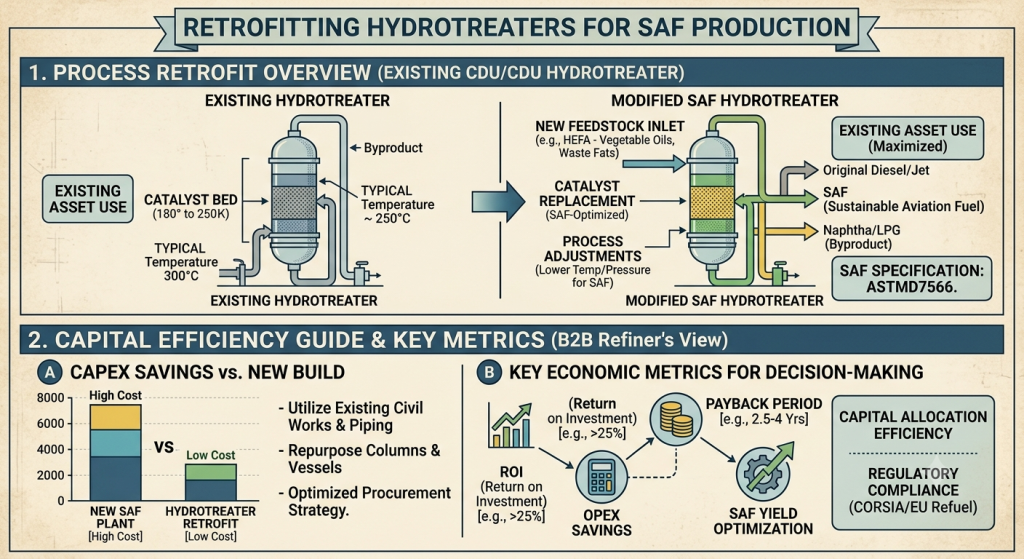
The global refining sector faces a structural shift toward low-carbon fuels. Mandatory blending frameworks—such as the US EPA Renewable Fuel Standard (RFS) with its associated Renewable Identification Number (RIN) architecture, California’s Low Carbon Fuel Standard (LCFS), EU RED III mandates, and the UAE Net Zero 2050 strategy—have transformed Sustainable Aviation Fuel (SAF) from an niche product into an operational imperative.
Building grassroot Hydroprocessed Esters and Fatty Acids (HEFA) 100% renewable facilities carries severe capital burdens, with CAPEX often exceeding $800M to $1.2B and construction lead times extending past 36 months. Consequently, downstream operators across North America, Europe, and the Middle East are prioritizing asset repurposing—specifically executing a refinery hydrotreater revamp to enable SAF co-processing technology.
┌──────────────────────────────────────────────────────────────────────────────────────────────────────┐
│ MARITIME & OFFSHORE BIO-FEEDSTOCK LOGISTICS (OITHA MARINE) │
│ (Tallow, Used Cooking Oil [UCO], Degummed Soybean Oil, & Hydrotreated Esters Quality Control) │
└───────────────────────────────────────────────────┬──────────────────────────────────────────────────┘
│
▼ (OPC UA / Dynamic API Ingestion)
┌──────────────────────────────────────────────────────────────────────────────────────────────────────┐
│ HYDROTREATER REVAMP CLOSED-LOOP AUTOMATION STACK │
│ (Honeywell Experion / Emerson DeltaV / Schneider EcoStruxure DCS) │
└───────────────────────────────────────────────────┬──────────────────────────────────────────────────┘
│
▼
┌──────────────────────────────────────────────────────────────────────────────────────────────────────┐
│ REAL-TIME HYDROGEN BALANCE & THERMAL DEACTIVATION OPTIMIZATION ENGINE │
│ (Multivariable Predictive Control [MPC] & Rigorous Non-Linear RTO) │
└───────────────────────────────┬──────────────────────────────────┬───────────────────────────────────┘
│ │
▼ ▼
┌──────────────────────────────────────────────────┐ ┌────────────────────────────────────────────────┐
│ ISOMERIZATION & SELECTIVE DEWAXING MATRIX │ │ METALLURGICAL & HIGH-TEMP CORROSION CONTROL │
│ • ASTM D1655 / D7566 Freeze Point Compliance │ │ • Organic Acid Corrosion (Naphthenic/FFA) │
│ • Yield Retention via Isomerization Catalysts │ │ • High-Pressure CO2 / H2S Water Wash Systems │
└──────────────────────────────────────────────────┘ └────────────────────────────────────────────────┘
Co-processing lipidic feedstocks (such as Used Cooking Oil [UCO], tallow, or degummed soybean oil) at 5 vol% to 15 vol% rates within existing distillate or kerosene hydrotreaters delivers a rapid, capital-efficient pathway to SAF market entry. However, introducing oxygenated bio-derived lipids into hydrotreaters designed strictly for fossil hydrocarbons introduces complex chemical engineering and metallurgical challenges:
- Exothermic Hydrodeoxygenation (HDO) Reactions: Yielding massive local temperature spikes across reactor beds.
- Hydrogen Consumption Surges: Incurring high operational costs.
- Severe Cold Flow Degradation: Caused by high linear paraffin generation (
and
).
DigitalRefining
- Accelerated Metallurgy Corrosion: Caused by Free Fatty Acids (FFAs) and carbonic acid (
).
To execute a successful refinery hydrotreater revamp, refiners must pair advanced catalyst metallurgy with closed-loop process control automation. Crucially, managing this transition requires tight synchronization across the midstream-to-downstream marine supply chain. By partnering with offshore logistics orchestrators like Oitha Marine, refining operators can stream real-time lipid feedstock quality metrics (such as FFA content, metals concentration, moisture, and total acid number [TAN]) directly from marine tanker manifolds into plant automation systems.
Connecting Oitha Marine’s offshore custody transfer telemetry with plant-wide closed-loop control enables refiners to dynamically adjust hydrotreater quench gas injection and catalyst bed operating parameters prior to bio-feedstock injection, protecting process integrity and maximizing biogenic carbon yield.
Technical Deep-Dive: Engineering & System Architecture
Converting or co-processing bio-feedstocks within a conventional kerosene or diesel hydrotreating unit requires addressing fundamental shifts in reaction kinetics, thermodynamics, and fluid dynamics.
┌─────────────────────────────────────────────────────────────────────────────────────────────────┐
│ HYDROTREATER CO-PROCESSING & CLOSED-LOOP CONTROL ARCHITECTURE │
└─────────────────────────────────────────────────────────────────────────────────────────────────┘
[Bio-Feed Logistics Layer] [Analyzer & Sensor Layer] [Control & Optimization Layer]
┌──────────────────────┐ ┌─────────────────────────┐ ┌─────────────────────────────────┐
│ Oitha Marine Tanker │───────►│ Near-Infrared (NIR) / │──────►│ Real-Time Optimizer (RTO) │
│ FFA & TAN Telemetry │ │ Moisture & TAN Profiler │ │ Kinetic HDO & Yield Models │
└──────────────────────┘ └─────────────────────────┘ └─────────────────────────────────┘
┌──────────────────────┐ ┌─────────────────────────┐ │
│ High-Pressure Feed │───────►│ Multipoint Thermocouple │ ▼
│ Charge Pumps │ │ Arrays Across Catalyst │ ┌─────────────────────────────────┐
└──────────────────────┘ └─────────────────────────┘──────►│ Multivariable Predictive Control│
┌──────────────────────┐ ┌─────────────────────────┐ │ (MPC) Quench & Ratio Engine │
│ High-Pressure Wash │───────►│ Dissolved CO2 / H2S │ └─────────────────────────────────┘
│ Water Injection System│ │ Corrosion Rate Probes │ │
└──────────────────────┘ └─────────────────────────┘ ▼
┌─────────────────────────────────┐
│ Closed-Loop DCS Setpoints │
│ (Gas Quench & Recycle Valves) │
└─────────────────────────────────┘
When triglycerides and FFAs enter a hydrotreating reactor operating at to
and 40 to 80 bar
partial pressure, they undergo three main simultaneous reactions:
- Hydrodeoxygenation (HDO):
(Consumes
per mole FFA; highly exothermic).
- Decarboxylation (
):
(Generates
, which reacts with
via methanation, further consuming hydrogen).
- Decarbonylation (
):
(Generates
, a potent catalyst poison for conventional hydrodesulfurization catalysts).
These reactions generate straight-chain -paraffins (predominantly
,
,
, and
). While these molecules offer high cetane numbers for diesel, their high melting points severely impair freeze point performance, preventing compliance with ASTM D1655 / D7566 SAF specifications (which mandate a jet fuel freeze point below
).
To address this challenge without sacrificing biogenic carbon yield, the revamp configuration utilizes a multi-bed catalyst architecture paired with specialized renewable diesel catalyst systems:
[Bio-Feedstock + Fossil Kerosene / Diesel]
│
▼
┌──────────────────────────────────────────────────────────────────────────────────┐
│ BED 1: Dense Grading & Metal Trap Layer │
│ • Captures Na, K, Ca, P, and Fe Contaminants to Prevent Bed Plugging │
└─────────────────────────────────────────┬────────────────────────────────────────┘
│
▼
┌──────────────────────────────────────────────────────────────────────────────────┐
│ BED 2: Hydrodeoxygenation (HDO) & Hydrodesulfurization (HDS) Layer │
│ • Highly Active NiMo / CoMo Catalyst on Alumina Matrix │
│ • Saturated Triglycerides Cleaved into n-Paraffins │
└─────────────────────────────────────────┬────────────────────────────────────────┘
│ ◄── [Cold Recycle Hydrogen Quench Line]
▼
┌──────────────────────────────────────────────────────────────────────────────────┐
│ BED 3: Selective Hydroisomerization & Dewaxing Layer │
│ • High-Selectivity Bifunctional Zeolite/Noble Metal Catalyst (e.g., Topsoe TK) │
│ • Converts n-Paraffins to Iso-Paraffins to meet ASTM Freeze Point (-47°C) │
└─────────────────────────────────────────┬────────────────────────────────────────┘
│
▼
[SAF & Renewable Diesel Product]
High-Value Process Use Cases
1. Managing Hydrogen Consumption & Exothermic Runaway in Co-Processing
Co-processing bio-feedstocks consumes roughly 40 to 50 (18–24
) of hydrogen per 1% of bio-feed added, while releasing
(
) of extra heat per percentage of bio-blend. At a 10% bio-feed rate, reactor temperature can rise by over
across a single bed, causing accelerated catalyst coking and thermal runaway risks.
The control architecture deploys high-density multipoint thermocouples linked to an adaptive Multivariable Predictive Control (MPC) system. The MPC controller monitors bed temperature profiles and dynamically throttles cold recycle hydrogen quench valves between reactor beds. Simultaneously, it adjusts the fresh make-up hydrogen compressor throughput to maintain constant hydrogen partial pressure across the HDO zones, stabilizing the reaction front.
Feedstock Telemetry Ingestion Predictive Reaction Engine Closed-Loop Directives
┌───────────────────────────────┐ ┌──────────────────────────────┐ ┌────────────────────────────┐
│ • Bio-Feed Rate & Lipid TAN │ │ • Exotherm Calculation Engine│ │ • Dynamic Quench Valve │
│ • Multipoint Bed Thermocouples│ ─────────►│ • Real-time H2 Partial │ ───────────► │ Positioning │
│ • Make-up H2 Pressure Sensors │ │ Pressure Modeling │ │ • Make-up H2 Comp. Speed │
└───────────────────────────────┘ └──────────────────────────────┘ └────────────────────────────┘
2. Mitigating Jet Fuel Freeze Point Degradation via Selective Isomerization
Straight-chain paraffins generated during HDO degrade jet fuel cold flow properties. Conventional hydrocracking can reduce molecular weight into the jet range (), but causes biogenic carbon loss into low-value fuel gas (
) and naphtha fractions.
Sustainable Aviation Futures
The revamped catalyst bed integrates a selective hydroisomerization layer (e.g., Topsoe TK-930 D-wax™ or Honeywell UOP Enfining™). The closed-loop process controller utilizes inferential freeze-point estimators updated by online NIR product analyzers. The controller fine-tunes the weighted average bed temperature (WABT) of the isomerization bed to selectively convert -paraffins into branched
-paraffins. This holds the product freeze point precisely at
(providing a
safety margin under ASTM D1655) while preserving maximum biogenic mass yield within the jet fuel cut.
Process Inferential Signals Inferential Model Engine Yield Slate Impact
┌───────────────────────────────┐ ┌──────────────────────────────┐ ┌────────────────────────────┐
│ • Isomerization Bed WABT │ │ • Iso-to-Normal Paraffin │ │ • Freeze Point Maintained │
│ • Online Jet Cut Viscometer │ ─────────►│ Ratio Modeling │ ───────────► │ Below -47°C │
│ • Product Freeze Point Analyzer│ │ • Carbon Yield Optimizer │ │ • Zero Carbon Yield Loss │
└───────────────────────────────┘ └──────────────────────────────┘ └────────────────────────────┘
3. Preventing High-Temperature Carbonic Acid Corrosion & Ammonium Carbonate Salt Deposition
Decarboxylation of lipid feeds releases carbon dioxide () and water (
). In reactor effluent air coolers (REACs) and high-pressure separators, condensed water absorbs
and
, forming carbonic acid (
) and ammonium bisulfide (
), which cause severe aqueous corrosion and ammonium carbonate salt fouling.
The automation system monitors and
concentrations in the recycle gas loop via inline gas chromatographs. The DCS automatically adjusts wash water injection pumps upstream of the REAC to maintain water wash rates above stoichiometric requirements, keeping dissolved salt concentrations below 2 wt%. Simultaneously, the control system calculates carbonic acid dew points and regulates REAC variable-pitch fan blades to keep wall temperatures safely above the dew point threshold.
Gas & Corrosion Telemetry Aqueous Phase Model Engine Unit Protection Execution
┌───────────────────────────────┐ ┌──────────────────────────────┐ ┌────────────────────────────┐
│ • Online Recycle Gas GC │ │ • Carbonic Acid Dew Point │ │ • Closed-Loop Water Wash │
│ • REAC Tube Wall Temperatures │ ─────────►│ Calculation │ ───────────► │ Pump Control │
│ • Dissolved Salt Conductivity │ │ • Salt Saturation Estimator │ │ • REAC Fan Blade Pitch Adj.│
└───────────────────────────────┘ └──────────────────────────────┘ └────────────────────────────┘
Financial Impact & ROI for Refinery Operators
Executing a refinery hydrotreater revamp for 10 vol% SAF co-processing represents a capital-efficient approach to low-carbon fuel compliance. Consider a benchmark 200,000 bpd refinery with an existing 30,000 bpd middle distillate hydrotreater executing a co-processing revamp:

At a 3,000 bpd renewable intake rate, the facility generates approximately 45,990,000 gallons of SAF/renewable diesel per year. Under North American regulatory frameworks, every gallon of SAF eligible for LCFS credits and D4/D6 RINs commands a significant regulatory premium over conventional fossil jet fuel.
┌──────────────────────────────────────────────────────────────────────────────────────────────────┐
│ ANNUAL FINANCIAL IMPACT & ROI SUMMARY │
└──────────────────────────────────────────────────────────────────────────────────────────────────┘
Gross LCFS & D4 RIN Credit Generation (45.99M gal/yr @ $1.65/gal avg) : $75,883,500
Fossil Jet/Diesel Margin Baseline ($12.00/bbl on bio-portion) : +$13,140,000
Pre-Treatment & Bio-Feed Premium Costs (Tallow/UCO vs. Crude) : ($41,390,000)
Incremental Hydrogen & Catalyst Opex : ($6,200,000)
──────────────────────────────────────────────────────────────────────────────────────────────────
NET ANNUAL GROSS MARGIN EXPANSION : $41,433,500 / Year
CAPEX Investment (Revamp Engineering, Metallurgy, Catalyst Load) : ($28,500,000)
──────────────────────────────────────────────────────────────────────────────────────────────────
Capital Expenditure & Catalyst Replacement Cost Comparison
The primary operational expenditure in renewable co-processing is the renewable diesel catalyst cost and guard bed replacement frequency. Lipid feeds contain trace metals (P, Na, K, Ca, Fe) that poison active hydrotreating sites. Advanced grading and demetallization catalyst layers represent an upfront catalyst load investment of $2.5M to $4.5M per cycle, but protect the $12M to $18M main active bed, extending cycle lengths from 12 to 24 months.
SAF Production Pathway Maturity Matrix
| Performance Metric | Grassroot HEFA Unit (100% Bio) | Unoptimized Co-Processing (No Revamp) | Revamped Hydrotreater + Closed-Loop RTO |
| Capital Expenditure (CAPEX) | $800M – $1.2B | $1.5M – $3.0M (Basic Spool Shifts) | $20M – $35M Total Revamp |
| Execution Timeline | 36 – 48 Months | 2 – 4 Months | 6 – 10 Months (Turnaround Aligned) |
| Max Bio-Feed Capacity | 100 vol% | 2 vol% – 5 vol% Limit | 10 vol% – 20 vol% Bio-Feed |
| ASTM D1655 Freeze Point | Fully Compliant ( | High Risk of Off-Spec Drops | Guaranteed via Selective Dewaxing |
| Unit Corrosion Risk | Stainless/Inconel (Built-in) | Severe Carbonic Acid/Salt Risk | Mitigated via Water Wash & Metallurgy |
| Simple Payback Period | 4.5 – 7.0 Years | Immediate (Low Volume) | 6 to 10 Months Payback |
Implementation Roadmap & System Integration
Phase 1: Logistics & Metallurgy Audit Phase 2: Reactor Revamp & Catalyst Phase 3: Closed-Loop Automation
┌──────────────────────────────────────┐ ┌───────────────────────────────────┐ ┌─────────────────────────────────┐
│ • Bio-Feed Ingestion (Oitha Marine) │ │ • High-Grade Guard Bed Loading │ │ • Adaptive MPC Matrix Tuning │
│ • REAC Corrosion & Metallurgy Audit │ ─►│ • Isomerization Catalyst Install │ ─►│ • IEC 62443 Cyber Audits │
│ • Water Wash Pump Capacity Expansion │ │ • Cold Hydrogen Quench Upgrades │ │ • SAP Energy / Maximo EAM Links │
└──────────────────────────────────────┘ └───────────────────────────────────┘ └─────────────────────────────────┘
Executing a refinery hydrotreater revamp for SAF production requires a synchronized engineering roadmap spanning feed logistics, unit hardware modifications, enterprise software integration, and OT cybersecurity.
┌─────────────────────────────────────────────────────────────────────────────────────────────────┐
│ ENTERPRISE SYSTEM INTEGRATION FLOW │
└─────────────────────────────────────────────────────────────────────────────────────────────────┘
[Oitha Marine Bio-Feed Tanker Logistics & Off-shore Assays] ──► [Refinery Edge Ingestion Hub]
│
▼
┌──────────────────────────────────┐
│ Distributed Control System (DCS) │
│ (Honeywell Experion / DeltaV) │
└─────────────────┬────────────────┘
│
▼
┌──────────────────────────────────┐
│ Closed-Loop RTO & MPC Engine │
│ (AspenTech / Topsoe / UOP) │
└─────────────────┬────────────────┘
│
┌───────────────────────────────────────────────┴───────────────────────────────────────────────┐
│ │
▼ (Real-time Bio-Yield & LCFS Credit Tracking) ▼ (Preventive Maintenance Work Orders)
┌──────────────────────────────────────────────┐ ┌──────────────────────────────────────────────┐
│ ENTERPRISE RESOURCE PLANNING (ERP) │ │ ENTERPRISE ASSET MANAGEMENT (EAM) │
│ (SAP Energy / Oracle Energy / PDI) │ │ (SAP PM / IBM Maximo / GE Vernova) │
└──────────────────────────────────────────────┘ └──────────────────────────────────────────────┘
1. Interoperability & Enterprise Software Integration
Co-processing bio-feedstocks requires real-time tracking of biogenic carbon mass balances to qualify for regulatory carbon credits. The process control system integrates via OPC UA and MQTT protocols with enterprise platforms such as SAP Energy (SAP PM/MM) and IBM Maximo.
Real-time feed composition and flow metrics from Oitha Marine’s offshore discharge manifolds pass directly into the plant’s Mass Balance & LCFS Credit Calculation engine. The software continuously calculates the exact biogenic carbon fraction exiting the fractionation column, generating verified audit trails required for EPA RFS RIN generation and EU RED III mass-balance compliance. Furthermore, if high TAN levels in incoming bio-feed are detected by marine telemetry, the system updates SAP PM to automatically schedule corrosion probe inspections across the REAC circuit.
2. Operational Technology (OT) Cybersecurity & Compliance
Connecting bio-feed supply chain telemetry and advanced optimization stacks to plant control networks requires strict compliance with IEC 62443 OT cybersecurity standards.
ENTERPRISE IT NETWORK
┌───────────────────────┐
│ SAP PM / IBM Maximo │
└───────────▲───────────┘
│
══════════════════════════════════════════════╪══════════════════════════════════════════════ Demilitarized Zone (DMZ)
│
┌───────────┴───────────┐
│ Secure DMZ Proxy Hub │
│ (IEC 62443 Compliant)│
└───────────▲───────────┘
│
══════════════════════════════════════════════╪══════════════════════════════════════════════ OT / IT Boundary Firewall
│
INDUSTRIAL OT NETWORK
┌───────────┴───────────┐
│ Edge Automation Hub │
└───────────▲───────────┘
│
┌───────────┴───────────┐
│ DCS / SIS Controllers │
└───────────────────────┘
The system architecture utilizes the Purdue Model for control network segmentation:
- Level 0–2 (Field & Control): Critical hydrotreater pressure relief valves, trip interlocks, and Safety Instrumented Systems (SIS) reside on isolated subnets.
- Level 3 (Operations Management): RTO kinetic models and MPC controllers run within a secured OT domain.
- Level 3.5 (Industrial DMZ): Firewalls and secure proxy servers inspect incoming Oitha Marine marine logistics data and NIR analyzer streams before crossing into Level 3.
All external communications use encrypted TLS 1.3 pipelines. Closed-loop setpoint overrides generated by the optimization engine cannot bypass SIL-3 emergency depressurization systems (EDP). If an unexpected exotherm occurs during bio-feed processing, local safety hardware overrides RTO targets instantly, tripping safety valves to isolate the bio-feed line and flood reactor beds with cold nitrogen/hydrogen quench.
3. Change Management & Operational Readiness
Operating a co-processing hydrotreater requires shift personnel to adapt to dynamic exotherms and bio-feed variability:
- High-Fidelity OTS Training: Training operators on Operator Training Simulators (OTS) that model hydrodeoxygenation exotherms, hydrogen consumption spikes, and water wash system failures.
- Unified Control Room Dashboards: Displaying active HDO temperature profiles, catalyst bed pressure drops (
), and biogenic carbon recovery metrics directly on DCS consoles.
- Cross-Departmental Bio-Fuel Taskforces: Establishing daily alignment protocols between crude/bio-feed procurement, process engineers, marine logistics teams, and compliance managers.
Frequently Asked Questions
What is the maximum bio-feedstock co-processing limit in an existing hydrotreater without major vessel modifications?
Most conventional diesel or kerosene hydrotreaters can handle 5 vol% to 10 vol% bio-feed co-processing with minor modifications (such as installing high-capacity demetallization guard beds and upgrading REAC water wash metallurgy). Exceeding 10 vol% to 15 vol% typically requires larger make-up hydrogen compressors, upgraded metallurgy (316L SS or duplex alloys to resist carbonic acid), and expanded liquid recycle loops to moderate bed exotherms.
www.topsoe.com
How does renewable diesel catalyst cost compare to conventional hydrotreating catalysts?
The renewable diesel catalyst cost is typically 30% to 60% higher per unit volume than standard hydrodesulfurization (HDS) catalysts. This premium stems from the inclusion of specialized noble metal/zeolite hydroisomerization components and high-capacity demetallization grading layers designed to trap phosphorus, sodium, and calcium. However, because the guard bed protects the active bed, overall catalyst cost per barrel produced remains highly favorable when factored against generated carbon credit revenues.
www.topsoe.com
Why is hydroisomerization required when co-processing bio-feedstocks for SAF production?
Hydrodeoxygenation of bio-lipids generates long-chain straight -paraffins (
through
). These straight-chain molecules have high freezing points. Without hydroisomerization to convert
-paraffins into branched
-paraffins, adding even 5 vol% bio-feed can cause the final jet fuel cut to fail the mandatory ASTM D1655 freeze point limit of
.
What role does Oitha Marine play in optimizing bio-feedstock co-processing operations?
Oitha Marine manages the offshore and terminal logistics interface for bio-feedstocks. By performing pre-discharge laboratory testing and streaming real-time lipid assay metrics (such as FFA percentage, moisture content, and trace metal PPM) from offshore tankers directly into the refinery’s control system, Oitha Marine enables automated pre-adjustments to hydrotreater quench gas rates and bed temperatures, ensuring operational stability upon feed arrival.
Executive Implementation Summary
Executing a refinery hydrotreater revamp for SAF co-processing offers refiners a capital-efficient, fast-to-market pathway to meet expanding low-carbon fuel mandates. By pairing advanced hydroisomerization catalyst systems with closed-loop process automation and real-time marine supply chain telemetry from Oitha Marine, downstream operators can maximize biogenic carbon recovery, safeguard asset integrity, and achieve rapid financial payback.
Recent Comments