
By Olayinka John Alegbeye
Chief Executive Officer, Oitha Marine
Executive Overview
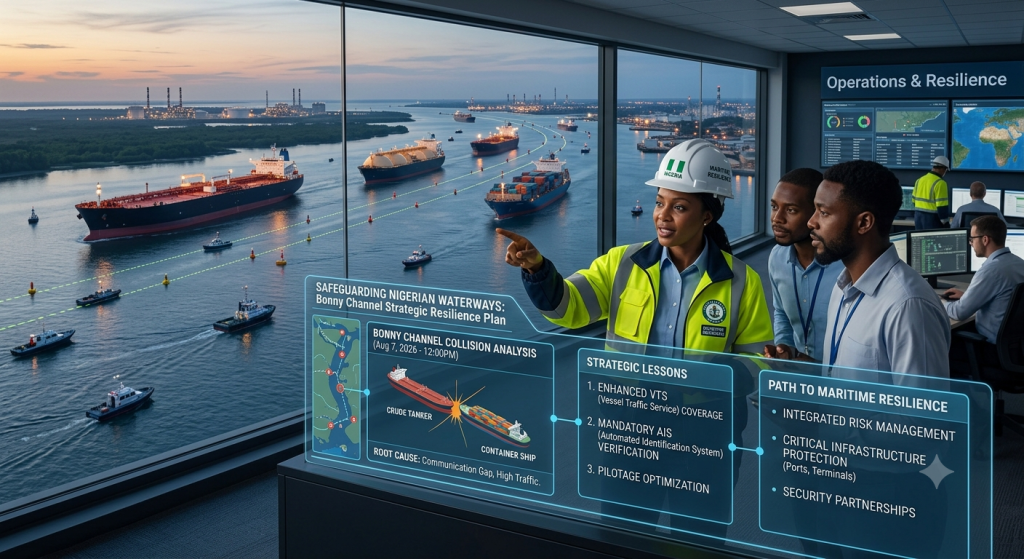
The maritime sector in the Gulf of Guinea remains a vital engine for West African economic commerce, yet it operates along narrow, high-density navigational corridors where operational friction can carry severe consequences. The collision between the oil tanker MT Lady Martina and the container vessel MV Maersk Valparaiso in the Bonny Channel—resulting in the loss of MT Lady Martina and subsequent environmental contamination across Ogu Creek—serves as a stark reminder of the delicate balance between maritime volume, channel safety, and environmental stewardship.
For shipowners, charterers, marine underwriters, and government regulators, this incident highlights critical vulnerabilities in coastal vessel traffic management, emergency spill response, and asset protection for domestic tonnage. Preventing similar maritime disasters requires a coordinated strategy that bridges advanced navigational compliance, marine insurance underwriting, salvage infrastructure, statutory oversight by regulatory bodies like the Nigerian Maritime Administration and Safety Agency (NIMSA) and the Nigerian Ports Authority (NPA), and strategic financial backing for coastal shipowners.
[ HIGH-DENSITY NAVIGATION: BONNY CHANNEL ]
│
┌───────────────────┴───────────────────┐
▼ ▼
[ Primary Impact Event ] [ Environmental Spread ]
Loss of Coastal Tonnage Ogu Creek Ecosystem Impact
│ │
└───────────────────┬───────────────────┘
▼
[ SYSTEMIC RESPONSE FRAMEWORK ]
┌─────────────────────────────────────────────────────────┐
│ • Vessel Traffic Management Systems (VTMS Modernization)│
│ • Advanced P&I, H&M, & Environmental Insurance Coverage │
│ • Rapid Salvage & Containment Infrastructure │
│ • Statutory Regulatory Oversight (NIMASA / NPA) │
│ • Sovereign Maritime Financing & Tonnage Fleet Funds │
└─────────────────────────────────────────────────────────┘
1. Navigational Risk Mitigation and Collision Prevention
The Bonny Channel serves as the sole deep-water arterial route for crude oil exports, liquefied natural gas (LNG) carriers, container ships, and domestic coastal tankers accessing Port Harcourt, Onne, and Okrika. Managing traffic in restricted waterways requires strict adherence to international standards and modern navigational technologies.
Technological and Operational Controls
Preventing collisions in high-density choke points depends on combining technical equipment upgrades with strict bridge procedures:
- Vessel Traffic Management Systems (VTMS): Establishing real-time, mandatory VTMS coverage across the Bonny Channel—managed continuously by the Nigerian Ports Authority—is essential. Dynamic radar, Automatic Identification System (AIS) tracking, and clear channel slotting prevent dangerous close-quarters situations between large deep-sea container vessels and smaller coastal tankers.
- Bridge Resource Management (BRM) & COLREGs Compliance: Strict compliance with the International Regulations for Preventing Collisions at Sea (COLREGs, 1972)—specifically Rule 9 regarding narrow channels—must be maintained. Bridge teams must practice disciplined BRM, ensuring clear communication via VHF channels between vessel pilots, coastal stations, and tug escorts.
- Mandatory Escort Tug Services: Implementing compulsory tug escort protocols for non-gas/oil tankers navigating narrow bends in the channel helps offset sudden steering gear failures or severe tidal currents.
2. The Role of Marine Insurance: Underwriting, P&I, and Claims Execution
When a vessel is lost, marine insurance provides the necessary financial recovery, environmental mitigation, and asset protection. Managing total loss and oil spill liability claims requires a clear understanding of marine policy structures.
+———————————————————————————–+
| MARINE INSURANCE COVERAGE MATRIX |
+————————–+——————————————————–+
| Hull & Machinery (H&M) | Covers physical damage or total loss of the vessel structure,|
| | engines, and onboard equipment resulting from marine |
| | casualties. |
+————————–+——————————————————–+
| Protection & Indemnity | Provides third-party liability coverage, including oil |
| (P&I) Clubs | pollution response, wreck removal, personal injury, and|
| | environmental damage compensation. |
+————————–+——————————————————–+
| Environmental & Pollution| Dedicated insurance policies covering immediate spill |
| Response Extensions | containment, shoreline cleanup, and long-term ecosystem|
| | remediation claims. |
+————————–+——————————————————–+
Strategic Insurance Practices for Coastal Operators
- Adequate Agreed Value H&M Policy Limits: Shipowners operating small to mid-sized coastal tankers must ensure Hull & Machinery policies reflect current market replacement costs, preventing under-insurance in the event of a total loss.
- First-Tier P&I Club Entry: Securing coverage through International Group (IG) P&I Clubs or high-rated marine underwriters guarantees prompt financial reserves to fund immediate emergency response, containment booms, and community compensation following a spill.
- Wreck Removal & Debris Liability Clauses: In narrow waterways, sunken hulls create immediate hazards to navigation. P&I coverage must include full, un-capped wreck removal endorsements to fulfill statutory clearing directives issued by maritime authorities.
3. Professional Salvage Infrastructure and Environmental Response
The impact of the Bonny Channel incident expanded once spilled petroleum products reached the delicate mangrove ecosystems of Ogu Creek. Minimizing damage from marine casualties requires rapid, professional salvage and containment measures.
[ Incident Detection in Bonny Channel ]
│
▼
[ Deploy Containment & Skimming Teams ] ◄── (P&I / Salvage Response)
│
▼
[ Stabilize / Isolate Wreck Location ] ◄── (Lloyd’s Open Form Salvage)
│
▼
[ Environmental Remediation in Ogu Creek ] ◄── (Community & Regulatory Oversight)
Immediate Emergency Protocols
- Lloyd’s Open Form (LOF) Contracting: Shipmasters and owners must be empowered to execute standard LOF or SCOPIC (Special Compensation and P&I Club Clause) agreements without delay. Allowing salvors to mobilize specialized equipment immediately helps prevent manageable hull breaches from escalating into total sinkings.
- Pre-Positioned Oil Spill Response Equipment: Salvage operators and oil spill response organizations (OSROs) must maintain pre-positioned containment booms, high-capacity skimmers, and chemical dispersants near high-risk zones like the Bonny Bar and Onne Approaches.
- Mangrove & Tidal Estuary Protection: Estuarine environments like Ogu Creek require rapid deployment of physical sorbent barriers to prevent petroleum hydrocarbons from seeping into mangrove root structures, where long-term toxicity severely impacts local fishing economies.
4. Statutory Regulatory Oversight: NPA and NIMASA
Federal maritime authorities serve as the primary regulators ensuring navigational safety, statutory compliance, and casualty investigations across Nigerian waters.
Institutional Responsibilities
- Nigerian Ports Authority (NPA): Responsible for maintaining capital dredging depths, hydrographic surveying, channel buoyage maintenance, and vessel pilotage. Ensuring all lightbuoys and navigational aids along the Bonny Channel remain fully operational and correctly positioned is vital for night navigation.
- Nigerian Maritime Administration and Safety Agency (NIMASA): As the designated Maritime Safety Administration, NIMASA enforces Port State Control (PSC) and Flag State Control (FSC) inspections. NIMASA’s casualty investigation units conduct root-cause analyses under the IMO Casualty Code, publishing findings to update maritime safety protocols.
- National Oil Spill Detection and Response Agency (NOSDRA): Coordinates multi-agency Tier 2 and Tier 3 oil spill responses, ensuring environmental remediation in affected communities complies with international environmental standards.
5. Government Assistance, Sovereign Financing, and Fleet Renewal
A major challenge facing indigenous shipowners in West Africa is accessing capital to replace aging tonnage and upgrade safety equipment. When an indigenous operator loses a vessel, replacing that asset without affordable financing can prove extremely difficult.
[ PUBLIC-PRIVATE MARITIME FINANCING ]
│
┌────────────────────────────┼────────────────────────────┐
▼ ▼ ▼
[ CVFF Disbursal ] [ Sovereign Guarantees ] [ Import-Bank Credit ]
Cabotage Vessel Low-Interest Fleet Renewal Long-Term Infrastructure
Financing Fund Guarantees Financing Facilities
Recommended Policy and Financial Interventions
- Operationalizing the Cabotage Vessel Financing Fund (CVFF): Accelerating the disbursement of accumulated CVFF funds enables qualified indigenous shipowners to finance modern, double-hull coastal tankers fitted with advanced navigation, fire-suppression, and propulsion technology.
- Sovereign Guarantee & Low-Interest Fleet Renewal Grants: The Federal Government, via the Ministry of Marine and Blue Economy alongside the Central Bank of Nigeria (CBN) and the Nigerian Export-Import Bank (NEXI), can establish structured fleet-renewal credit facilities capped at single-digit interest rates.
- Fiscal Incentives for Modern Tonnage: Waiving import tariffs and customs duties on critical safety systems, modern navigation electronics, and double-hull tanker acquisitions encourages operators to phase out older single-hull vessels that are more vulnerable to catastrophic breaches upon impact.
B2B Compliance and Operational Checklist for Shipowners
To maintain operational readiness and meet global chartering standards, coastal tanker operators should implement the following compliance framework:
- [ ] Bridge Equipment Audit: Verify that dual radar systems, ECDIS, AIS, and VDR systems are fully operational before entering restricted channels.
- [ ] Channel Pilotage Protocol: Ensure bridge teams conduct a comprehensive Pilot/Master Exchange (MPX) before transit, reviewing tidal currents, draft constraints, and tug capabilities.
- [ ] Insurance Adequacy: Conduct quarterly reviews of H&M agreed values, P&I entries, and oil pollution clauses to confirm compliance with international conventions like CLC 92 and BUNKERS 2001.
- [ ] Emergency Response Contract: Maintain pre-signed, active agreements with accredited Oil Spill Response Organizations (OSROs) and salvage contractors in primary trading areas.
- [ ] Environmental Training: Train vessel crews on initial spill containment procedures, including onboard SOPEP (Shipboard Oil Pollution Emergency Plan) drills.
Frequently Asked Questions (FAQ)
What primary regulations govern narrow channel navigation in West Africa?
Navigation in restricted channels is primarily governed by the International Regulations for Preventing Collisions at Sea (COLREGs, 1972)—specifically Rule 9 (Narrow Channels)—supplemented by local port regulations enforced by the Nigerian Ports Authority (NPA).
How does a vessel owner initiate emergency environmental response during a channel collision?
The shipmaster must immediately activate the vessel’s Shipboard Oil Pollution Emergency Plan (SOPEP), notify the nearest Port Control and Maritime Rescue Coordination Centre (MRCC), and alert the vessel’s P&I Club representative to mobilize accredited local OSROs.
What compensation mechanisms protect local communities affected by marine oil spills?
Affected communities can seek remediation and financial compensation through the vessel’s P&I Club pollution coverage, supported by statutory frameworks such as the International Convention on Civil Liability for Oil Pollution Damage (CLC) and local environmental enforcement overseen by NOSDRA.
How can indigenous shipowners access funds to replace lost or aging vessels?
Indigenous shipowners can apply for fleet renewal financing through the Cabotage Vessel Financing Fund (CVFF) managed by NIMASA, alongside specialized maritime lending programs offered by NEXIM Bank and international marine finance institutions.
Conclusion: Building a Secure Maritime Future
The collision in the Bonny Channel underscores the ongoing need for rigorous operational standards across West Africa’s maritime industry. Preventing future incidents requires a coordinated effort: shipowners must invest in bridge safety and modern tonnage, insurance underwriters must provide clear risk coverage, salvors and regulators must maintain rapid emergency response capabilities, and government bodies must provide accessible financing for fleet modernization.
At Oitha Marine, we remain committed to promoting operational excellence, technical vetting, and strategic risk management across the maritime supply chain. Through industry collaboration, rigorous safety standards, and modern infrastructure investments, we can protect coastal waters, safeguard maritime commerce, and secure the future of the regional blue economy.
About Oitha Marine
Oitha Marine is a maritime consultancy and logistics company specializing in end-to-end freight strategy, technical vessel vetting, charter party risk management, and offshore support logistics. We help global charterers, shipowners, and marine investors navigate complex maritime operations safely and efficiently.
- Contact: info@oithamarine.com | commercial@oithamarine.com
- Website: www.oithamarine.com
- Executive Leadership: Olayinka John Alegbeye, Chief Executive Officer
Recent Comments