
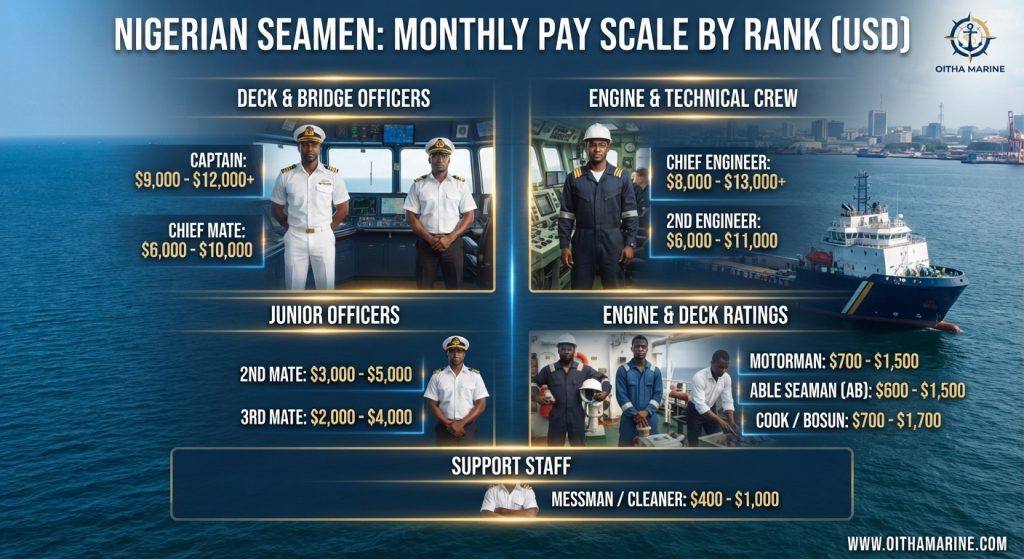
Understanding the salary scale for Nigerian seamen is essential for shipowners, crewing agencies, offshore contractors, charterers, and maritime professionals operating across Lagos, the Niger Delta, and international shipping routes. Whether budgeting vessel operating expenses (OPEX) for an offshore support vessel (OSV) in Nigerian waters or benchmarking international merchant marine pay scales, accurate crew remuneration data ensures competitive recruitment, regulatory compliance, and high crew retention.
At Oitha Marine ([www.oithamarine.com], we work closely with marine operators, charterers, and qualified seafarers across Nigeria and West Africa. Below is a complete breakdown of the Nigerian seamen salary scale by rank—covering senior deck and engine officers through to junior officers, technical specialists, and deck/catering ratings—along with the key factors that influence actual take-home pay.
Complete Salary Scale for Nigerian Seamen by Rank (USD / Month)
For Nigerian seafarers serving on international merchant ships, deep-sea tankers, and USD-denominated offshore oil and gas contracts, monthly wages generally align with international market benchmarks and Collective Bargaining Agreements (CBAs).
The table below outlines standard monthly compensation ranges across all 13 core shipboard ranks:
| Rank / Position | Department | Typical Monthly Salary (USD) | Primary Shipboard Responsibility |
| 1. Captain (Master) | Deck (Senior Officer) | $9,000 – $12,000 | Overall vessel command, navigation safety, regulatory compliance, and commercial cargo/mission execution |
| 2. Chief Engineer | Engine (Senior Officer) | $8,000 – $13,000 | Head of technical department; oversees main propulsion, auxiliary machinery, bunkering, and planned maintenance |
| 3. Chief Mate (Chief Officer) | Deck (Senior Officer) | $6,000 – $10,000 | Second-in-command; manages cargo operations, deck crew supervision, vessel stability, and ISPS security |
| 4. 2nd Engineer | Engine (Senior Officer) | $6,000 – $11,000 | Engine room day-to-day operations, watchkeeping leadership, fuel management, and mechanical repairs |
| 5. 3rd Engineer | Engine (Junior Officer) | $3,000 – $5,000 | Engine watchkeeping, boilers, generators, purifiers, and routine machinery maintenance |
| 6. 2nd Mate (Second Officer) | Deck (Junior Officer) | $3,000 – $5,000 | Navigation officer; passage planning, ECDIS/chart corrections, GMDSS communications, and bridge watch |
| 7. 4th Engineer | Engine (Junior Officer) | $2,000 – $4,000 | Junior engine watchkeeper; pumps, air compressors, bilge systems, and auxiliary machinery upkeep |
| 8. 3rd Mate (Third Officer) | Deck (Junior Officer) | $2,000 – $4,000 | Bridge watchkeeping, safety officer duties (LSA/FFA equipment inspections), and port watch support |
| 9. Electrical Officer (ETO) | Technical / Engine | $1,000 – $2,000 | Shipboard electrical power distribution, automation, alarms, navigation electronics, and switchboards |
| 10. Motorman / Oiler | Engine (Rating) | $700 – $1,500 | Engine room watch assistance, lubrication, cleaning machinery spaces, and routine mechanical support |
| 11. Able Seaman (AB) | Deck (Rating) | $600 – $1,500 | Helm steering, lookout watches, mooring/anchoring operations, cargo handling, and deck maintenance |
| 12. Cook, Bosun & Fitter | Deck / Engine / Catering | $700 – $1,700 | Bosun: leads deck ratings; Fitter: welding/fabrication; Chief Cook: crew meals and galley hygiene |
| 13. Messman / Cleaner | Catering / Utility | $400 – $1,000 | Messroom service, cabin/alleyway sanitation, provisions handling, and galley assistance |
Note: On specialized offshore vessels—such as Dynamic Positioning (DP2) PSVs, AHTS vessels, VLCC tankers, and LNG carriers—senior officers and ETOs with specialized endorsements frequently earn at or above the upper end of these ranges.
Departmental Breakdown: Understanding Seafarer Roles & Pay Tiers
To help ship managers, HR teams, and maritime entrants evaluate how pay scales correlate with certification and onboard responsibility, shipboard personnel are divided into four primary operational tiers:
1. Senior Management Officers ($6,000 – $13,000 / Month)
- Captain (Master) – $9,000 to $12,000: Holds ultimate legal and operational responsibility for the vessel, crew, cargo, and marine environment. Captains on complex offshore support spreads or product tankers often command higher day rates than those on standard coastal general cargo ships.
- Chief Engineer – $8,000 to $13,000: Directly mirrors the Master in rank and technical authority. Because high-horsepower offshore engines, diesel-electric propulsion, and automated systems require deep diagnostic expertise, Chief Engineers regularly match or slightly exceed Captain pay on technical vessels.
- Chief Mate ($6,000 – $10,000) & 2nd Engineer ($6,000 – $11,000): These senior deputies run daily deck and engine room execution, manage safety drills, and bridge senior command with junior watchkeepers.
2. Junior Watchkeeping Officers ($2,000 – $5,000 / Month)
- 2nd Mate ($3,000 – $5,000) & 3rd Engineer ($3,000 – $5,000): Mid-level officers holding STCW Officer of the Watch (OOW) Certificates of Competency (CoCs). They handle independent navigation and engine watches alongside passage planning and auxiliary plant management.
- 3rd Mate ($2,000 – $4,000) & 4th Engineer ($2,000 – $4,000): Entry-level licensed officers building sea time toward senior CoCs while managing Life-Saving Appliances (LSA), Fire-Fighting Appliances (FFA), and auxiliary engine systems.
3. Technical & Specialized Support ($1,000 – $2,000+ / Month)
- Electrical Officer / ETO ($1,000 – $2,000): Responsible for high-voltage systems, control panels, sensors, and communication hardware. On modern automated vessels and DP ships, certified Electro-Technical Officers (ETOs) can earn significantly higher rates depending on vessel complexity.
4. Skilled & Entry-Level Ratings ($400 – $1,700 / Month)
- Bosun, Fitter & Chief Cook ($700 – $1,700): Senior ratings who keep daily operations running smoothly—whether leading deck maintenance (Bosun), executing shipboard welding and pipe repairs (Fitter), or maintaining crew morale and nutrition (Chief Cook).
- Motorman ($700 – $1,500) & Able Seaman ($600 – $1,500): Certified STCW watchkeeping ratings forming the backbone of engine room checks, steering, mooring, and cargo watch.
- Messman / Cleaner ($400 – $1,000): Entry-level maritime roles responsible for hygiene, catering support, and housekeeping—often serving as the starting point for new seafarers building sea service records.
Key Factors That Influence Nigerian Seamen Salaries
When shipowners or crewing managers prepare vessel manning budgets in Nigeria, two seafarers holding the same rank may receive noticeably different compensation packages based on six commercial and regulatory variables:
1. Domestic Coastal Cabotage vs. International Deep-Sea Contracts
- International / Offshore USD Contracts: Nigerian seafarers working on foreign-flagged vessels, international oil company (IOC) charters, or cross-border West African spreads are typically paid in US Dollars (USD) matching the table above.
- Domestic Coastal / Local Naira Contracts: Seafarers operating strictly within Nigerian inland and coastal waters on smaller domestic craft are often paid in Nigerian Naira (NGN) under local company scales or National Joint Industrial Council (NJIC) collective agreements. Following recent NIMASA and NJIC maritime labor reviews, Nigerian seafarer minimum wage standards have seen substantial upward adjustments to bring local remuneration closer to International Transport Workers’ Federation (ITF) benchmarks.
2. Vessel Type and Operational Complexity
Vessel specialization strongly impacts crew day rates:
- Offshore Oil & Gas Vessels (PSV, AHTS, DSV, MPSV): Demand specialized offshore certifications (BOSIET/HUET, DP induction/unlimited) and pay premium rates.
- Oil, Chemical & Gas Tankers (VLCC, Product Tankers, LNG): Require Tanker Familiarization and Advanced Tanker endorsements, typically carrying a 15% to 35% wage premium over dry cargo vessels.
- Security Escort Boats, Crew Boats & Coastal Tugs: Operate on shorter rotation cycles out of Lagos, Warri, Bonny, and Port Harcourt with structured monthly or daily operational allowances.
3. Certificate of Competency (CoC) Issuing Flag
Holding an STCW Certificate of Competency issued by a white-listed maritime administration—such as NIMASA (Nigeria), UK MCA, Singapore MPA, or Panama—directly affects whether a Nigerian officer can join global ocean-going fleets or regional West African trade.
4. Rotation Schedule & Leave Pay Structure
B2B marine operators structure contracts in two primary ways:
- On-Board Only (Day-Rate / Contract Basis): Higher monthly pay while signed on the vessel, with no salary paid during leave periods.
- Permanent / Back-to-Back Rotation (e.g., 4 weeks on / 4 weeks off or 2 months on / 2 months off): Slightly lower monthly base rate, balanced by continuous year-round income, paid leave, and pension/medical benefits.
5. War Risk, High-Risk Area & Offshore Allowances
Transits through high-risk maritime corridors in the Gulf of Guinea, Ship-to-Ship (STS) transfer zones off Lagos or Lomé, and remote deepwater fields often include additional operational or hazard allowances on top of base pay.
6. Experience, Sea Time & Statutory Deductions
Years in rank, clean port state control (PSC) inspection records, and vessel-specific experience push candidates to the top of the pay band. For Nigerian-based payrolls, employers also factor in statutory deductions and benefits such as PAYE tax, pension contributions, NSITF, and P&I crew medical/insurance coverage.
B2B Manning & Crewing Best Practices for Shipowners in Nigeria
For vessel owners, charterers, and marine logistics companies operating in Nigeria, crew cost is one of the largest controllable components of daily vessel OPEX—yet underpaying qualified seafarers often leads to higher hidden costs:
- Benchmark Against NJIC and ITF Standards: Ensuring wages meet or exceed Nigerian Maritime Labour Regulations and NJIC collective bargaining agreements protects your vessel against port state detentions, union disputes, and charterer audits.
Trust Radio
- Verify STCW & Medical Documentation Upfront: Always confirm valid CoCs, Seafarer’s Discharge Books, NIMASA seafarer registration, yellow fever/vaccination records, and valid offshore medical certificates before mobilization.
- Prioritize Crew Retention on Critical Assets: Retaining a cohesive Captain, Chief Engineer, and Bosun team reduces machinery breakdowns, improves fuel efficiency, and keeps client HSSE KPIs on track.
Frequently Asked Questions (FAQ)
Are Nigerian seamen paid in USD or Naira?
It depends on the vessel and employer. Nigerian seafarers working on international ocean-going ships, foreign-flagged vessels, and major offshore oil and gas contracts are generally paid in US Dollars (USD). Those working on local coastal vessels, harbor tugs, or domestic barges within Nigeria are typically paid in Nigerian Naira (NGN), though many offshore contractors peg local pay to USD equivalents.
Who is the highest-paid seaman on a merchant or offshore ship?
The Captain (Master) ($9,000 – $12,000/month) and the Chief Engineer ($8,000 – $13,000/month) are the highest-paid ranks onboard. On highly specialized offshore vessels, DP2 construction ships, or LNG carriers, Chief Engineers and Masters can earn even higher day rates depending on experience and certifications.
How much does an Able Seaman (AB) earn in Nigeria?
On international and USD-paying offshore contracts, an Able Seaman (AB) typically earns between $600 and $1,500 per month, depending on vessel type, overtime structure, and offshore endorsements. On specialized offshore support vessels, AB day rates can push even higher.
Do seamen get paid when they are at home on leave?
That depends on the employment contract. Under voyage or fixed-term contracts, seamen are paid strictly for the days or months they are onboard (including travel days). Under permanent or back-to-back rotation contracts (common in offshore oil and gas), seafarers receive a monthly salary both while onboard and during scheduled off-duty rotation periods.
What qualifications are required to work as a seaman in Nigeria?
At a minimum, entry-level ratings require mandatory STCW Basic Safety Training (Personal Survival Techniques, Fire Prevention and Fire Fighting, Elementary First Aid, and Personal Safety and Social Responsibilities), a valid Seafarer’s Medical Certificate, a Nigerian Seafarer’s Discharge Book, and NIMASA registration. Officers must also hold accredited maritime academy training, required sea time, and an STCW Certificate of Competency (CoC).
Does Oitha Marine support vessel chartering and marine operations in Nigeria?
Yes. Oitha Marine provides comprehensive maritime solutions across Lagos, the Niger Delta, and West Africa—including escort and ballistic security boat charters, offshore support vessel (OSV/PSV/AHTS) chartering, Ship-to-Ship (STS) transfer support, and marine logistics consulting.
Partner with Oitha Marine for Reliable Maritime Operations in Nigeria
Whether you are planning vessel movements in Lagos, scoping crew and OPEX budgets for an offshore project, or looking to charter a compliant escort security boat or offshore support vessel in West Africa, Oitha Marine is ready to support your operations.
- Website: www.oithamarine.com
- Operational Hubs: Lagos, Lekki, Warri, Bonny, Port Harcourt & West Africa
Recent Comments