
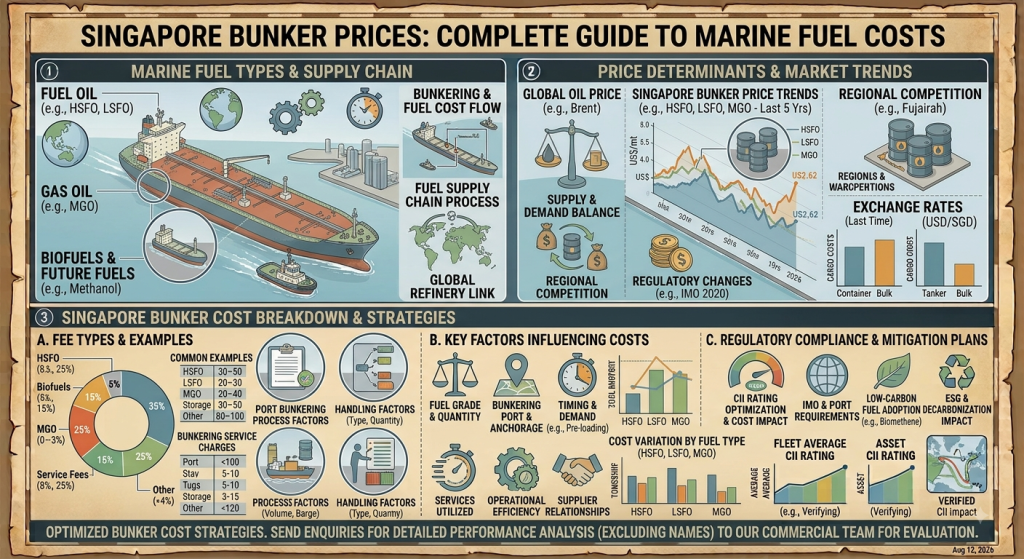
Bunker fuel represents the single largest operational expenditure for commercial vessel operators, frequently accounting for 50% to 70% of total voyage costs. As the world’s premier bunkering port, handling over 50 million metric tons of marine fuel annually, Singapore sets the global benchmark for marine fuel pricing, regulatory oversight, and quality standards. For shipowners, charterers, and procurement managers, navigating Singapore bunker prices requires an understanding of benchmark pricing mechanisms, mass flow meter mandates, fuel specification standards, and the economic shifts brought on by global decarbonization mandates.
Evaluating fuel costs in Singapore goes beyond comparing daily spot prices. Accurate voyage planning demands a granular assessment of price spreads between Very Low Sulfur Fuel Oil (VLSFO), Low Sulfur Marine Gas Oil (LSMGO), High Sulfur Fuel Oil (HSFO), and emerging biofuels or alternative fuels like methanol and LNG. This comprehensive guide examines the structural drivers of Singapore bunker prices, compliance requirements imposed by the Maritime and Port Authority of Singapore (MPA), operational risk management strategies, and practical frameworks for optimizing marine fuel procurement.
EXECUTIVE SUMMARY
- Market Leadership: Singapore retains its position as the world’s top bunkering hub due to its strategic position along the Malacca Strait, dense supplier ecosystem, advanced logistics infrastructure, and strict regulatory enforcement.
- Primary Pricing Drivers: Singapore bunker prices track international crude benchmarks (Brent/WTI) and regional product refining margins (Singapore 0.5% Sulfur Fuel Oil and 0.1% Gas Oil swaps), adjusted for local barging fees, inventory levels, and demand cycles.
- Regulatory Rigor: The MPA enforces mandatory Mass Flow Meter (MFM) usage for all marine fuel deliveries (including distillate and biofuel blends), virtually eliminating volumetric disputes and standardizing quantity measurement across the port.
- Fuel Grade Dynamics: The price spread between HSFO (used with scrubbers) and VLSFO/LSMGO determines scrubber payback periods, while growing mandates under IMO Carbon Intensity Indicator (CII) and EU ETS drive adoption of higher-priced bio-bunker blends (B24/B30).
- Procurement Best Practice: Shipowners must balance spot purchases against term contracts, audit bunker delivery notes (BDNs) against ISO 8217 quality specifications, and factor hidden operational costs (such as barge wait times and off-spec fuel handling) into their total cost of bunkering.
1. Structural Benchmarks and Price Formation in Singapore
Understanding how Singapore bunker prices are quoted and settled requires analyzing the supply chain from refinery gate to vessel manifold. Singapore serves as the price discovery center for Asian petroleum products, with prices published daily by reporting agencies such as S&P Global Commodity Insights (Platts) and Argus Media.
+———————————————————————————–+
| SINGAPORE BUNKER PRICE FORMATION |
| |
| [ Upstream Crude Benchmark ] —-> [ Regional Refining Swaps ] |
| • Brent / WTI Crude • Cargo Quotes (MOPS / Platts) |
| |
| │ |
| ▼ |
| |
| [ Delivered Bunker Price ] <—– [ Physical Supply Premium ] |
| • Final Spot / Term Quote • Barging / Storage / Terminal Fees |
| • Supplier Margin & Licensing Costs |
+———————————————————————————–+
Upstream Crude and Refined Product Swaps
The foundation of Singapore marine fuel pricing is Mean of Platts Singapore (MOPS). Physical bunker quotes reflect MOPS baseline cargo assessments plus or minus a market premium that covers local operational logistics:
- Upstream Inputs: Global crude prices dictate the overall direction of refined marine fuels.
- Product Crack Spreads: The price differential between crude oil and refined products (such as 0.5% VLSFO or 0.1% LSMGO) expands or contracts based on regional refinery utilization, yield balances, and industrial demand.
- Physical Premiums: The “delivered” bunker price quoted to a shipowner includes the physical premium. This premium covers storage terminal throughput charges, bunker barge freight tariffs, insurance, MPA licensing fees, and the supplier’s commercial margin.
Key Marine Fuel Grades Traded in Singapore
The commercial shipping fleet utilizes four main conventional fuel categories, each governed by ISO 8217 technical specifications:
| Fuel Grade | Sulfur Content Limit | Primary Usage / Vessel Profile | Price Level vs. VLSFO Baseline |
| VLSFO (Very Low Sulfur Fuel Oil) | Max 0.50% | Mainstream merchant fleet (container, bulk, tanker) without scrubbers. | Baseline Benchmark |
| LSMGO (Low Sulfur Marine Gas Oil) | Max 0.10% | Emission Control Areas (ECAs), port operations, auxiliary engines, boiler start-ups. | $100 – $200/MT Premium |
| HSFO (High Sulfur Fuel Oil – RMK/RMG) | Max 3.50% | Vessels equipped with Exhaust Gas Cleaning Systems (EGCS / Scrubbers). | $100 – $200/MT Discount |
| ULSFO (Ultra Low Sulfur Fuel Oil) | Max 0.10% | Specialized regional trades operating continuously within strict ECA zones. | Similar to or higher than LSMGO |
2. Mass Flow Meters (MFM) and Regulatory Compliance
A defining factor in the commercial reliability of Singapore’s bunkering sector is the regulatory framework enforced by the Maritime and Port Authority of Singapore (MPA).
Mandatory Mass Flow Meter (MFM) Usage
In 2017, Singapore became the first port worldwide to mandate the use of Mass Flow Meter (MFM) systems for fuel oil deliveries, subsequently expanding the requirement to distillates and bio-bunker blends.
- Volumetric vs. Mass Measurement: Traditional soundings measure volume, requiring temperature and density conversions susceptible to errors, air entrainment (“cappuccino effect”), and manual manipulation. MFMs measure mass directly in metric tons.
- Transparency and Turnaround: MFM technology reduces bunkering clearance times by 2 to 3 hours per stem, eliminates quantity disputes at the manifold, and provides tamper-proof digital data logs.
- TR 48 and TR 56 Standards: Bunkering operations must strictly comply with Technical Reference 48 (for fuel oil) and Technical Reference 56 (for distillates). MFM systems are sealed and calibrated under MPA supervision.
Supplier Licensing and Compliance
The MPA maintains a strict licensing regime for bunker suppliers and craft operators. Unlicensed bunkering or non-compliance with MFM protocols results in license revocation. For shipowners, purchasing exclusively from MPA-licensed bunker suppliers guarantees legal recourse, standardized documentation, and transparent disputes resolution under Singapore law.
3. Commercial Dynamics: Fuel Spreads and Scrubber Economics
Fuel selection directly influences vessel capital expenditure and charter market competitiveness. The price relationship between fuel grades creates operational choices for owners.
+———————————————————————————–+
| SCRUBBER ECONOMICS & FUEL SPREAD |
| |
| HIGH VLSFO-HSFO SPREAD (> $150/MT) –> Accelerated Scrubber Payback |
| Stronger Earnings for Scrubber Ships |
| |
| LOW VLSFO-HSFO SPREAD (< $100/MT) –> Extended Scrubber Payback |
| Narrower Capesize/VLCC Spread |
+———————————————————————————–+
The HiLo (VLSFO vs. HSFO) Spread
The price difference between VLSFO (0.5% S) and HSFO (3.5% S)—often termed the HiLo spread or scrubber spread—is a primary metric in shipping economics.
- Scrubber Investment Returns: Shipowners who installed scrubbers purchase cheaper HSFO. When the HiLo spread in Singapore widens beyond $150 per metric ton, scrubber-fitted Capesize bulkers, VLCCs, and large container ships achieve substantial daily operating savings compared to non-scrubber sister vessels.
- Payback Dynamics: A widening spread shortens the payback period of a $2 million to $4 million scrubber retrofit to under two years for high-consumption vessels. Conversely, when the spread narrows below $80/MT, payback periods extend, favoring VLSFO compliance.
The VLSFO vs. LSMGO Spread
LSMGO is mandatory inside designated Emission Control Areas (ECAs) such as the North Sea, Baltic Sea, and North American ECAs. While Singapore itself enforces the global 0.50% sulfur cap outside local berth requirements, many operators stem LSMGO in Singapore before transiting to ECA-regulated trade lanes due to Singapore’s competitive distillate pricing compared to smaller regional ports.
4. Alternative Marine Fuels and Decarbonization in Singapore
As the international maritime sector responds to the IMO Strategy on Reduction of GHG Emissions and regional frameworks like FuelEU Maritime and the EU Emissions Trading System (EU ETS), Singapore is expanding its alternative fuel infrastructure.
+————————————————————————————+
| ALTERNATIVE FUELS MATRIX IN SINGAPORE |
+———————–+———————————-+————————-+
| FUEL TYPE | AVAILABILITY / INFRASTRUCTURE | COMMERCIAL CONSIDERATION|
+———————–+———————————-+————————-+
| Bio-Bunker (B24/B30) | Widely Available (Licensed Slips)| Premium over VLSFO |
| LNG (Liquefied Gas) | Established (FueLNG / Pavilion) | Requires Dual-Fuel Engine|
| Methanol (e- / bio-) | Expanding (TR 115 Framework) | Higher Volumetric Ratio |
| Ammonia / Hydrogen | Pilot Projects / R&D Phase | Long-term Transition |
+———————–+———————————-+————————-+
Bio-Bunker Blends (B24 / B30)
Bio-bunker fuel—typically a blend of 24% or 30% Used Cooking Oil Methyl Ester (UCOME) with 70%–76% VLSFO—is commercially available across Singapore anchorages.
- Mass Balance and Certification: Bio-bunkers sold in Singapore carry ISCC (International Sustainability and Carbon Certification) proof of sustainability, allowing operators to calculate net GHG reductions for CII and EU ETS compliance.
- Pricing Mechanics: Bio-bunkers carry a cost premium driven by feedstocks. Pricing is structured as the base VLSFO market price plus the biofuel component cost per metric ton.
LNG and Methanol Bunkering
- LNG: Ship-to-ship LNG bunkering is fully operational in Singapore via dedicated bunker vessels (such as FueLNG Bellina), servicing dual-fuel container vessels and bulkers trading on long-haul routes.
- Methanol: The MPA has established Technical Reference 115 (TR 115) for methanol bunkering, facilitating early adoption by container lines operating dual-fuel methanol fleets.
5. Practical Example: Voyage Fuel Cost Calculation
To illustrate how marine fuel prices, barging fees, and fuel specification choices translate into bottom-line voyage expenses, consider this scenario:
Illustrative Example
A 180,000 DWT Capesize Bulk Carrier completes a laden voyage from Western Australia to Qingdao, returning via Singapore to stem fuel for its next voyage cycle.
- Fuel Requirement: 1,800 MT of VLSFO and 100 MT of LSMGO.
- Market Pricing Assumptions (Singapore Delivered Spot):
- VLSFO: $600 per Metric Ton
- LSMGO: $750 per Metric Ton
- Ancillary Bunkering Costs:
- Barge Delivery Fee: Included in delivered quote (standard stem >500 MT).
- Independent Bunker Survey: $800 flat rate.
- MPA Port Dues (Fast-Turnaround Bunkering Concession <24 hrs): Approx. $0.05 per GT.
- Agency Coordination Fee: $1,200 flat rate.
Cost Breakdown:
- VLSFO Procurement: 1,800 MT × $600 = $1,080,000
- LSMGO Procurement: 100 MT × $750 = $75,000
- Bunker Quantity & Quality Survey: $800
- Port & Agency Clearance Fees: $2,500 (approximate total)
Total Bunkering Cost: $1,158,300
Key Takeaway: Fuel procurement represents 99.7% of the total cash outlay for this port call. Securing a $3/MT discount through effective commercial negotiation or timing the market order saves $5,700—far exceeding the cost of agency or survey services.
6. Risk Management and Quality Control for Shipowners
While quantity is secured by Singapore’s MFM mandate, quality risks and price volatility require active operational management.
+———————————————————————————–+
| BUNKER RISK MANAGEMENT FRAMEWORK |
| |
| PRICE RISK QUALITY RISK OPERATIONAL RISK |
| • Bunker Swaps / Hedging • ISO 8217 Testing • Barge Scheduling |
| • Forward Fixed Pricing • Cat Fines & Density Audits• Off-Spec Dispute Management|
| • Charter Party Escalators • Stability & Compatibility • Demurrage Mitigation |
+———————————————————————————–+
Managing Off-Spec Fuel Risks
Despite strict MPA oversight, fuel quality issues can arise upstream in the supply chain. Common quality off-spec parameters include:
- Catalytic Fines (Cat Fines): Excessive aluminum and silicon particles can cause severe cylinder liner and piston ring wear if not properly purified onboard.
- Chemical Contamination: Organic chlorides or chemical waste in blendstocks can cause fuel pump sticking, filter clogging, or engine failure.
- Stability and Compatibility: Blending different VLSFO batches can cause sludge formation, clogging fuel lines and separators.
Operational Safeguards: Always sample fuel during bunkering at the vessel manifold using continuous drip samplers in compliance with MARPOL Annex VI. Send samples to an accredited testing laboratory (e.g., VPS, FOBAS) before burning the fuel onboard.
Hedging and Contractual Strategies
To guard against crude price shocks, commercial fleet operators employ structured financial and commercial tools:
- Bunker Swaps (Paper Hedging): Fixing future fuel costs by taking offsetting positions in Singapore 0.5% fuel oil or gas oil derivative contracts.
- Fixed Price Contracts (Physical Term Deals): Agreeing on a fixed price for a dedicated volume over a 3- to 12-month period with physical suppliers.
- Bunker Adjustment Factors (BAF): For liner operators, passing fuel price fluctuations directly to cargo owners through indexed freight surcharges.
Need Support with Marine Fuel Procurement or Port Operations?
Managing marine fuel procurement, agency representation, and vessel logistics across international bunkering hubs requires commercial oversight and reliable local execution.
Oitha Marine provides vessel chartering, ship agency representation, marine logistics support, offshore vessel support, and marine procurement services tailored to shipowners, fleet operators, charterers, and traders worldwide.
Whether you require assistance with local port agency clearances, vessel supply coordination, charter party support, or marine logistics management, our team works to safeguard your operational efficiency and commercial interests.
Contact Oitha Marine today to discuss your operational requirements or request technical support for your next vessel call.
Frequently Asked Questions (FAQ)
What are Singapore bunker prices?
Singapore bunker prices are the commercial rates charged to shipowners and charterers for marine fuel delivered within Singapore port limits. These prices are quoted in U.S. Dollars per metric ton ($/MT) and vary based on fuel grade (VLSFO, LSMGO, HSFO, biofuels), market demand, upstream crude benchmarks, and local delivery fees.
How are marine fuel prices in Singapore determined?
Singapore bunker prices are determined by regional petroleum benchmarks—specifically Mean of Platts Singapore (MOPS)—plus a physical supplier premium. This premium covers local storage, barge freight, terminal handling, regulatory compliance, and supplier margins.
Why is Singapore the world’s largest bunkering port?
Singapore’s leadership stems from its location along major East-West shipping lanes, world-class oil refining and storage infrastructure, strict regulatory oversight by the MPA (including mandatory Mass Flow Meters), competitive pricing, and efficient vessel turnaround times.
What is a Mass Flow Meter (MFM) and why is it mandatory in Singapore?
A Mass Flow Meter (MFM) is a device that measures the mass of fuel transferred during bunkering directly, rather than calculating volume. The MPA mandates MFMs on all bunker barges to ensure transparent, accurate quantity measurement and to eliminate volumetric disputes caused by temperature changes or air entrainment.
What is the price difference between VLSFO and HSFO in Singapore?
The price difference between VLSFO (0.50% sulfur) and HSFO (3.50% sulfur)—known as the HiLo or scrubber spread—typically fluctuates between $80 and $200 per metric ton based on global refining margins, crude oil supply, and scrubber demand.
Who pays for bunker fuel under a charter party agreement?
Under a Time Charter (TC), the charterer pays for all bunker fuel consumed during the charter period and must redeliver the vessel with equivalent fuel quantities. Under a Voyage Charter (VC), the shipowner pays for bunker fuel as part of total voyage operating expenses.
What fuel quality standard is used for bunkering in Singapore?
Marine fuel delivered in Singapore must comply with ISO 8217 international standards (e.g., ISO 8217:2010/2017/2024 specifications) and MARPOL Annex VI regulations governing sulfur limits and GHG emissions.
How long does a bunkering operation take in Singapore?
A standard bunkering operation in Singapore typically takes between 4 and 8 hours depending on the volume transferred, pumping rates (usually 300 to 1,000 MT/hr via MFM), barge mooring, and mandatory pre/post-bunkering administrative checks under TR 48/56 protocols.
Recent Comments