
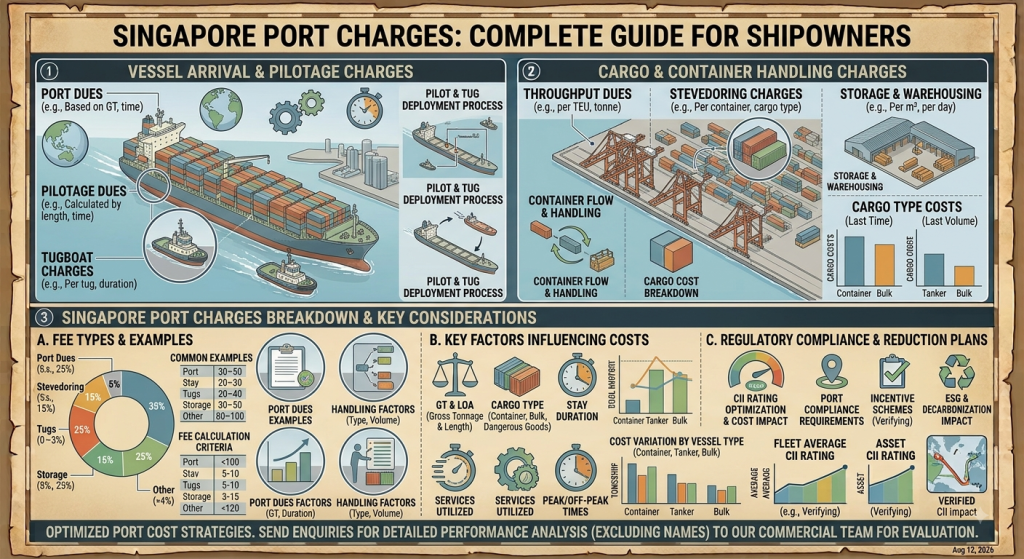
Managing port disbursement accounts (PDAs) for vessel calls in Singapore requires a granular understanding of the Maritime and Port Authority of Singapore (MPA) tariff structures, terminal operator fees, and marine services pricing. As the world’s busiest transshipment hub and leading bunkering port, Singapore maintains a transparent but multi-layered cost environment. For shipowners, ship managers, and charterers, line-item precision in calculating port dues, pilotage, towage, and berthage directly impacts voyage profitability.
Unplanned expenses during port calls usually stem from miscalculating vessel gross tonnage (GT) thresholds, misapplying port dues concession rules, or underestimating marine service surcharges during peak hours. This comprehensive guide breaks down every primary cost category incurred during a Singapore port call, details official MPA tariff mechanisms, identifies incentive programs, and provides practical frameworks for optimizing overall port call expenditure.
EXECUTIVE SUMMARY
- Core Cost Pillars: Singapore port charges fall into three distinct operational categories: Statutory Port Dues (payable to the MPA), Marine & Pilotage Services (payable to licensed providers like PSA Marine), and Terminal Operations/Berthage (payable to terminal operators like PSA Singapore or Jurong Port).
- Primary Cost Driver: Vessel Gross Tonnage (GT), duration of stay, purpose of call (e.g., loading/discharging vs. bunkering/repair), and location within port limits dictate the baseline pricing.
- Key Concessions & Savings: The MPA offers structured incentives, including the Green Port Programme (offering 25% to 30% reduction in port dues for low-emission vessels) and specific short-stay concessions (e.g., vessels staying under 24 hours for bunkering/supplies).
- Critical Operational Risk: Ancillary surcharges—such as public holiday pilotage fees, late order penalties, and extended anchorage charges—frequently cause disbursement account overruns if not accounted for during voyage planning.
1. Regulatory Framework and Port Dues (MPA Singapore)
Statutory port dues in Singapore are governed by the Maritime and Port Authority of Singapore (MPA) under the Maritime and Port Authority of Singapore Act. Port dues are levied on all vessels entering Singapore port limits, calculated primarily on the vessel’s Gross Tonnage (GT) as reflected in its International Tonnage Certificate (1969), and the duration of the call.
Standard Port Dues Structure Port dues accrue based on 24-hour periods or part thereof. The MPA categorizes vessels by purpose of call, applying differentiated rates to commercial cargo vessels, passenger liners, vessels calling solely for bunkering or ship supplies, and vessels undergoing repairs or lay-up.
- Commercial Cargo Operations: Vessels loading or discharging cargo incur standard port dues calculated per 100 GT per 24-hour block.
- Non-Cargo Calls (Bunkering, Stores, Crew Change): Vessels entering port limits exclusively for bunkering, taking ship supplies, or effecting crew changes qualify for a reduced port dues rate, provided the stay remains under specific time thresholds (typically within 24 hours).
- Vessels at Anchorage vs. Berth: Dues continue to accumulate as long as the vessel remains within Singapore port limits, whether at a terminal berth, working anchorage, or petroleum/dangerous goods anchorage.
Port Dues Concessions and Exemptions To maintain competitive positioning, the MPA applies automatic and application-based port dues concessions:
- 24-Hour Fast-Turnaround Concession: Vessels entering solely for bunkering or provisioning that clear port limits within 24 hours benefit from preferential base rates.
- Port Dues Incentive Scheme for Green Ships: Under the MPA’s Maritime Singapore Green Initiative (MSGI), vessels that exceed IMO EEDI requirements or utilize alternative low-carbon fuels (such as LNG, methanol, or ammonia) receive substantial discounts on port dues ranging between 25% and 30%.
- Repairs and Offshore Lay-up: Vessels entering shipyards for drydocking or designated anchorages for offshore repairs can access long-term discounted rates upon prior declaration through their appointed port agent.
2. Marine Services: Pilotage, Towage, and Lines Handling
Marine services within Singapore waters are provided by licensed operators, predominantly PSA Marine and specialized tug service providers. These charges represent a major portion of the marine services section in any Proforma Disbursement Account (PDA).
+———————————————————————————–+
| SINGAPORE PORT COST PIPELINE |
| |
| [ Statutoy Port Dues ] —-> [ Marine Services ] —-> [ Terminal Operations ] |
| • MPA Tonnage Dues • Pilotage (Per Hour/GT) • Berthage (Per Meter/Hr)|
| • Regulatory Clearance • Tug Assistance Rates • Stevedoring & Cranage |
| • Environmental Levey • Lines & Launch Hire • Wharfage & Storage |
+———————————————————————————–+
Pilotage Charges
Pilotage is compulsory for vessels of 300 GT and above navigating within specified pilotage districts, including harbour precincts, oil terminals, and single point moorings (SPM). Pilotage fees are structured around:
- Vessel GT Banding: Base rates scale progressively according to tonnage tiers.
- Duration: Charges apply per hour or part thereof, calculated from the time the pilot boards or is mobilized to the time the pilot disembarks.
- Surcharges: Standard rates double or incur heavy multipliers during night hours (typically 19:00 to 07:00), public holidays, or when servicing vessels with restricted maneuverability (e.g., dead ships or towed units).
Towage and Tug Assistance
Tugs are deployed based on vessel length overall (LOA), draft, deadweight tonnage (DWT), berth location, and prevailing tidal conditions. Guidelines issued by the Port Master specify the minimum number of tugs required for berthing and unberthing maneuvers.
- Tug Allocation: Calculated per tug, per hour or per movement.
- Horsepower/Bollard Pull Requirements: Larger container vessels, VLCCs, and capesize bulkers requiring high-bollard-pull tugs (e.g., 60–80 tonnes bollard pull) incur higher hourly unit rates.
- Cancellation & Standby Fees: Late cancellation of tug orders (typically less than 2 hours’ notice) triggers fixed cancellation penalties, while operational delays at the berth result in hourly standby surcharges.
Lines Handling and Launch Services
- Mooring/Unmooring Teams: Charged per berthing/unberthing event at container terminals, conventional berths, and private oil jetties.
- Pilot Launches: Transportation of pilots, surveyors, and crew between shore piers (e.g., Marina South Pier, West Coast Pier) and anchorages is billed per trip based on designated location zones (Eastern, Western, or OPL sectors).
3. Terminal Operations and Berthage Charges
Terminal charges depend heavily on whether the vessel berths at PSA Singapore terminals (Tanjong Pagar, Keppel, Brani, Pasir Panjang, and Tuas Port) or Jurong Port (specializing in dry bulk, liquid bulk, and breakbulk cargo).
Berthage Charges Berthage is billed based on the vessel’s Length Overall (LOA) and the duration (in hours) the vessel occupies the berth.
- PSA Container Terminals: Berthage is integrated into terminal service agreements for liner operators, but ad-hoc calls or non-container vessels calling at container berths face standard LOA-per-hour tariffs.
- Jurong Port (General & Bulk Cargo): Berthage rates vary depending on whether the berth is conventional, deep-water, or specialized (e.g., cement or liquid bulk berths).
Wharfage, Stevedoring, and Cargo Handling Cargo movement costs represent the primary variable cost for charterers and cargo owners operating under Free In/Out (FIO) terms:
- Container Operations: Terminal Handling Charges (THC) cover discharge, loading, transshipment, and rehandling of full and empty containers. Storage fees (demurrage/detention) apply after prescribed free-time allowances expire.
- Breakbulk and Project Cargo: Rates are assessed per revenue ton (cubic meter or metric ton, whichever is greater). Heavy lifts incurring specialized shore crane deployments attract equipment hire surcharges.
- Dry & Liquid Bulk: Handled via conveyor systems, pipelines, or grabs, with charges calculated per metric ton of throughput plus equipment cleaning/pipeline flushing fees.
4. Bunkering, Anchorage, and Ancillary Expenses
Singapore is the world’s largest marine refueling market. Vessels calling strictly for bunkering incur distinct operational cost profiles.
+————————————————————————————+
| SINGAPORE ANCHORAGE & BUNKERING COSTS |
+———————–+———————————-+————————-+
| COST CATEGORY | MAIN BASIS / DRIVER | PRIMARY APPLICABILITY |
+———————–+———————————-+————————-+
| Anchorage Dues | Per GT / 24-hr block | Long-stay, repair, wait |
| Bunker Barging | Delivered MT (Mass Flow Meter) | All fuel calls |
| Survey & Inspection | Per survey / Sampling fees | Bunker quantity/quality |
| Fresh Water Supply | Per Metric Ton (Barge or Shore) | Vessel provisioning |
| Garbage / Sludge | Per cubic meter / Disposal trip | MARPOL Annex I & V |
+———————–+———————————-+————————-+
Anchorage Fees and Allocation
Singapore’s waters are strictly zoned. Key anchorages include:
- Eastern & Western Bunkering Anchorages: Dedicated strictly for fuel transfer operations. Stay is typically capped to optimize vessel turnover.
- Petroleum & Dangerous Goods Anchorages: Require heightened safety clearances and attract specialized environmental levies.
- Man-of-War & Small Craft Anchorages: Reserved for specific vessel classes and naval units.
- General Purpose & Lay-up Anchorages: Designed for vessels awaiting orders, undergoing afloat repairs, or taking stores.
If a vessel exceeds its allocated anchorage duration without operational justification, the MPA may apply escalating penalty tariffs per 24-hour block to prevent port congestion.
Bunkering-Related Charges
While the fuel price itself dominates the transaction, associated port call charges include:
- Mass Flow Meter (MFM) Charges: Mandatory use of MPA-approved MFM bunkering barges ensures volume accuracy, with costs embedded into the delivered bunker price or itemized as a barge delivery fee.
- Bunker Surveying Fees: Independent surveyor costs for quantity verification and sampling.
- Port Agency Supervision: Fixed-fee disbursements for coordinating bunker barge logistics, MPA clearances, and sampling collection.
Environmental, Garbage, and Sludge Disposal
In compliance with MARPOL regulations, Singapore enforces strict waste management protocols:
- Garbage Disposal: Collected via licensed craft at anchorage or shore reception facilities at berth, charged per cubic meter or per trip.
- Sludge and Oily Water Discharge: Must be handled by MPA-certified reception facilities, with pricing governed by volume, flashpoint, and chemical composition.
5. Cost Breakdown Analysis: Comparative Operational Scenarios
To illustrate how port dues, marine services, and terminal charges interact in practice, consider these three representative vessel operational profiles.
Scenario A: 50,000 GT Container Vessel (Port Call for Discharge/Load)
- Objective: Discharge 1,200 TEU, Load 1,000 TEU.
- Duration: 28 Hours at Berth.
- Primary Cost Center: Terminal Handling Charges (THC) and Stevedoring form the majority of the bill, followed by LOA-based berthage fees. Marine services (pilotage in/out, 2 x harbor tugs per movement) form the second-largest cost block.
- Port Dues Impact: Standard cargo operations tariff applies per 100 GT per 24-hour period.
Scenario B: 115,000 DWT Suezmax Tanker (Bunkering and Stores at Anchorage)
- Objective: Receive 2,500 MT VLSFO, crew change (3 offsigners, 3 onsigners), take fresh water.
- Duration: 18 Hours at Eastern Bunkering Anchorage.
- Primary Cost Center: Bunkering barge delivery fees and independent survey fees. Port dues are significantly reduced due to the <24-hour non-cargo concession.
- Marine Services Impact: Inward/outward pilotage (if navigating designated pilotage zones), launch hire for crew transfer and fresh water barge delivery.
Scenario C: 180,000 DWT Capesize Bulk Carrier (Awaiting Orders / Afloat Repair)
- Objective: Afloat main engine maintenance and hull inspection by class surveyor.
- Duration: 6 Days at General Purpose Anchorage.
- Primary Cost Center: Accumulative anchorage port dues. Standard rates apply for the first 24-48 hours, with potential tier escalations for extended stays depending on port occupancy.
- Ancillary Costs: Launch hire across multiple days for technicians/surveyors, garbage collection craft, and underwater hull inspection permits.
6. Optimization Strategies for Shipowners and Managers
Cost control during a Singapore port call requires proactive planning, rigorous proforma auditing, and strict operational execution.
+———————————————————————————–+
| PORT DISBURSEMENT OPTIMIZATION MATRIX |
| |
| PRE-ARRIVAL IN-PORT EXECUTION POST-DEPARTURE |
| • Audit Proforma Accounts • Track Pilot Boarding • Cross-check Statements|
| • Verify GT Certificates • Monitor Tug Clock • Reconcile Service Logs|
| • Qualify for MSGI Rebates • Validate MFM Logs • Dispute Deviations |
+———————————————————————————–+
1. Leverage the Maritime Singapore Green Initiative (MSGI)
Shipowners investing in green fleet modernization should register their vessels with the MPA prior to arrival.
- Green Ship Programme (GSP): Singapore-flagged vessels achieving EEDI thresholds beyond IMO mandates receive port dues concessions.
- Green Port Programme (GPP): Foreign and local vessels utilizing LNG, methanol, or verified alternative fuels during port stay receive up to a 30% reduction in port dues. Environmental compliance directly impacts the bottom line.
2. Tighten Operational Schedules to Minimize Marine Service Surcharges
- Avoid Unnecessary Night/Holiday Shifts: Pilotage and tug tariffs carry steep surcharges outside standard day windows and on public holidays. Align vessel ETA to clear pilot stations during standard operating hours where bunkering or non-urgent repairs are involved.
- Optimize Order Windows: Cancel or adjust tug and pilot orders strictly within allowable time limits (typically >2–3 hours prior to notice) to avoid fixed late-cancellation penalties.
3. Implement Strict Disbursement Account (DA) Auditing
- Cross-Verify Pilot and Tug Logs: Ensure the hours billed by pilotage and tug providers match the actual times signed on the master’s service certificates.
- Monitor Anchorage Durations: Departure clearances must be coordinated efficiently to ensure the vessel clears Singapore port limits before entering a new 24-hour billing cycle.
4. Utilize Local Expertise via Appointed Port Agencies
Partnering with an experienced port agency ensures that proforma calculations reflect current official tariffs, localized operational nuances are addressed, and pilotage/tug requirements are not over-allocated beyond regulatory minimums.
Need Assistance with Your Singapore Port Call or Marine Operations?
Navigating port tariffs, bunkering logistics, marine procurement, and vessel agency requirements across global hub ports requires specialized commercial and operational support.
Oitha Marine provides vessel chartering, ship agency representation, marine logistics support, offshore vessel management, and marine procurement services tailored to shipowners, operators, and charterers worldwide.
Whether you require accurate Proforma Disbursement Accounts, local agency coordination, marine fuel logistics support, or vessel chartering assistance, our team is equipped to safeguard your commercial interests.
Contact Oitha Marine today to discuss your operational requirements or request a tailored solution for your next voyage.
Frequently Asked Questions (FAQ)
What are Singapore port charges?
Singapore port charges are fees levied on vessels calling at the Port of Singapore. They consist of statutory port dues payable to the Maritime and Port Authority of Singapore (MPA), marine services fees (pilotage, towage, mooring), and terminal charges (berthage, wharfage, stevedoring) payable to terminal operators like PSA Singapore or Jurong Port.
How are MPA port dues calculated?
MPA port dues are calculated based on the vessel’s Gross Tonnage (GT), the duration of stay inside Singapore port limits (charged in 24-hour blocks or part thereof), and the nature/purpose of the call (e.g., cargo operations, bunkering, repairs, or taking supplies).
Who pays port charges during a vessel charter?
Under a Time Charter (TC), the charterer is typically responsible for port charges, pilotage, towage, and berthage expenses. Under a Bareboat Charter, the charterer assumes all operational costs. Under a Voyage Charter (VC), the shipowner pays port dues and marine services, while cargo handling costs depend on agreed charter party terms (e.g., FIOST vs. Gross Terms).
Is pilotage mandatory in Singapore waters?
Yes, pilotage is compulsory for all vessels of 300 Gross Tonnage (GT) and above navigating within designated pilotage districts in Singapore port limits, unless specifically exempted by the MPA Port Master.
How can shipowners qualify for port dues discounts in Singapore?
Shipowners can reduce port dues through the MPA’s Maritime Singapore Green Initiative (MSGI). Vessels operating on alternative low-carbon fuels (LNG, methanol, ammonia) or exceeding IMO Energy Efficiency Design Index (EEDI) standards can receive port dues concessions between 25% and 30%. Short-stay bunkering calls under 24 hours also qualify for reduced tariffs.
What is the difference between PSA Singapore and Jurong Port charges?
PSA Singapore primarily handles containerized traffic and transshipment operations, with charges structured around container throughput (THC) and vessel LOA berthage. Jurong Port specializes in dry bulk, liquid bulk, breakbulk, and project cargo, charging based on revenue tonnage, specialized berth usage, and bulk material handling equipment.
What fees apply to vessels calling Singapore solely for bunkering?
Vessels calling exclusively for bunkering or ship stores incur reduced 24-hour non-cargo port dues, pilotage/launch fees (if entering pilotage districts or anchorages), bunker survey charges, and MFM barge delivery costs. They do not incur terminal berthage charges unless berthing alongside a terminal jetty.
How are tugboat requirements determined for berthing in Singapore?
Tugboat requirements are mandated by the MPA Port Master guidelines and terminal safety regulations. The required number and bollard-pull capacity of tugs are determined by the vessel’s Length Overall (LOA), draft, displacement, bow thruster operational status, and specific berth characteristics.
Recent Comments