
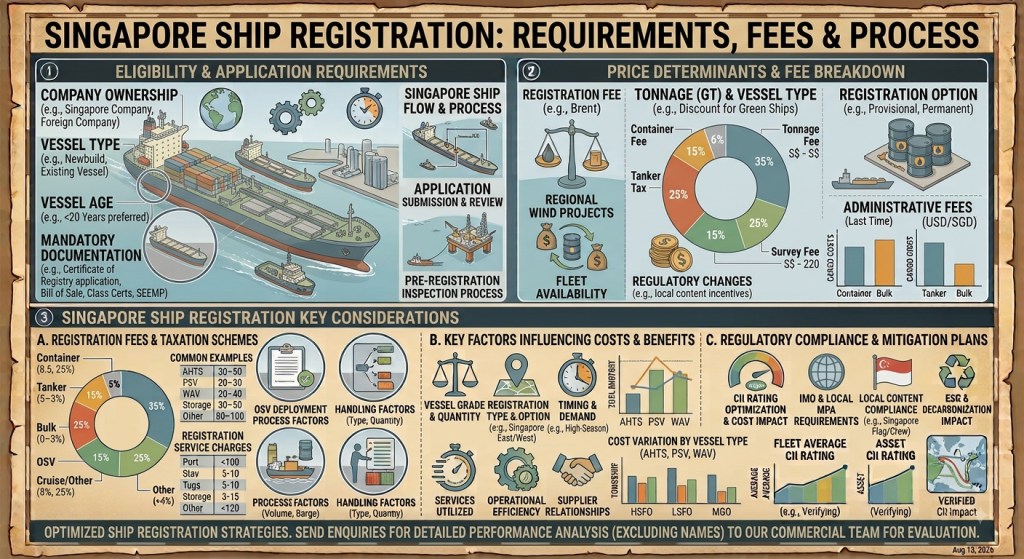
What is required to register a ship in Singapore?
To register a vessel under the Singapore Registry of Ships (SRS), the vessel owner must be a Singapore-incorporated company, a Singapore citizen, or a permanent resident. The vessel must generally be less than 17 years old, meet strict IMO safety and environmental standards, be surveyed by an MPA-authorized Classification Society, and pay an Initial Registration Fee (IRF) of S100,000) alongside an Annual Tonnage Tax (ATT) of S$0.20 per Net Ton.
Executive Summary
The Singapore Registry of Ships (SRS), administered by the Maritime and Port Authority of Singapore (MPA), consistently ranks among the top global ship registries by tonnage. Known for its combination of quality enforcement, white-list Port State Control (PSC) standing, and commercial flexibility, the SRS operates as a quality flag rather than a open registry of convenience.
For international shipowners, charterers, and fleet managers evaluating flag state performance, registering a vessel under the Singapore flag provides substantial operational, fiscal, and legal advantages:
- Tax Optimization: Income derived from the operation of Singapore-flagged ships in international waters is exempt from Singapore corporate income tax under Section 13A of the Income Tax Act.
- Corporate Structure: Foreign shipowners must establish a Singapore-incorporated entity with a minimum paid-up capital of S$50,000 to register vessels under the SRS.
- Age Restrictions: Standard eligibility limits vessel age to under 17 years. Vessels between 17 and 20 years undergo strict pre-registration surveys, while vessels over 20 years are rarely accepted.
- Statutory Cost Structure: Registration involves an Initial Registration Fee (IRF) of S
1,250, capped at S
0.20 per NT (minimum S
10,000).
- Technical Integrity: Singapore mandates double-hull construction for oil tankers and strict adherence to major IMO conventions (SOLAS, MARPOL, STCW, MLC 2006).
1. Strategic and Commercial Advantages of the Singapore Flag
Flag selection dictates a vessel’s operational efficiency, insurance premiums, bankability, and exposure to Port State Control (PSC) detentions. The Singapore flag offers several strategic benefits for commercial shipping operations.
+———————————————————————————–+
| SINGAPORE REGISTRY OF SHIPS (SRS) |
| |
| [ Quality Standards ] —-> High PSC Performance (Tokyo / Paris MOU White-Lists) |
| [ Fiscal Framework ] —-> Section 13A Tax Exemptions & No Withholding Tax |
| [ Legal Security ] —-> Admiralty Jurisdiction & Financed Mortgage Protection|
| [ Operational Depth ] —-> Global Network of Recognized Classification Societies|
+———————————————————————————–+
High Operational Quality & PSC Standing
The SRS maintains a strong safety record across major global PSC regimes, consistently placing on the White Lists of both the Tokyo MOU and Paris MOU, as well as holding Qualship 21 status with the United States Coast Guard (USCG). For shipowners, operating a White-List flagged vessel lowers the probability of disruptive PSC inspections, reduces berth delays, and streamlines terminal vetting procedures with oil majors and bulk charterers.
Fiscal Incentives and Double Tax Treaties
Singapore does not levy capital gains tax or withholding tax on dividend distributions. Under Section 13A of the Singapore Income Tax Act, international shipping revenue earned by a Singapore-flagged vessel is exempt from Singapore corporate tax. This exemption applies to:
- Freight earnings from international transport of goods and passengers.
- Charter hire income (time, voyage, or bareboat charters) derived from international operations.
- Towage and salvage operations conducted internationally.
- Capital gains derived from the sale of SRS-registered vessels.
Furthermore, Singapore’s network of over 90 Avoidance of Double Taxation Agreements (DTAs) protects shipowners operating worldwide from aggressive foreign withholding taxes on freight earnings.
Financing and Mortgage Registration
Ship finance institutions view the SRS favorably due to Singapore’s stable legal environment based on English Common Law. The Merchant Shipping Act provides a clear legal framework for registering mortgages. Priorities of registered mortgages are established strictly by the date and time of registration in the SRS database, giving lenders secure collateral enforcement rights.
2. Ownership Criteria and Corporate Structuring Requirements
Under the Merchant Shipping Act, only specific persons or legal entities are eligible to register vessels under the Singapore Flag.
Ownership Eligibility Rules
A vessel may be registered under the SRS if ownership is held by:
- A citizen of Singapore or a Singapore Permanent Resident (PR).
- A body corporate incorporated in Singapore.
Foreign individuals or offshore corporations (e.g., Marshall Islands, Panama, BVI) cannot directly hold legal title to an SRS vessel. Instead, foreign owners must set up a local corporate holding structure.
Corporate Setup Guidelines for Foreign Shipowners
To register an SRS vessel, foreign shipowners establish a Private Limited Company (Pte Ltd) in Singapore through the Accounting and Corporate Regulatory Authority (ACRA).
| Corporate Requirement | Standard Mandate | Operational Consideration |
| Minimum Paid-Up Capital | S$50,000 | Required if the company owns an SRS vessel. |
| Local Resident Director | Minimum 1 Director | Must be a Singapore Citizen, PR, or EntrePass holder. |
| Company Secretary | Mandatory | Must be a natural person resident in Singapore. |
| Registered Address | Local Physical Address | Cannot be a P.O. Box. Must be a physical Singapore office. |
Note on Capital Adjustments: While ACRA permits generic company incorporation with S50,000. The MPA may waive this capital threshold if the company’s parent entity holds a minimum paid-up capital equivalent to S$50,000 or if the company owns another SRS vessel.
3. Technical, Age, and Classification Requirements
The MPA enforces technical standards to preserve the quality and safety profile of the Singapore fleet.
+———————————————————————————–+
| VESSEL ELIGIBILITY ASSESSMENT FLOW |
| |
| Vessel Age < 17 Years =======> Standard Technical Audit & Documentation |
| Vessel Age 17–20 Yrs =======> Mandatory Pre-Registration Survey Required |
| Vessel Age > 20 Years =======> Generally Declined (Exceptional Approval Only) |
+———————————————————————————–+
Age Limits and Condition Surveys
- Under 17 Years Old: Standard eligibility. Processed through document verification and routine class status reports.
- 17 to 20 Years Old: Subject to a mandatory pre-registration inspection by MPA surveyors or designated class surveyors at the owner’s expense.
- Over 20 Years Old: Generally not accepted for registration under the SRS unless exceptional circumstances are demonstrated (e.g., highly specialized offshore assets or comprehensive life-extension drydockings).
Authorized Classification Societies (Recognized Organizations)
The MPA delegates statutory surveys, audits, and certification under international safety conventions (SOLAS, MARPOL, LOADLINE, TONNAGE, AFS, BWMC, MLC) to authorized Classification Societies known as Recognized Organizations (ROs). The primary authorized ROs in Singapore include:
- American Bureau of Shipping (ABS)
- Bureau Veritas (BV)
- China Classification Society (CCS)
- DNV
- Korean Register (KR)
- Lloyd’s Register (LR)
- Nippon Kaiji Kyokai (ClassNK)
- Registro Italiano Navale (RINA)
Minimum Crewing and STCW Compliance
Singapore does not enforce strict local crewing quotas for lower-tier ratings on SRS vessels, allowing shipowners to deploy qualified international crews. However, all officers serving on Singapore-registered ships must hold valid STCW certificates. If the certificates are issued by foreign maritime administrations, officers must obtain a Singapore Certificate of Endorsement (COE) issued by the MPA prior to joining the vessel.
4. Comprehensive Fee Structure and Tax Schemes
Evaluating the financial aspect of ship registration requires analyzing both statutory government charges and ongoing maintenance expenses.
Official MPA Fee Schedule
Official Tariff Data Source: Maritime and Port Authority of Singapore (MPA) Merchant Shipping Regulations.
| Fee Category | Calculation Basis | Minimum Charge | Maximum Cap |
| Initial Registration Fee (IRF) | S$2.50 per Net Ton (NT) | S$1,250 | S$100,000 |
| Annual Tonnage Tax (ATT) | S$0.20 per Net Ton (NT) | S$100 | S$10,000 |
| Provisional Certificate Extension | Flat Fee | S$1,250 | S$1,250 |
| Change of Vessel Name | Flat Fee | S$200 | S$200 |
| Mortgage Registration Fee | Flat Fee per Vessel | S$60 | S$60 |
| Certificate of Endorsement (COE) | Per Officer Application | S$40 | S$40 |
Illustrative Example: Financial Calculation for a 35,000 NT Bulk Carrier
Illustrative Example
Consider an international shipowner registering a 35,000 Net Ton (NT) Bulk Carrier (approx. 63,000 DWT) under the Singapore flag.
1. Initial Registration Fee (IRF) Calculation:

(Since S100,000 cap, the payable IRF is S$87,500).
2. Annual Tonnage Tax (ATT) Calculation:

(Since S100 minimum and S
7,000*).*
3. Total Government Fees in Year 1:

Financial Block Block Discounts: Maritime Sector Incentive (MSI)
The MPA offers reduced fee tiers to incentivize fleet operations through the Block Transfer Scheme (BTS):
- Owners transferring multiple vessels to the SRS concurrently (minimum 3 vessels or aggregate 40,000 NT) receive discounted IRF rates (e.g., S
1.50 per NT) and potential caps on total initial registration outlay.
5. Step-by-Step Ship Registration Process
Registering a vessel under the Singapore flag involves two distinct legal phases: Provisional Registration and Permanent Registration.
+———————————————————————————–+
| SINGAPORE REGISTRATION TIMELINE |
| |
| [ Phase 1 ] Application & Name Reservation (MPA MARINET System) |
| [ Phase 2 ] Document Submission (Bill of Sale, Class Status, Application Forms) |
| [ Phase 3 ] Fee Settlement & Issuance of Provisional Certificate (Valid 1 Yr) |
| [ Phase 4 ] Carving & Marking Note Execution & Statutory Surveys |
| [ Phase 5 ] Final Certificate of Registry & Radio License Issuance |
+———————————————————————————–+
Phase 1: Application and Vessel Name Approval
- Name Reservation: The owner submits proposed vessel names via the MPA’s digital portal (Marinet). Name approvals take approximately 1 to 2 working days.
- Company Setup Verification: Submit ACRA business profile confirming the owning company’s paid-up capital meets SRS mandates.
Phase 2: Document Submission for Provisional Registration
The owner submits the following documents to the Registrar of Ships:
- Form Application for Registration of a Ship.
- Form Appointment of Agent (if using an external ship management or agency firm).
- Copy of the existing Certificate of Registry (for existing vessels) or Builder’s Certificate (for newbuildings).
- Certified True Copy of the Bill of Sale or Transfer Document.
- Class Attestation confirming the vessel is in class and acceptable under SRS technical rules.
- Evidence of P&I Cover for Wreck Removal, Oil Pollution (CLC), and Maritime Labour Convention (MLC) financial security.
Phase 3: Issuance of Provisional Registry Certificate
Upon reviewing documents and receiving payment for the IRF and first-year ATT, the MPA issues a Provisional Certificate of Registry. This document is valid for up to one year and allows the vessel to trade under the Singapore flag immediately while permanent documentation is finalized.
Phase 4: Carving and Marking Execution
The MPA issues a Carving and Marking Note. The owner must ensure that the vessel’s name is marked on its bows, its port of registry (SINGAPORE) and name are marked on its stern, and its Net Tonnage and Official Number are permanently carved/marked on its main beam. An RO surveyor inspects the markings, signs the Note, and returns it to the MPA.
Phase 5: Permanent Registration
To convert from Provisional to Permanent status, the owner must submit original executed copies of:
- De-registration certificate from the previous flag state (confirming the vessel is free of encumbrances).
- Signed Carving and Marking Note.
- Official Tonnage Certificate issued under SRS authority by the RO.
- Safety Management Certificate (SMC), ISSC, and statutory survey certificates issued on behalf of Singapore.
Upon verification, the MPA issues the official Permanent Certificate of Registry and the vessel’s permanent Ship Station Radio License.
6. Operational, Insurance, and Bunkering Considerations
Registering a vessel in Singapore affects its commercial and technical operations in several practical ways:
+———————————————————————————–+
| COMMERCIAL & OPERATIONAL INTEGRATION POINTS |
+———————————————————————————–+
| • Bunkering Logistics –> Priority access to certified mass flow meter (MFM) |
| suppliers in the Port of Singapore. |
| • Marine Insurance –> P&I Clubs and H&M Underwriters recognize SRS quality, |
| offering competitive risk-adjusted rates. |
| • Port Agency & Stores –> Direct integration with Singapore port logistics |
| hubs for crew changes, technical spares, and stores. |
+———————————————————————————–+
Marine Insurance and Underwriting Security
Because the Singapore Registry maintains low PSC detention rates and strict safety standards, major marine insurance underwriters, International Group (IG) P&I Clubs, and War Risk underwriters accept SRS-registered vessels without additional structural risk surcharges.
Bunkering Coordination and Quality Assurance
Singapore operates as the world’s largest marine refueling hub. Operating a Singapore-flagged vessel streamlines bunkering procedures, as the MPA enforces mandatory Mass Flow Meter (MFM) systems for fuel deliveries within Singapore waters, providing clear verification of fuel quantity and quality for SRS vessels bunkering locally.
Technical Management and Agency Coordination
Maintaining compliance with the SRS requires clear communication between the vessel’s ISM managers, local port agents, and the MPA. Owners must report any marine casualties, structural damages, or PSC detentions immediately to the Flag Administration.
Technical Support for Your Marine Operations
Managing vessel flagging, registration transfers, port calls, and commercial supply chains requires coordinated maritime execution.
Oitha Marine provides vessel chartering, ship brokerage, port agency representation, offshore logistics support, and marine procurement services across key maritime hubs.
Whether you require assistance with vessel inspections, agency coordination, commercial chartering, or bunker supply logistics, our team protects your operational timelines and commercial interests.
Contact Oitha Marine today to discuss your marine support requirements or request technical assistance for your fleet operations.
Frequently Asked Questions (FAQ)
What are the main requirements to register a ship under the Singapore flag?
To register a ship under the Singapore Registry of Ships (SRS), the vessel must be owned by a Singapore citizen, permanent resident, or a Singapore-incorporated company with a minimum paid-up capital of S$50,000. The vessel must generally be less than 17 years old, surveyed by an authorized Classification Society, and fully compliant with IMO safety standards.
How much does it cost to register a vessel in Singapore?
Statutory initial costs include an Initial Registration Fee (IRF) of S1,250 and a maximum cap of S
0.20 per NT is charged (minimum S
10,000). Corporate incorporation, legal documentation, and classification survey costs are billed separately.
Can a foreign company directly register a vessel in Singapore?
No. A foreign entity cannot directly register a vessel under the SRS. Foreign shipowners must incorporate a Singapore subsidiary (Private Limited company) to hold legal title to the vessel.
How long does the Singapore ship registration process take?
Once all required documentation is submitted and fees are paid, the MPA can issue a Provisional Certificate of Registry within 24 to 48 hours. The owner then has up to 12 months to complete permanent registration requirements, including previous flag deletion and carving and marking verifications.
Is income from Singapore-registered ships tax-exempt?
Yes. Under Section 13A of the Singapore Income Tax Act, net income derived from the operation of Singapore-flagged ships in international waters is exempt from Singapore corporate income tax. Capital gains from the sale of SRS vessels are also non-taxable.
What is the maximum age limit for registering a ship in Singapore?
The standard age limit for vessels entering the SRS is 17 years. Vessels aged between 17 and 20 years must undergo a mandatory pre-registration inspection by MPA surveyors. Vessels over 20 years old are generally declined entry.
Are foreign crew members allowed on Singapore-flagged ships?
Yes. Singapore does not enforce local crewing quotas for ratings on SRS vessels. Foreign officers and crew may be deployed, provided officers hold valid STCW certificates and obtain a Certificate of Endorsement (COE) from the MPA.
Which Classification Societies are recognized by the MPA?
The MPA delegates statutory survey authority to eight major Classification Societies: ABS, BV, CCS, DNV, KR, LR, ClassNK, and RINA.
Recent Comments