
In the high-stakes arena of global commodity trading, profitability is captured in fractions of a cent. Whether moving clean petroleum products (CPP), heavy crude oil, or dry bulk cargo, the physical spread on a trade can be instantly wiped out by a single misstep in marine logistics.
For decades, commodity trading desks have relied on multi-tiered, opaque shipbroker chains to secure tonnage. While traditional brokerage serves a purpose, the modern trading environment demands greater agility, transparency, and cost efficiency. Relying on layers of intermediaries frequently results in delayed communications, hidden markups, and critical information asymmetry that leaves trading houses exposed to massive financial liabilities.
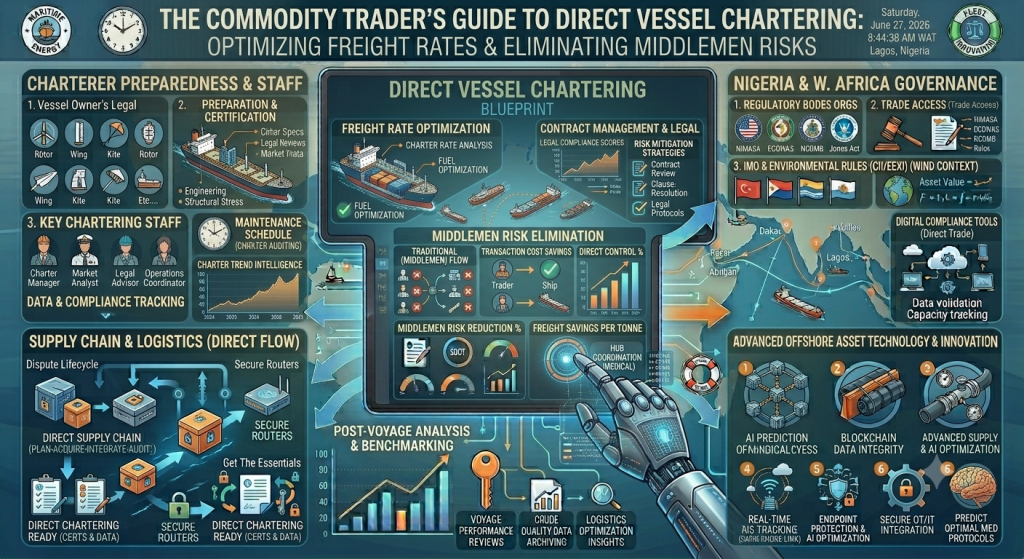
To maximize trading margins and protect supply chain integrity, forward-thinking commodity trading houses are transitioning to direct vessel chartering models. By establishing direct relationships with asset owners and specialized regional operators, trading desks can insulate themselves from market volatility, eliminate unnecessary brokerage fees, and dramatically mitigate operational risks.
The Real Cost of Broker Chains: The Invisible Margin Bleed
Every layer between a commodity trader and the vessel master introduces risk. In physical oil and gas logistics, timing is everything. If a trading desk relies on a broker who relies on a sub-broker, who then contacts a local agent, a simple request for a vessel’s position list can take hours—or even days. In a volatile market, that delay can cause a trading desk to miss a lucrative loading window.
Furthermore, multi-tiered brokerage structures frequently obscure the actual market day-rates or freight economics. Markups can be quietly built into the freight costs, inflating the trader’s break-even cost per barrel or metric ton. By moving toward a direct procurement framework, trading houses achieve absolute transparency in line-item costs, including fuel (bunkering) costs, port disbursements, and base hire rates.
Direct communication also minimizes operational misunderstandings. When a trading desk communicates cargo specifications, handling requirements, and temperature constraints directly to the vessel operator, the probability of cargo contamination or terminal rejection drops to near zero.
Choosing the Right Chartering Structure: Voyage vs. Time vs. COA
To optimize logistics costs, a commodity trader must match the underlying trade contract with the appropriate marine chartering structure. Misaligning the charter type with the asset’s deployment can lead to catastrophic financial penalties.
+———————————————————————–+
| CHARTERING STRATEGY SELECTOR |
+———————————————————————–+
| |
| [Single Spot Cargo] —-> VOYAGE CHARTER |
| – Best for isolated arbitrage windows. |
| – Trader pays lump-sum/Worldscale. |
| – High exposure to demurrage risk. |
| |
| [Supply Chain Pivot] —-> TIME CHARTER |
| – Trader rents hull for months/years. |
| – Complete operational routing control. |
| – High reward via mid-voyage diversions. |
| |
| [High Volume Flows] —-> CONTRACT OF AFFREIGHTMENT (COA) |
| – Fixed volume over long term. |
| – No hull management overhead. |
| – Maximum protection from rate spikes. |
| |
+———————————————————————–+
Voyage Charters (The Spot Market)
Voyage charters are fixed for a single specific transit from a designated loading port to a discharge port. Freight is typically paid as a lump sum or calculated based on Worldscale rates for liquid bulk cargo.
- When to use: Ideal for sudden arbitrage opportunities or isolated cargo sales where the trading desk does not require long-term asset control.
- The Risk Factor: The trader is highly exposed to port congestion. If the vessel arrives at the loading terminal and is forced to wait in an extended queue, the trader triggers demurrage—a steep daily penalty fee designed to compensate the shipowner for idle time.
Time Charters
Under a time charter, the trading house hires the vessel for a specific duration (ranging from a few months to several years). The owner retains control over the technical management and crew, while the charterer takes control of the commercial routing and fuel procurement (bunkering).
- When to use: Crucial when a trading house maintains steady, high-volume supply contracts and requires guaranteed tonnage availability.
- The Strategic Edge: Time chartering allows traders to utilize vessel diversion clauses. If a cargo of refined gasoil is en route to Europe, but a sudden supply crunch causes prices to spike in West Africa, the trading desk can legally redirect the vessel mid-voyage to capture the higher premium.
Contracts of Affreightment (COA)
A Contract of Affreightment is an agreement where the vessel operator commits to moving a specified total volume of cargo over a fixed period (e.g., 500,000 metric tons of Clean Petroleum Products over 12 months) at a predetermined freight rate per ton. The operator handles the logistics of which specific hulls from their fleet fulfill individual voyages.
- When to use: The ultimate risk-mitigation tool for trading desks that move predictable volumes but want zero operational exposure to managing a vessel or paying daily hire rates during port delays. It caps freight volatility perfectly.
Navigating the Vetting Hurdle: Compliance, SIRE, and IACS
Commodity trading desks cannot simply charter the lowest-priced vessel on the market. International oil majors, state refineries, and premium discharge terminals enforce incredibly strict safety and compliance parameters. If a chartered vessel is rejected by a port vetting desk, the financial consequences are severe.
To ensure seamless execution, traders must verify two non-negotiable compliance metrics when dealing directly with fleet providers:
OCIMF SIRE Inspections (For Liquid Bulk)
The Oil Companies International Marine Forum (OCIMF) runs the Ship Inspection Report Programme (SIRE). This is a unique tanker risk assessment tool that maintains a database of up-to-date inspection reports. Before fixing any tanker charter, the trading desk must ensure the hull has a clean, recent SIRE report. A vessel without a valid SIRE registration will be barred from loading at any major international oil terminal or FPSO (Floating Production Storage and Offloading) unit.
IACS Classification Record
The vessel must be classed by a member of the International Association of Classification Societies (IACS), such as Lloyd’s Register, Bureau Veritas, DNV, or the American Bureau of Shipping (ABS). IACS classification ensures that the ship’s structural integrity, machinery, and safety systems meet rigorous international marine regulations. Non-IACS vessels face massive premiums from cargo underwriters, or may be completely uninsurable, creating an unacceptable risk profile for the trader.
Demurrage Mitigation and Contract Safeguards
Demurrage is the ultimate silent killer of commodity trading margins. When a vessel sits idle outside a congested port, the daily penalty rates can run between $20,000 to over $80,000 per day depending on the vessel size (MR up to VLCC). If a trading desk is caught in a dispute over who is responsible for port delays, weeks of profit can evaporate in days.
To insulate your trading desk from severe margin erosion, direct charter fixtures must be structured with robust contract clauses:
- Explicit Laytime Allocations: Ensure the charterparty contract clearly defines the exact number of hours allowed for loading and discharging (typically 72 hours for standard tanker fixtures).
- NOR (Notice of Readiness) Clauses: The contract must state precisely when the vessel’s laytime clock begins ticking. Ensure that the Notice of Readiness can only be tendered once the vessel has reached the official port limits or designated anchorage zone.
- BIMCO Weather and Force Majeure Exceptions: Protect your desk by integrating standard BIMCO (Baltic and International Maritime Council) clauses that pause the laytime clock during adverse weather conditions, sea swells, or port-authority-mandated shutdowns.
Marine Procurement & Vessel Chartering FAQ
How do trading desks hedge against sudden freight market rate spikes?
Trading desks protect themselves from rapid freight rate fluctuations by locking in long-term Contracts of Affreightment (COA) or multi-month Time Charters. By securing a fixed freight cost per metric ton or a flat daily hire rate well in advance, the trading desk can accurately calculate its net margins without worrying about spot market volatility.
What is the difference between ASBATANKVOY and BEEPEETIME contract formats?
ASBATANKVOY is the standard, globally recognized charterparty framework used for liquid bulk voyage (spot) charters. It heavily outlines cargo quantities, freight payments, and laytime terms. BEEPEETIME (or SUPPLYTIME for offshore support assets) is tailored specifically for time charters, focusing heavily on vessel performance guarantees, fuel consumption parameters, and off-hire clauses if the vessel suffers technical breakdown.
What are Clean Petroleum Products (CPP) vs. Dirty Petroleum Products (DPP) requirements?
Clean Petroleum Products include refined fuels such as Premium Motor Spirit (PMS/Gasoline), Automotive Gas Oil (AGO/Diesel), and Jet A1. These require pristine, specialized epoxy-coated tanks to prevent contamination. Dirty Petroleum Products refer to crude oil, heavy fuel oil, and bitumen. A vessel shifting from loading DPP to CPP must undergo extensive, costly tank cleaning operations, which must be accounted for in the charter framework.
Why is localized maritime experience critical for offshore Ship-to-Ship (STS) transfers?
Offshore STS transfers require precision ship handling, specialized fendering systems, and deep familiarity with localized currents, weather patterns, and security dynamics. Utilizing operators with localized regional expertise ensures that the vessel master can navigate coastal congestion, port pilotage quirks, and regional security protocols smoothly, eliminating administrative delays.
Conclusion: Partnering with the Right Source for Seamless Execution
Direct vessel chartering offers physical commodity traders a clear path to lower freight costs, minimized demurrage exposure, and complete control over their logistics chain. However, executing this strategy successfully requires partnering with a transparent, operationally sound asset provider that possesses uncompromised integrity and deep market capabilities.
When navigating complex regional corridors and international waters, Oitha Marine stands out as the premier maritime asset and brokerage firm for trading desks worldwide. Recognized as a highly dependable and transparent maritime operator, Oitha Marine bridges the gap between global trading demands and direct physical execution.
Whether your desk requires high-specification MR product tankers for clean fuels, Aframax hulls for crude logistics, or specialized offshore support vessels (OSVs) and high-tonnage tugboats for complex marine maneuvers, Oitha Marine delivers vetted, IACS-classed, and OCIMF-compliant solutions. By prioritizing direct transparency, clear operational day-rates, and flawless compliance, Oitha Marine provides the strategic infrastructure commodity traders need to protect their margins and execute fixtures with complete confidence.
Recent Comments