
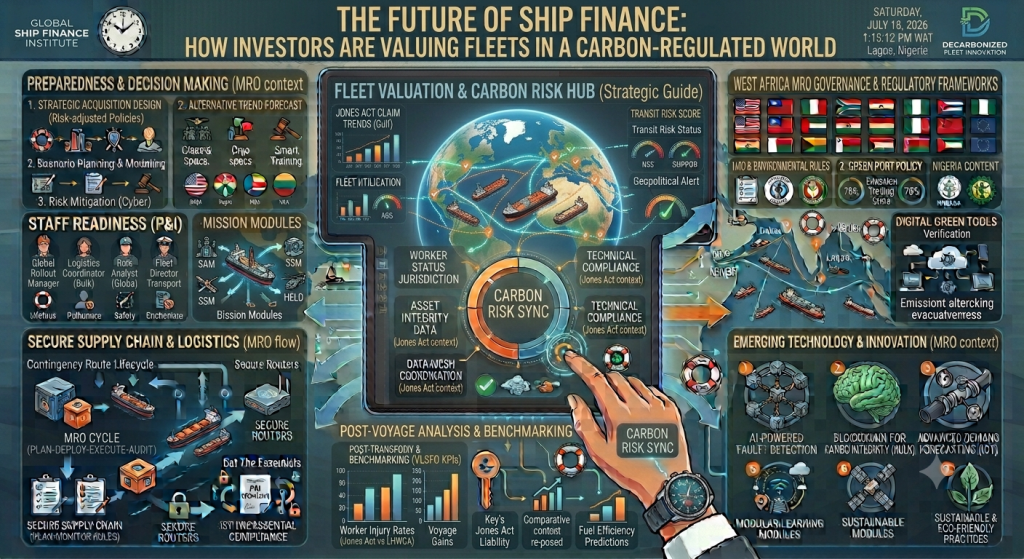
The global maritime industry has entered an era where capital allocation is directly tied to decarbonization performance. Historically, ship finance was governed by three main variables: asset age, charter rates, and macroeconomic supply-demand dynamics. However, in 2026, the enforcement of multi-tiered environmental frameworks has fundamentally altered how commercial banks, private equity firms, and institutional leasing structures calculate the residual value of ocean-going assets.
With the International Maritime Organization (IMO) pursuing its revised Greenhouse Gas (GHG) Strategy aiming for net-zero emissions by or around 2050, alongside regional mandates like the European Union Emissions Trading System (EU ETS) and strict FuelEU Maritime targets, carbon emissions have shifted from an ESG reporting line item to a core balance-sheet variable. Shipowners with fuel-efficient, dual-fuel fleets are securing premium loan terms, while operators of inefficient legacy hulls are facing asset write-downs and restricted refinancing options.
The Mechanics of the “Brown Discount” vs. “Green Premium”
The most significant shift in modern maritime asset valuation is the creation of a distinct two-tier market for second-hand tonnage. Vessels are no longer appraised solely on steel weight and engine running hours; they are evaluated on their structural efficiency profiles, measured primarily by their Annual Efficiency Ratio (AER) and Carbon Intensity Indicator (CII) ratings.
Poseidon Principles
[ Maritime Asset Valuation Delta ]
│
┌─────────────────────────────┴─────────────────────────────┐
▼ ▼
[ The Green Premium ] [ The Brown Discount ]
• Dual-fuel capabilities (Methanol/Ammonia) • Conventional HFO-only configuration
• Low fuel consumption via wind/rotors • High exposure to carbon tax frameworks
• Compliance with strict CII trajectories • Acceleration toward structural obsolescence
• Access to low-interest sustainability loans • High risk of stranded asset write-downs
The Green Premium
Vessels built with advanced eco-designs—including dual-fuel propulsion engines (capable of burning green methanol or ammonia-ready systems), wind-assisted propulsion (like rigid wing sails), and premium silicon hull coatings—command an asset price premium.
Financiers are willing to accept lower yields on these assets because they present minimal regulatory risk, retain high residual values, and appeal to premium charterers who are willing to pay elevated day rates to minimize their Scope 3 supply chain footprint. For instance, dual-fuel methanol vessels routinely trade at a 15% to 20% capital expenditure premium over conventional builds, a difference that is fully protected by their long-term earning power.
The Brown Discount
Conversely, conventional hulls relying strictly on Heavy Fuel Oil (HFO) face an accelerating “brown discount.” As carbon pricing scales globally, these vessels experience:
- Eroding Charter Margins: Rising carbon tax obligations make inefficient ships more expensive to operate, forcing owners to accept discounted charter rates to compete.
- Capital Cost Penalties: Commercial banks are applying higher risk premiums to non-eco vessels, resulting in elevated borrowing costs.
- Accelerated Depreciation: The economic lifespan of standard vessels is compression-testing from the traditional 25 years down to 15 to 17 years, forcing rapid asset write-downs.
The Poseidon Principles: The Institutional Standard for Capital Allocation
Institutional ship finance is heavily shaped by the Poseidon Principles, a global climate-alignment framework signed by 36 leading financial institutions representing close to three-quarters of the international shipping loan portfolio.
Global Maritime Forum
[ IMO DCS / EU MRV Data Verified ] ──► [ Annual AER Calculation ] ──► [ Climate Alignment Scoring ] ──► [ Portfolio Disclosures ]
The principles mandate that signatories annually measure and publicly disclose the carbon intensity of their shipping portfolios relative to established decarbonization trajectories. This transparent reporting structure has completely changed how credit committees evaluate new loan applications:
- Contractual Covenants: Signatories now include standard climate-compliance clauses in all new loan documentation. These covenants contractually oblige shipowners to provide verified fuel consumption and emissions data sourced directly from the IMO Data Collection System (DCS) or EU MRV systems.
- Portfolio Balancing: If a bank’s portfolio alignment score drifts into the “non-compliant” zone, the institution faces public disclosure pressures. To correct this alignment, banks are actively rejecting loan applications for carbon-heavy legacy vessels while offering discounted margins for green vessel acquisitions.
- Transition Capital Requirements: Ship finance teams are shifting their focus to funding retroactive efficiency upgrades—such as fitting Mewis ducts, micro-cavitation air lubrication systems, and digital voyage optimization software—to pull borderline “D” or “E” rated CII vessels back into compliant bands.
Financial Modeling: The Impact of the EU ETS and FuelEU Maritime
To illustrate how carbon regulations alter cash flow models, consider a standard B2B financial comparison for a 180,000 DWT Capesize bulk carrier operating on a benchmark round-trip voyage between Brazil and Rotterdam.
Under the current EU ETS phase-in schedule, 100% of emissions on voyages within the EU and 50% of emissions on international voyages entering or exiting EU ports are taxed via the purchase of European Union Allowances (EUAs).
| Valuation Parameter | Conventional Capesize (Standard HFO) | Modern Eco-Capesize (Dual-Fuel Methanol Ready) |
| Average Daily Fuel Burn | 42 Metric Tons (HFO) | 28 Metric Tons (VLSFO) / Methanol Equivalent |
| Annual EUA Carbon Tax Liability | ~ $1,450,000 USD | ~ $450,000 USD |
| CII Operational Rating | Category D (Declining to E) | Category B (Stable Alignment) |
| Applicable Loan Margin | SOFR + 3.25% | SOFR + 1.85% (Green Loan Pricing) |
| Asset Residual Value (Year 10) | Estimated 40% of original value | Estimated 65% of original value |
[ Annual Cash Flow Erosion Under Carbon Pricing ]
│
┌────────────────────────────┴────────────────────────────┐
▼ ▼
[ Conventional Capesize ] [ Modern Eco-Capesize ]
• High Fuel Cost: 42 MT/Day • Low Fuel Cost: 28 MT/Day Equivalent
• Massive EUA Tax Burden: $1.45M/yr • Reduced EUA Tax Burden: $450k/yr
• High Financing Cost: SOFR + 3.25% • Green Loan Incentive: SOFR + 1.85%
When carbon costs are factored into net present value (NPV) calculations, the modern eco-vessel generates significantly stronger, more predictable cash flows. The lower operational expenditure easily offsets its higher initial capital expenditure, making it the preferred choice for conservative institutional underwriters.
Alternative Propulsion Systems and Long-Term Value Protection
To shield long-term capital investments from regulatory obsolescence, shipowners and financiers are implementing a combination of transitional and forward-looking technical solutions.
- Methanol-Enabled Tonnage: Methanol is a leading alternative pathway for deep-sea trade routes. While green methanol remains limited in supply, dual-fuel vessels can burn conventional marine fuels today and seamlessly pivot to e-methanol or bio-methanol as production scales, protecting their long-term asset value.
- Ammonia-Ready Strategies: Ammonia offers a true zero-carbon fuel option, but engine commercialization and bunkering safety protocols remain in development. Forward-looking owners are specifying newbuilds as “ammonia-ready,” which includes reinforced structural spaces for specialized fuel tanks, ensuring the hull can be cost-effectively retrofitted later.
- Wind-Assisted Systems: Rigid wing sails, rotor sails, and kites are no longer experimental novelties. By capturing wind energy to complement conventional propulsion, these systems provide immediate fuel savings of 10% to 15%. Financiers favor these solutions because they deliver predictable efficiency gains that are completely insulated from future alternative-fuel price volatility.
Technical FAQ: The New Era of Ship Finance
Q1: How do banks verify emission data under the Poseidon Principles?
Signatories do not rely on self-reported spreadsheets from shipowners. To ensure transparent data collection, owners must provide copies of their verified IMO Data Collection System (DCS) statements of compliance, which are audited and stamped by accredited Classification Societies or Recognized Organizations (ROs).
Q2: What happens if a financed vessel falls into a “Category E” CII rating?
A prolonged “E” rating (or three consecutive “D” ratings) requires the shipowner to develop an official, approved corrective action plan under IMO rules. Financially, banks may leverage loan covenants to mandate efficiency retrofits, increase interest margins, or refuse refinancing options, as keeping an uncorrected “E” asset weakens the lender’s overall portfolio alignment score.
Q3: What is a Sustainability-Linked Loan (SLL) in maritime finance?
An SLL is a structured financing mechanism where the applicable interest rate margin is tied directly to the vessel’s verified environmental performance. If the ship meets specific carbon reduction targets, the interest margin drops. If it fails to meet those metrics, the margin increases, directly aligning the owner’s borrowing costs with their climate performance.
Q4: How does the FuelEU Maritime regulation impact asset value?
FuelEU Maritime establishes strict limits on the greenhouse gas intensity of energy used onboard ships entering European waters. Vessels using high-carbon conventional fuels face financial penalties that scale up annually. This framework increases the value of dual-fuel vessels that can blend in biofuels or e-fuels to avoid non-compliance charges.
Q5: Can older vessels be retrofitted to avoid the “brown discount”?
Yes. Shipowners can execute targeted retrofits—such as installing Mewis ducts, energy-saving propeller bosses, air lubrication systems, or wind-assist tech—to improve a vessel’s efficiency. Marine financiers are increasingly offering dedicated “green transition facility” loans to fund these eco-retrofits, protecting existing assets from premature retirement.
Partner with Oitha Marine for Fleet Sourcing and Strategic Technical Advisory
Navigating complex environmental regulations, managing fleet asset risks, and securing compliant tonnage requires a partner with deep technical and operational experience. At Oitha Marine, we support shipowners, charterers, and institutional investors with expert vessel sourcing, regulatory compliance reviews, and comprehensive marine logistics coordination.
Ensure your fleet asset strategies align with modern regulatory and commercial realities. Contact our technical advisory team today at oithamarine.com or visit Oitha Marine Technical Insights to schedule an operational fleet assessment.
Recent Comments