
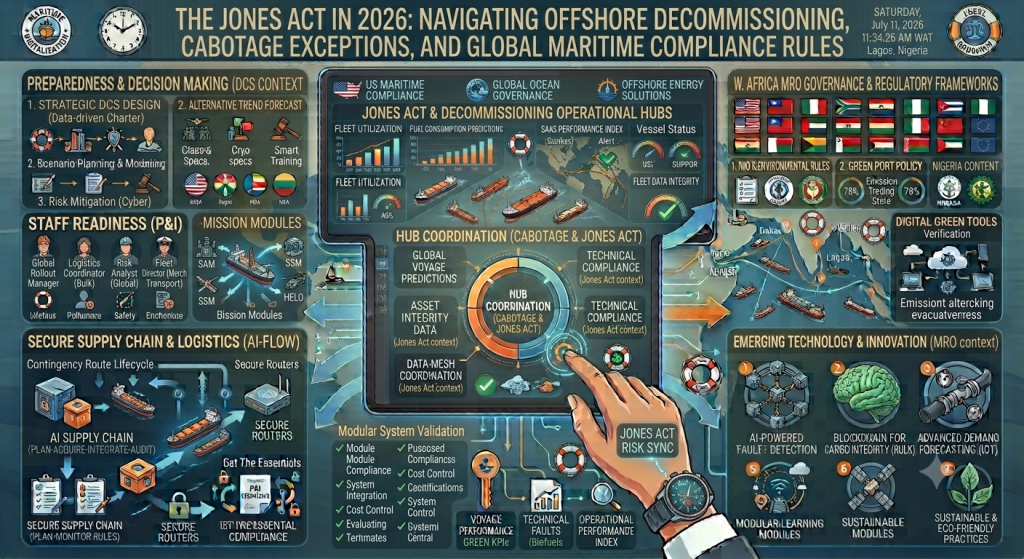
For global shipowners, energy conglomerates, and maritime logistics coordinators, regulatory compliance is the foundation of operational risk mitigation. In the international maritime sector, no single domestic law commands as much legal weight—or introduces as much operational complexity—as the Merchant Marine Act of 1920, universally known as the Jones Act.
The year 2026 has emerged as a historic turning point for maritime policy. Driven by shifting geopolitical conditions and the natural lifecycle of offshore oil and gas assets, global operators have had to navigate both emergency regulatory interventions and landmark administrative rulings. From temporary supply chain waivers to critical decisions from U.S. Customs and Border Protection (CBP) regarding offshore decommissioning, the legal boundaries of “coastwise trade” are being actively redefined.
Understanding these shifting legal frameworks is essential for international maritime operators—including those managing transcontinental charters between the Gulf of Guinea, Europe, and the Americas. Failing to navigate these regulations can lead to multi-million dollar compliance penalties, vessel detentions, or severe liability exposures under maritime injury laws.
Core Pillars of the Jones Act: Operational Foundations for Global Vessel Operators
Passed in the wake of World War I to protect the domestic merchant marine for national defense, the Jones Act (codified in Title 46 of the U.S. Code) establishes strict cabotage rules. It mandates that all commercial vessels transporting goods or passengers between two “coastwise points” (U.S. ports or offshore structures attached to the seabed) must meet four strict criteria:
- U.S.-Built: The hull and superstructure must be entirely manufactured and assembled within U.S. shipyards.
- U.S.-Flagged: The vessel must be registered under the United States flag and subject to U.S. Coast Guard (USCG) inspection.
- U.S.-Owned: At least 75% of the controlling interest in the owning corporation must be held by U.S. citizens.
- U.S.-Crewed: The officers and at least 75% of the crew must be U.S. citizens or lawful permanent residents.
[ The Four Pillars of Jones Act Compliance ]
│
┌───────────────────────────┼───────────────────────────┐
▼ ▼ ▼
[ Built in the U.S. ] [ Flagged in U.S. ] [ 75% U.S. Crewed ]
• Handled by domestic yards • Under USCG oversight • Officers & crew must
• Strict steel sourcing • Subject to U.S. law • meet citizenship tests
The definition of a “coastwise point” is particularly broad under the Outer Continental Shelf Lands Act (OCSLA), extending the Jones Act’s reach to installations, artificial islands, and devices permanently or temporarily attached to the seabed for resource exploration and production. This means that transporting equipment from a mainland port to an offshore drilling platform is legally identical to transporting cargo from New York to Miami.
Case Study: The 2026 Emergency Energy Waiver (Lessons in Supply Chain Fluidity)
In March 2026, the U.S. Department of Homeland Security (DHS), in coordination with U.S. Customs and Border Protection, announced a historic 60-day waiver of the Jones Act. The move was a direct response to severe domestic transport bottlenecks and regional energy shortages:
- The Cause: Structural shortages in U.S.-flagged tanker capacity, combined with infrastructure constraints, left critical coastal regions—particularly the non-contiguous territory of Puerto Rico—vulnerable to severe energy and supply shocks.
- The Waiver: Pursuant to Cargo Systems Messaging Service (CSMS) Message No. 68096516, the waiver permitted foreign-flagged, foreign-built tankers to transport specific energy products and agricultural inputs between U.S. ports.
- The Compliance Burden: Although designed to relieve supply chain friction, the waiver carried strict administrative and compliance reporting requirements. Vessel owners relying on the waiver had to submit advance notifications to jonesact@cbp.dhs.gov, file formal vessel entries via the Vessel Entrance and Clearance System (VECS), and submit detailed post-voyage cargo reports to the Maritime Administration (MARAD).
This emergency intervention highlighted a critical operational reality: while cabotage laws are designed to protect domestic industries, extreme supply chain emergencies require clear regulatory mechanisms and experienced administrative management to maintain global energy security.
Technical Deep-Dive: Offshore Platform Decommissioning and CBP Ruling HQ H349684
As offshore oil and gas assets in mature basins reach the end of their economic lifecycles, decommissioning has become a major focus for marine contractors. On May 1, 2026, CBP issued Ruling HQ H349684, clarifying how the Jones Act applies to decommissioned offshore infrastructure on the Outer Continental Shelf (OCS).
The ruling established a critical “complete terminus of production” standard to determine when an offshore structure ceases to be a “coastwise point”:
[ Decommissioning Asset Status ]
│
┌────────────────────────────┴────────────────────────────┐
▼ ▼
[ Permanently Plugged Well ] [ Offshore Platform Structure ]
• Deemed “Abandoned” by BSEE • Remains a “Coastwise Point”
• No longer a coastwise point • Transporting removed modules to shore
• Foreign-flagged vessels permitted • requires coastwise-qualified vessels
A. The Status of Abandoned Wellheads
CBP ruled that once an offshore well is permanently plugged and abandoned according to Bureau of Safety and Environmental Enforcement (BSEE) standards, the wellhead itself is no longer considered a “coastwise point”. Consequently, foreign-flagged vessels can perform direct well-capping and plug-and-abandonment operations without violating the Jones Act.
B. The Status of Platform Structures
Crucially, CBP distinguished the platform structure from the wellhead. Even when associated wells are fully plugged and the platform is legally incapable of producing resources, the physical platform remains a coastwise point because it is structurally attached to the seabed.
CBP ruled that the platform does not reach the “complete terminus of its production” until it is physically removed. Therefore, transporting removed topside modules, structural components, or personnel from the platform to a domestic port for recycling must be executed by coastwise-qualified (Jones Act-compliant) vessels.
This landmark ruling requires offshore energy operators and marine construction firms to carefully plan their vessel charters to ensure compliant operations throughout the entire decommissioning process.
High-Stakes Liability: The Jones Act Personal Injury Framework and Employer Risk
Beyond cargo transportation, the Merchant Marine Act of 1920 establishes a powerful personal injury framework for maritime workers. Codified at 46 U.S.C. § 30104, the Jones Act allows “seamen” to file direct lawsuits against their employers for negligence.
Unlike standard land-based workers’ compensation laws, which limit employer liability through fixed schedules, the Jones Act exposes vessel operators to significant financial liability. This high liability exposure explains why maritime legal and insurance costs remain a primary concern for fleet managers.
The Legal Pillars of Maritime Injury Claims
- Negligence under 46 U.S.C. § 30104: To recover damages, an injured seaman must prove their employer’s negligence contributed to the injury. Under maritime law, this is governed by a “featherweight” burden of proof, meaning the employer can be held liable if their negligence played even the slightest part in causing the injury.
- The Unseaworthiness Doctrine: Separate from negligence, a shipowner has an absolute, non-delegable duty to provide a vessel that is “seaworthy”—meaning the hull, equipment, and crew are reasonably fit for their intended operations. A failure of any component (such as a worn cable, a broken winch, or an untrained crew member) can trigger an unseaworthiness claim.
- Maintenance and Cure: This is a long-standing maritime right that requires employers to pay an injured seaman a daily living allowance (“maintenance”) and cover all medical expenses (“cure”) until they reach maximum medical improvement, regardless of who was at fault for the injury.
This legal environment highlights the need for strict onboard safety protocols, high-quality vessel maintenance, and comprehensive Protection and Indemnity (P&I) insurance coverage to mitigate exposure to high-value injury claims.
5. Global Cabotage Benchmarks: Comparing the US Jones Act to Nigeria’s Cabotage Act of 2003
While the Jones Act remains the most prominent cabotage framework, similar protective policies exist globally. For companies operating offshore assets in West Africa, Nigeria’s Coastal and Inland Shipping (Cabotage) Act of 2003 was modeled directly after the U.S. Jones Act.
Both frameworks seek to protect domestic maritime industries, but they use different mechanisms to manage local shipyard and fleet capacity limits.
Regulatory Comparison: US vs. Nigeria
| Regulatory Element | United States Jones Act (1920) | Nigerian Cabotage Act (2003) |
| Domestic Build Rule | Strictly Enforced. All vessels must be built in domestic shipyards. | Statutory, with Waivers. Vessels should be built locally, but waivers are regularly granted due to local shipyard capacity limits. |
| Flag Registration | Must carry the U.S. Flag. | Must be registered under the Nigerian Flag. |
| Crew Citizenship | Minimum 75% U.S. crew requirement. | 100% Nigerian crew mandate, subject to waiver approvals for specialized technical roles. |
| Joint-Venture Options | Forbidden for domestic coastwise trade (must maintain 75% U.S. citizen ownership). | Permitted. Foreign companies can participate via joint-venture structures with majority domestic ownership. |
For international fleet managers, operating across these varying cabotage regimes requires specialized local knowledge. While the U.S. system maintains rigid structural requirements, the West African framework relies on a structured waiver system to balance domestic industry protection with the need for specialized foreign offshore support vessels.
Technical FAQ: Compliance, Maritime Law, and Operations
Q1: Does the 2026 emergency Jones Act waiver apply to offshore crew transfers?
No. The emergency waiver issued by the Department of Homeland Security specifically targets energy products and agricultural fertilizers across 659 product categories. It does not suspend the coastwise laws governing passenger transport. Any commercial transport of crew or offshore personnel between U.S. ports and offshore platforms must continue to utilize Jones Act-compliant vessels.
Q2: How does a vessel owner verify the “U.S.-Built” requirement for older hulls?
A vessel’s build origin is verified through its Certificate of Documentation (Form CG-1270) issued by the National Vessel Documentation Center (NVDC). If a vessel undergoes major structural modifications or rebuilding abroad, it may lose its coastwise trading privileges unless the work remains within strict weight and structural limits defined by the USCG.
Q3: What is the “featherweight” burden of proof in Jones Act negligence lawsuits?
In standard personal injury cases, a plaintiff must prove the defendant’s negligence was the primary cause of the injury. Under the Jones Act, the standard of causation is significantly lower: the employer is liable if their negligence played any part, however small, in producing the injury. This lower legal threshold is a key driver of the high cost of maritime injury claims.
Q4: How do “Rigs-to-Reefs” programs interact with the Jones Act?
Under CBP Ruling HQ H349684, towing a floating platform hull to an approved reefing site on the Outer Continental Shelf constitutes coastwise trade. Because the platform hull remains a coastwise point during the decommissioning process, the towing operation must utilize coastwise-qualified tugs.
Q5: Can a foreign-flagged vessel perform seismic surveys inside the U.S. Exclusive Economic Zone (EEZ)?
Generally, yes. Purely scientific research and oceanographic seismic mapping are not considered “transporting merchandise” under the Jones Act. However, if the seismic vessel deploys or retrieves physical equipment (such as ocean-bottom cables or anchors) from the seabed, those activities may trigger coastwise restrictions, requiring careful legal review before deployment.
Strategic Summary for Maritime Operators and Fleet Managers
Successfully navigating global cabotage regulations requires a proactive, compliance-first approach to fleet management:
- Enforce Rigorous Pre-Charter Due Diligence: Always verify a vessel’s documentation, flag state history, and shipyard build certifications before deploying it to regulated coastwise zones.
- Establish Clear Operational Protocols: During offshore construction or decommissioning, clearly separate “transportation” activities (which require domestic vessels) from “installation” or “lifting” operations (which may be performed by foreign-flagged heavy-lift assets).
- Implement Proactive Risk Management: Address both mechanical safety and crew training to minimize exposure to high-value negligence and unseaworthiness claims.
Secure Cabotage Compliance and Fleet Advisory with Oitha Marine
Navigating international cabotage laws, managing offshore charter risks, and ensuring regulatory compliance across global trade lanes requires an experienced maritime partner. At Oitha Marine, we support shipowners, offshore operators, and energy companies with expert vessel sourcing, regulatory compliance reviews, and comprehensive marine logistics coordination.
Protect your marine operations from regulatory and compliance risks. Contact our technical management desk today at oithamarine.com or visit Oitha Marine Technical Insights to schedule a professional operational assessment.
Recent Comments