
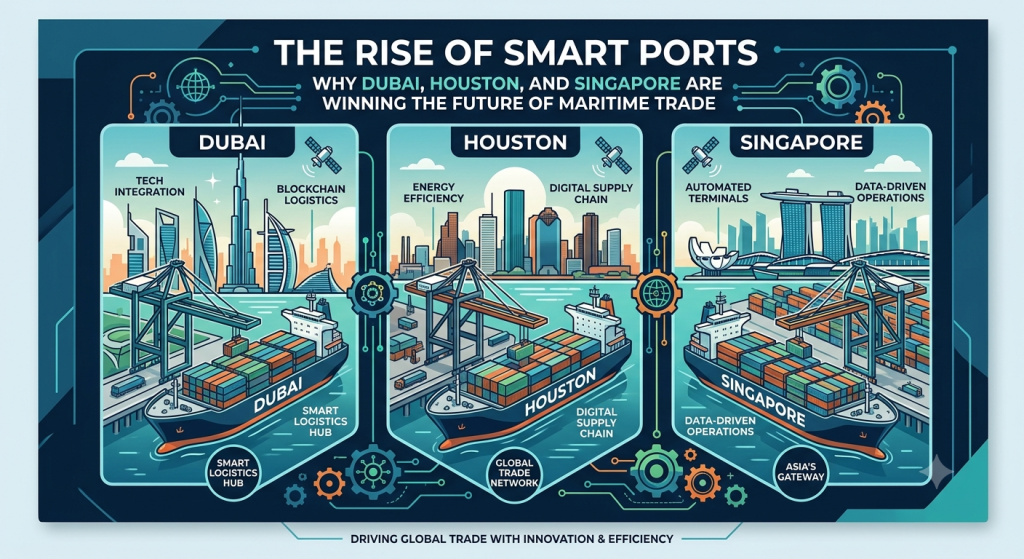
In the fractured maritime architecture of 2026, the transition toward fully automated, digitally integrated “Smart Ports” has evolved from an efficiency play into a critical requirement for structural asset protection. For institutional allocators, private equity syndicates, and corporate treasurers across the US, UK, Singapore, and the UAE, bypassing automated logistic hubs like Dubai (Jebel Ali), Houston, and Singapore introduces catastrophic operational exposures, including automated regulatory fines, rapid credit facility acceleration, and total policy forfeiture.
The Economic Impact: Algorithmic Logistics, Port-Stay Volatility, and Covenant Contagion
The “Million-Dollar Problem” for corporate entities and asset backers in 2026 is the severe operational drag and balance sheet exposure generated by legacy, manual port infrastructure. In an era defined by compressed trade margins and immediate regulatory penalties, a vessel’s time spent at a port berth is no longer a neutral logistical gap; it is an active risk vector that directly determines capital allocation efficiency.
Capital Stack Erosion and Financing Vulnerabilities
When a vessel encounters manual processing delays, labor bottlenecks, or analog customs clearance procedures at outdated ports, the operational friction ripples through the asset’s entire financial structure. A 5-to-7 day delay at an un-automated port instantly stops top-line freight and charter revenue from materializing, while fixed daily operating expenses (OPEX) continue to accumulate.
[Legacy Port Bottleneck / Manual Customs Delay] —> [Extended Off-Hire Window (5-7 Days)]
|
v
[Immediate Top-Line Revenue Halts]
|
v
[Compression of Net Operating Income (NOI)]
|
v
[Breach of Debt Service Coverage Ratio (DSCR)]
|
+———————————-+———————————-+
| |
v v
[Senior Secured Debt Acceleration] [Mezzanine Capital Emergency Funding]
(Lenders Freeze Revolving Credit) (Asset Yield & Project IRR Loss)
This sudden cash-flow compression directly drops Net Operating Income (NOI). Because high-value maritime assets are funded using complex, tiered financing tranches, a sudden contraction in NOI can breach critical Debt Service Coverage Ratio (DSCR) or minimum liquidity covenants.
Primary institutional lenders move quickly to protect their exposure in the volatile markets of 2026. A technical covenant breach gives commercial banks the absolute right to freeze revolving credit facilities or demand an accelerated restructuring of Senior Secured Debt & Mezzanine Financing agreements.
If forced into emergency, high-yield alternative lending lines to fund ongoing voyage costs or settle outstanding terminal invoices, the resulting basis-point surcharges can erase the targeted internal rate of return (IRR) for private equity sponsors and institutional investors.
The Financial Advantage of Smart Port Deployments
Smart ports utilize automated container terminal orchestration, 5G-enabled automated guided vehicles (AGVs), and blockchain-backed customs networks to minimize port turnaround times. The economic returns are explicit when comparing legacy operations to smart-port metrics:
| Operational Risk Vector | Legacy Port Infrastructure | Smart Port Infrastructure (Dubai, Houston, Singapore) | Multi-Year Balance Sheet Impact |
| Berth Turnaround Time | 48 – 72 Hours (Average) | 12 – 18 Hours (Average) | Maximizes active charter days; eliminates unhedged demurrage charges. |
| Customs Manifest Auditing | Manual / Multi-Day Friction | Algorithmic / Real-Time Release | Lowers structural working capital requirements; prevents administrative customs holds. |
| Bunkering Data Integration | Unverified / Manual Logs | Automated Mass Flow Meters (MFM) | Guarantees precise energy accounting; isolates fuel procurement fraud. |
Failing to prioritize smart hubs leads to continuous structural losses. Assets trapped in analog ports accumulate significant demurrage surcharges and face increased exposure to cargo rejections, missed laycan windows, and contractual disputes. Resolving these failures under standard charter-parties results in high, unrecoverable Arbitration & Litigation Costs that must be funded directly out of corporate working capital reserves.
The Compliance/Legal Framework: The 2026 Algorithmic Port Enforcement Grid
The regulatory landscape governing international trade lanes in 2026 treats port processing networks as central data aggregation hubs. Smart ports are no longer passive transshipment zones; they act as primary enforcement centers for international trade sanctions, environmental taxation, and underwriting compliance.
+—————————————–+
| 2026 SMART PORT ENFORCEMENT GRID |
+—————————————–+
| – JWLA-032 Automated Risk Screening |
| – EU ETS Phase-In (Methane Surcharges) |
| – OFAC Sanctions Automated Vetting |
+—————————————–+
|
v
+———————————————————–+
| Severe Operational Levies, Policy Forfeitures, & Seizures |
+———————————————————–+
I. Automated OFAC Sanctions Compliance and Supply Chain Vetting
The primary compliance driver in smart-hub operations is the use of automated, artificial intelligence screening frameworks to verify trade integrity. In 2026, OFAC Sanctions Compliance is enforced via real-time data integration directly at the port terminal level. Singapore and Dubai have fully integrated their terminal operating systems with international watchlists, automated ultimate beneficial owner (UBO) registries, and orbital satellite tracking data.
Legacy ports rely on manual manifest reviews, which create significant opportunities for compliance blind spots. If a vessel handles cargo that has been co-loaded or transshipped through front companies linked to blocked states or restricted entities, automated screening systems at smart hubs will instantly flag the transaction.
This results in immediate administrative terminal locks, cargo confiscation, or regulatory Asset Seizure. Underwriters treat any contact with sanctioned entities as a fundamental breach of contract terms, which can result in the automatic denial of claims and leave the asset owner completely unhedged against capital loss.
II. Geopolitical Hull Underwriting Alignment: The Realities of JWLA-032
The global marine underwriting market has adjusted its terms to align with smart port data systems. The Joint War Committee (JWC) Circulars, notably the active JWLA-032 protocol, place strict operational obligations on shipowners transiting volatile corridors.
Under JWLA-032, underwriters use automated satellite telemetry and smart port arrival data to verify vessel movements continuously within listed high-risk geographic zones.
If an operator alters a voyage or uses legacy port routings to avoid high terminal fees, and the vessel unknowingly crosses an active war-risk boundary without advanced notification, the primary insurance policies are suspended automatically.
If a vessel faces an incident during this unverified window, underwriters hold the absolute right to declare a breach of navigation warranties. This voids all Asset Seizure & Hull War Risk policies, leaving the shipowner and its institutional backers completely exposed to total asset loss.
[Unverified Route Alteration to Avoid Fees] —> [Crossing of Active JWC Boundary]
|
v
[Automated Port Telemetry Identifies Deviation]
|
v
[Underwriter Declares Warranty Breach]
|
v
[Asset Seizure & Hull War Risk Voided]
III. Automated Environmental Enforcement: Methane Slip and Carbon Taxes
Smart ports also serve as automated environmental tax collection centers. With the full integration of the EU ETS Phase-In costs for methane slip and carbon emissions, smart hubs utilize optical emissions monitoring systems and automated data integration to calculate a vessel’s precise environmental impact during its stay. These rules target not just main engine fuel consumption, but also unburned methane emissions escaping from dual-fuel engines and auxiliary boilers during port stays and terminal handling.
If a vessel idles for extended periods at an un-automated port due to congestion, it continues to burn auxiliary fuel and generate reportable emissions. When entering a smart hub like Singapore or a major US gateway like Houston, this accumulated emissions profile is audited via automated terminal data links.
Failing to properly monitor, report, and offset these emissions profiles in your corporate financial records creates an immediate ESG Disclosure Liability. This exposure can trigger automated divestment mandates from institutional green funds and invite enforcement actions from financial regulators for misrepresenting material environmental compliance costs.
IV. Algorithmic Routing and Port Entry Complexities
The integration of automated port systems introduces unique operational risks, particularly concerning AI-driven navigation liability in the Red Sea and other high-traffic corridors leading into major trade hubs. To optimize port arrival slots and avoid congestion, fleets use automated voyage optimization platforms that connect directly with smart port scheduling APIs.
However, if an autonomous routing platform alters a vessel’s heading or increases its speed to meet an automated arrival window, the rapid adjustment can overload auxiliary machinery or cause steering failures in restricted channels.
Determining liability for a resulting collision or terminal disruption leads to complex multi-jurisdictional legal disputes. Assigning liability between the software provider, the ship manager, and the system engineer generates extensive, multi-million-dollar Arbitration & Litigation Costs.
Strategic Recommendations: 3 Actionable Steps for the CEO
I. Institutionalize Automated Pre-Arrival Sanctions and Compliance Vetting
Cease relying on manual manifest reviews or backward-looking compliance checks. Mandate the integration of cloud-based, real-time data fusion systems that automatically cross-reference all cargo manifests, UBO documentation, and historical vessel tracking data before routing tonnage to any major port.
Ensuring your compliance teams verify every participant in the transaction helps eliminate OFAC Sanctions Compliance vulnerabilities and protects your Senior Secured Debt facilities from covenant defaults driven by unexpected terminal holds or regulatory detentions.
II. Restructure Port Overrun Risks via Parametric Insurance Hedges
Traditional hull and machinery insurance policies do not cover the indirect financial losses caused by extended port congestion, software interface errors, or automated customs delays. Corporate leaders should integrate specialized Parametric Insurance Premiums into their operational budgets.
These parametric policies utilize objective data triggers—such as a documented terminal delay past a specific target window or a system-wide software malfunction at a primary hub—to execute immediate cash payouts without requiring a lengthy claims adjustments process. This immediate liquidity helps keep your operations funded, protecting your cash flows from unexpected operational disruptions.
III. Incorporate Strong Technology Vetting and Indemnification in Charter Contracts
When negotiating charter-party agreements and interfacing with smart port networks, ensure your legal teams insert explicit, multi-tier indemnification clauses regarding data transmission and automated scheduling. Clearly assign the financial risks of automated routing errors and unexpected carbon taxes to the technology provider or the charterer if they insist on using an unverified optimization engine.
Additionally, ensure your agreements contain clear language regarding AI-driven navigation liability, establishing clear financial responsibilities before a transit occurs to minimize your exposure to unexpected legal liabilities and help lower potential Arbitration & Litigation Costs.
Specialized Underwriting and Digital Risk Advisory
Managing the operational and regulatory complexities of modern smart port environments requires a partner with deep risk management expertise. Navigating changing Joint War Committee (JWC) Circulars, complex carbon regulations, and strict international trade compliance demands specialized advisory support. Traditional, off-the-shelf marine policies are no longer adequate to protect high-value maritime investments from sudden regulatory interventions, environmental penalties, or Asset Seizure & Hull War Risk events.
At Oitha Marine, we provide the Professional Advisory Services and Specialized Insurance Cover required to protect your fleet from these systemic disruptions. Whether you are restructuring financing across Senior Secured Debt & Mezzanine Financing or defending your firm against unexpected subrogation claims involving ESG Disclosure Liability, our underwriter-led risk solutions help ensure your fleet remains compliant, efficient, and fully insurable.
FAQ: 2026 Smart Port Operations & Capital Allocation
Q: Why does a manual port bottleneck pose a direct threat to a shipowner’s Senior Secured Debt? A: When a vessel is delayed at an un-automated port, it ceases to generate revenue while continuing to accumulate fixed operating expenses. This cash-flow compression drops Net Operating Income (NOI), which can trigger immediate breaches of Debt Service Coverage Ratio (DSCR) covenants within lending agreements, allowing banks to accelerate debt repayment schedules.
Q: How do smart port automated screening systems enforce OFAC Sanctions Compliance? A: Smart ports integrate their terminal operating systems with international watchlists, automated beneficial ownership registries, and orbital satellite tracking data. This allows automated networks to instantly flag any cargo manifest or vessel history connected to a sanctioned entity, triggering automated terminal holds or regulatory Asset Seizure.
Q: How do the EU ETS Phase-In costs for methane slip apply to vessels delayed at anchor? A: Extended delays at un-automated ports force vessels to idle at anchor, burning auxiliary fuel and generating reportable emissions. Under 2026 rules, these emissions face significant financial penalties upon entering regulated waters, creating an unhedged operational expense and an increased ESG Disclosure Liability if omitted from corporate records.
Q: Can an enterprise use Parametric Insurance Premiums to cover the costs of port congestion? A: Yes. Specialized parametric policies can be structured to trigger immediate cash payouts based on objective, data-driven parameters—such as a documented port stay extending past a specific number of hours—providing immediate liquidity to help meet ongoing financial obligations during operational disruptions.
Q: What steps should a company take to manage AI-driven navigation liability when approaching a smart port? A: Commercial agreements must include explicit clauses defining liability for automated voyage modifications. Legal teams should ensure that optimization software vendors carry robust technology errors and omissions (E&O) coverage to cover liabilities arising from automated scheduling errors, reducing potential Arbitration & Litigation Costs.
Technical Execution and Systems Integration Strategy
The Technical Reality of Smart Port Telemetry and Berth Automation
The financial performance of an ocean asset within a smart port ecosystem is directly tied to the technical integration between the vessel’s bridge systems and the terminal’s automation infrastructure. Modern smart hubs utilize automated scheduling platforms that coordinate automated quay cranes, AGVs, and container stackers in a synchronized loop.
+—————————————————————–+
| THE TERMINAL DATA INTEGRATION LOOP |
+—————————————————————–+
| Vessel Navigation Telemetry Syncs with Smart Port API |
| -> Automated Allocation of Optimal Berth & Crane Infrastructure|
| -> Real-Time Manifest Processing via Blockchain Networks |
| -> Reduction in Cargo Dwell Times and Fuel Burn at Berth |
| -> Elimination of Unhedged Demurrage Risks and Margin Losses |
+—————————————————————–+
If a vessel’s internal communications systems fail to properly interface with the port’s digital infrastructure, the asset loses its prioritized arrival slot. This technical misalignment forces the vessel to wait at anchor, increasing its daily operating costs and elevating its emissions profile under regional reporting frameworks.
Advanced Risk Management in Automated Freight Tracking
In automated transshipment hubs, artificial intelligence engines scan cargo profiles to detect hidden compliance liabilities. These networks evaluate not just primary bill of lading data, but also underlying commodity origins and transaction tracking.
+————————————————————+
| AUTOMATED COMPLIANCE AUDITING PATHWAY |
+————————————————————+
| AI Scans Manifest Data and Commodity Origins |
| -> Identifies Discrepancies in Raw Material Tracking |
| -> Triggers Automated Administrative Holds at Terminal |
| -> Initiation of Multi-Jurisdictional Legal Disputes |
| -> Increased Exposure to Prolonged Legal Arbitration Costs|
+————————————————————+
Relying on legacy manual documentation when trading into smart ports introduces substantial operational risks. If an automated port audit detects any discrepancies in commodity origins, the asset can face immediate terminal holds and regulatory investigations. Ensuring your legal teams draft clear indemnification clauses within your charter agreements is essential to protecting your working capital and minimizing your exposure to unexpected legal liabilities.
Conclusion: Safeguarding Portfolio Value through Rigorous Operations
In the contemporary international trade environment, managing risk requires a comprehensive approach that connects technical fleet operations with proactive regulatory compliance and structured risk transfer. Relying on legacy port infrastructure or unverified data interfaces exposes a maritime enterprise to severe financial and legal liabilities. By enforcing strict automated screening protocols, incorporating robust technology indemnifications, and securing advanced parametric hedges, you protect your fleet from sudden operational and financial disruptions.
Oitha Marine offers the underwriting expertise and specialized risk management solutions required to guide your portfolio through these changing technical and regulatory environments. Protect your capital, safeguard your returns, and build a compliant corporate infrastructure designed to withstand modern operational challenges.
Recent Comments