
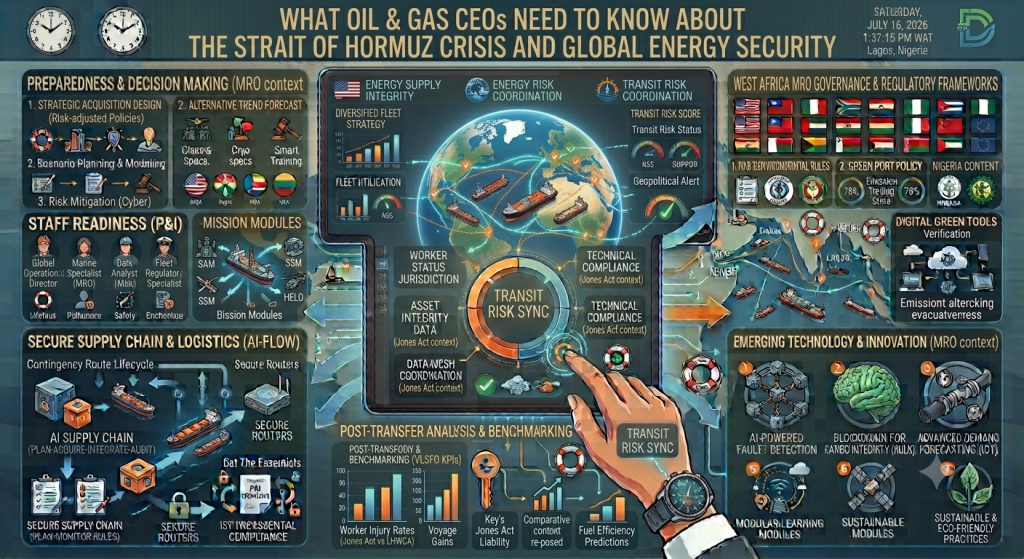
The global energy landscape faces its most profound structural disruption in modern history. The escalation of conflict in the Middle East has culminated in an extended, highly volatile operational blockade of the Strait of Hormuz. For Chief Executive Officers, board members, and upstream planners in the oil and gas sector, this crisis has shifted from a temporary geopolitical risk into a fundamental baseline constraint for global asset management, maritime logistics, and supply chain security.
Historically considered a localized chokepoint, the Strait normally handles approximately 20% of global seaborne crude oil and 20% of global Liquefied Natural Gas (LNG) flows. The current disruption has triggered an unmitigated physical supply shock that surpasses both the 1973 Arab oil embargo and the 1990 Gulf War in sheer volume and commodity scope.
For leadership executing multi-billion-dollar capital allocation strategies, navigating the structural realities of this “dual blockade” environment—where both the Strait of Hormuz and the Red Sea channels are simultaneously restricted—demands an immediate reevaluation of transit operations, contract frameworks, and long-term asset positioning.
Macro Economics of the Crisis: Volume, Scope, and Structural Deviations
The 2026 Strait of Hormuz crisis is not merely a rerun of 20th-century oil shocks. While the global economy has structurally reduced its overall oil intensity per unit of GDP by over 50% since the 1970s, the current conflict introduces critical complications that amplify supply chain volatility.
The Hague Centre for Strategic Studies
[ 2026 Chokepoint Disruption Scope ]
│
┌──────────────────────────────┴──────────────────────────────┐
▼ ▼
[ Hydrocarbon Supply Volatility ] [ Industrial Value Chain Shocks ]
• 13.6 Million b/d crude supply drop • 30% of global urea exports blocked
• 20% of global LNG capacity offline • 20-30% of global ammonia halted
• Force Majeure at key loading ports • Worldwide helium & plastics supply shortfalls
• Global inventory buffers falling fast • Extreme marine hull insurance spikes
The Magnitude of the Supply Deficit
The physical closure of the waterway removed an estimated 13.6 million barrels per day (mb/d) of crude oil and refined products from active trade lanes. This equates to roughly 13% of total global production, easily outstripping any historical supply disruption.
Compounding the oil deficit, the declaration of force majeure on all regional LNG shipments instantly froze 20% of global gas supply, immediately impacting European gas hubs and Asian industrial centers.
The Commodity Contagion
Unlike past energy shocks, the current crisis extends deep into the chemical and agricultural value chains:
The Hague Centre for Strategic Studies
- Fertilizers & Food Security: The Persian Gulf accounts for roughly 30% to 35% of global urea exports and 20% to 30% of ammonia exports. The restriction of these materials has sent global agricultural input costs surging, creating inflationary ripples that extend far beyond fuel prices.
- Petrochemicals & Fine Chemicals: Industrial processors are facing critical shortages of helium, plastics polymers, and primary aluminum, driving up manufacturing overhead across the automotive, tech, and pharmaceutical sectors.
Alternative Routings and the Logistical Bottleneck
CEOs must recognize that the geographical realities of the Middle East leave few viable alternative routing options. The region’s partial bypass pipelines—such as Saudi Arabia’s East-West Pipeline to Yanbu on the Red Sea and Abu Dhabi’s Crude Oil Pipeline (ADCOP) to Fujairah—are running at maximum capacity but can only offset a small fraction of the lost volume. Furthermore, these pipeline networks are technically incapable of transporting LNG.
International Monetary Fund+ 1
[ Global Maritime Re-Routing Dynamics ]
│
┌────────────────────────────┴────────────────────────────┐
▼ ▼
[ The Persian Gulf Trap ] [ The Cape of Good Hope Detour ]
• Vessel traffic near zero • Primary route for redirected tonnage
• Regular P&I coverage suspended • Adds ~3,500 nautical miles per voyage
• Massive port container shortages • ~10 to 14 days extra transit time
• Dark routing & spoofing threats • Escalated container lease & bunker fees
Consequently, global shipping lines have shifted their capacity to the Cape of Good Hope detour. For a standard tanker or container vessel traveling between Asia and European ports, this route adds up to 3,500 nautical miles and 10 to 14 days of sailing time per leg.
This extended distance effectively locks up a significant portion of the global fleet, reducing overall vessel availability, driving up bunker fuel consumption, and prompting ocean carriers to apply heavy emergency freight surcharges across all international trade lanes.
Operational Protection and Structural Risk Mitigation
To safeguard assets and maintain cash flow predictability during this extended period of high volatility, energy executives should implement immediate, structured risk-mitigation measures:
A. Invoke and Audit Force Majeure Covenants
Commercial teams must review all active off-take, supply, and charter contracts. In the event of an extended chokepoint shutdown, verify the precise language governing Force Majeure and non-performance liabilities.
Ensure your legal teams can document a clear, unbroken line of causation showing that physical blockades, military actions, or regional port closures directly prevented performance, thereby shielding your organization from costly breach-of-contract claims.
B. Address Hull and P&I Insurance Exclusions
As conflict levels fluctuate, primary Protection and Indemnity (P&I) clubs and hull underwriters frequently suspend standard coverage within designated “Listed Areas” in the Gulf.
Operating vessels in these zones requires securing specialized War Risk Addendums and navigating steep premium surcharges. Ensure your marine superintendents coordinate closely with insurance syndicates to maintain continuous coverage, particularly if vessels are forced to utilize defensive routing patterns or follow designated military escort corridors.
C. Build Tactical Inventory Depth and Stockpile Buffers
With global strategic and commercial inventories heavily drawn down over recent months, the cushion against sudden market shocks is shrinking.
Oil and gas companies must transition from efficient, “just-in-time” inventory models to resilient “just-in-case” structural stockpiling. Upstream and downstream operators should secure long-term storage capacity in stable, non-contiguous hubs (such as West Africa, the US Gulf Coast, or the Caribbean) to protect operations from sudden drops in prompt physical supply.
Comparative Global Exposure Matrix: Regional Cabotage and Supply Chains
The strategic impact of the chokepoint crisis is highly unequal, separating economies with built-in operational resilience from those dependent on immediate, unhedged maritime imports.
The Hague Centre for Strategic Studies
| Operational Region | Core Supply Chain Vulnerability | Primary Risk Transmission Channel | Strategic Mitigation Directive |
| Asia-Pacific (APAC) | Extreme. Imports 56–75% of crude via the Middle East corridor. | High reliance on spot pricing; limited commercial stockpiles. | Mandatory demand management; sudden pivots to alternative energy mixes. |
| European Union (EU) | High. Severe exposure to industrial gas and critical petrochemical deficits. | High industrial input costs; immediate inflation in fine chemical sectors. | Accelerated deployment of local renewable infrastructure; green hydrogen expansion. |
| West Africa (Gulf of Guinea) | Low / Opportunistic. Strong localized crude production capacity. | Surge in regional asset demand; complex compliance tracking for global exports. | Optimize local fleet utilization; review regulatory frameworks for international charters. |
FAQ: Energy Security and Crisis Logistics
Q1: What strategies are vessels using to mitigate electronic warfare risks near the chokepoint?
Commercial vessels operating in high-risk zones frequently encounter severe GNSS and GPS jamming, alongside satellite location spoofing managed by regional forces. To protect assets, crew members must rely heavily on traditional radar tracking, inertial guidance systems, and visual piloting. Many operators are choosing to run with disabled Automated Identification System (AIS) transponders (“dark routes”) to reduce the risk of targeting, though this requires explicit coordination with flag states and war-risk insurers.
Q2: How long will it take for international energy flows to normalize once the Strait physically reopens?
Historically, recovering from a major supply shock is a slow process. Marine technical analysts estimate that even after a full reopening and the clearing of sea mines, it will take two to three months for standard shipping lanes to resume efficient operations. Furthermore, repairing damaged infrastructure—including pipelines, loading terminals, and processing facilities—can take six months or longer, extending market volatility well past the end of the blockade.
Q3: How are global refiners adjusting to the sudden loss of Middle Eastern sour crude grades?
The closure has caused an immediate shortage of medium and heavy sour crude slates, which are essential for maximizing diesel yields in advanced refineries. Refiners are modifying their processing configurations to handle lighter, sweeter slates sourced from the United States, Guyana, and West Africa. This shift has driven up sweet crude premiums and altered regional refining margins worldwide.
Q4: What is the role of the International Energy Agency (IEA) during a prolonged disruption?
During structural supply crises, the IEA coordinates emergency oil stock releases across its member nations to stabilize spot markets and prevent panic buying. The historic release of 400 million barrels from strategic petroleum reserves (SPR) represents the largest coordinated intervention in history, serving as a critical secondary buffer as global commercial inventories decline.
Q5: Can overland transport networks provide a reliable alternative for stranded Gulf cargo?
While overland trucking and cross-border rail links across the Arabian Peninsula offer a minor relief valve for high-value container cargo, they cannot replace bulk maritime transportation. The sheer volume of daily crude and LNG transits means that land-based pipelines and multimodal logistics networks can handle less than 15% of the pre-crisis volume, leaving deep-sea shipping as the only viable option for global bulk energy trade.
Strategic Actions for Corporate Governance and Asset Management
To build operational resilience during this period of structural volatility, energy company CEOs should focus on three clear, forward-looking priorities:
- Map and Diversify Supply Chains: Conduct a thorough audit of your third-party suppliers, logistics providers, and transport networks to identify and eliminate exposure to critical maritime chokepoints.
- Optimize Shipping Assets: Partner with experienced, technically proficient vessel operators who maintain high safety standards, clear tracking protocols, and robust insurance coverage to handle high-risk transit environments.
- Invest in Strategic Flexibility: Allocate capital toward flexible logistics assets—including regional storage facilities, dual-fuel fleets, and diverse supply contracts—to ensure your business can quickly adapt to shifting global conditions.
Partner with Oitha Marine for Fleet Sourcing and Strategic Technical Advisory
Navigating complex geopolitical disruptions, managing international shipping risks, and securing reliable tonnage across changing global trade lanes requires an experienced maritime partner. At Oitha Marine, we support shipowners, offshore operators, and corporate energy clients with expert vessel sourcing, regulatory compliance reviews, and comprehensive marine logistics coordination.
Protect your marine logistics and fleet strategies from regulatory and geopolitical risks. Contact our technical advisory team today at oithamarine.com or visit Oitha Marine Technical Insights to schedule an operational risk assessment.
Recent Comments